Like undertakers preparing a body for viewing, heritage conservationists often find themselves in the curious position of preserving something that has already died. Yet this preservation is further complicated by a generational paradox: those doing the preserving are typically not those who knew the “body” when it was alive. Instead, each generation becomes the caretaker of another generation’s memories, preserving experiences they never had.
The Death of Original Purpose and Birth of New Meaning
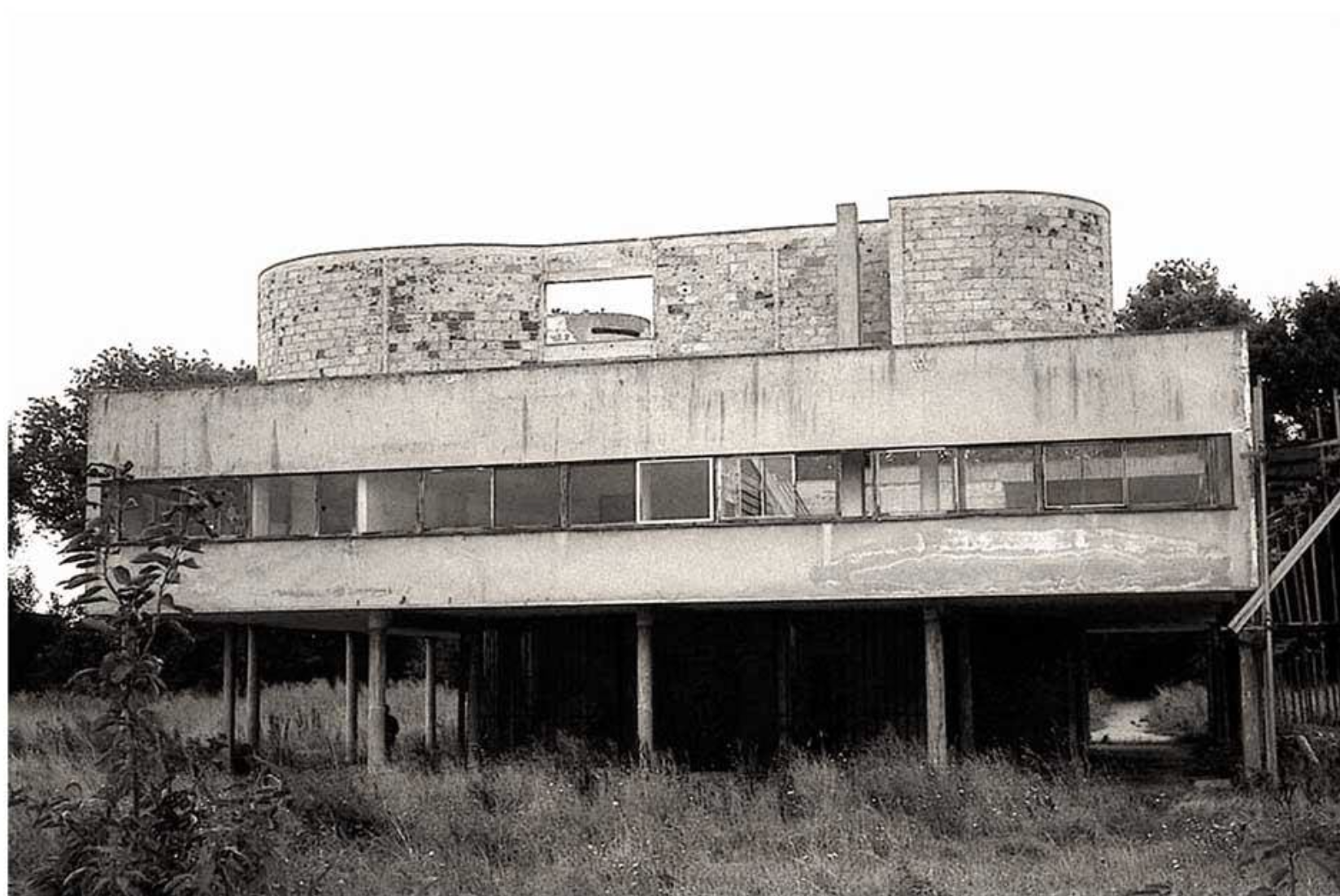
Bernard Tschumi’s encounter with the Villa Savoye in 1965 perfectly embodies this generational dynamic. As a young architect encountering Le Corbusier’s aging masterpiece, Tschumi was quite literally the next generation grappling with modernism’s physical and theoretical legacy. When he declared, “The most architectural thing about this building is the state of decay in which it is,” he was not speaking as someone mourning the loss of the building’s original pristine state, but as someone discovering new truths in its decay.

The Villa Savoye had already experienced multiple deaths by the time Tschumi encountered it. As a home, it died quickly – its original function failing almost immediately due to persistent leaks, heating problems, and an inherent inability to serve as a comfortable dwelling. The Savoye family’s rapid abandonment marked its first death. Yet like a body experiencing multiple clinical deaths, the building would “die” several more times: as an abandoned structure, as a hay barn, and finally as a deteriorating ruin before its “resurrection” as a heritage site.
This functional failure adds another layer to our understanding of decay’s revelatory power. In the 1950s and 60s photographs, we see the building deteriorate: its white walls stained, windows broken, and pristine surfaces overtaken by vegetation. These images reveal the structural bones of Le Corbusier’s geometric vision and, paradoxically, the building’s inherent contradictions. The clean lines and machine aesthetic of modernism are simultaneously emphasized and undermined by decay, making the tension between modernist ideals and lived reality visible.
The Generational Transmission of Memory
This pattern of death and rebirth through generational reinterpretation appears throughout architectural history. The Powell House in Philadelphia experienced its own death as an elite residence, only to be reborn as a horse hair brush factory. This utilitarian afterlife lasted far longer than its original incarnation. Each generation encounters these buildings not as living spaces but as inherited artifacts requiring interpretation and reanimation.

The multi-valent nature of these sites emerges precisely through this process of generational reinterpretation. Each generation approaches the “dead” building with fresh eyes, discovering new meanings:
- As Architectural Icon: The pristine vision of its creators
- As Functional Failure: The reality of its lived experience
- As Witness to Time: Its periods of decay and alternative use
- As Philosophical Tool: Its role in ongoing architectural discourse
- As Heritage Symbol: Its current status as preserved artifact
The Risk of Restoration
This multi-valent nature raises critical questions about restoration practices. When we restore a building like Villa Savoye to its “original” state, which version of original do we choose? The brief moment when it was newly completed? The state Le Corbusier photographed it in? The reality of its inhabited period? Or when the house, abandoned as a dwelling, was utilized as a haybarn – a period that ironically may have been its most extended consistent use? Each choice privileges certain interpretations while potentially erasing others.

This pattern of adaptive reuse – often ignored in traditional heritage narratives – appears across architectural history. The Powell House in Philadelphia, now restored as a pristine example of Georgian architecture, spent much of its life as a factory producing boar hair brushes. Like the Villa Savoye’s period as a haybarn, this industrial use represents a significant and legitimate part of the building’s history. Yet in both cases, heritage restoration practices often privilege the buildings’ brief periods as elite residences over their longer histories of practical adaptation and use.
Beyond Preservation: The Dialogue Between Generations
This suggests that heritage conservation might be better understood not as a process of preservation but as a facilitation of dialogue between generations. Tschumi’s interaction with Villa Savoye demonstrates how younger generations don’t simply inherit and preserve the past – they actively reinterpret and find new meanings.
This reframing has significant implications for heritage practice:
- Acknowledging Multiple Deaths: Preserving evidence of various uses and interpretations
- Generational Space: Creating room for new interpretations to emerge
- Temporal Honesty: Recognizing that each generation will “kill” and “revive” heritage sites in their own way
- Documentation of Process: Recording not just physical changes but interpretative evolution
Towards a Multi-Valent Heritage Practice
This suggests the need for new approaches to heritage conservation that can maintain multiple, simultaneous interpretations:
- Layered Interpretation: Presenting multiple narratives simultaneously through varied interpretive materials
- Preserved Contradictions: Deliberately maintaining evidence of both success and failure
- Temporal Honesty: Acknowledging that different periods may hold equal heritage value
- Emotional Space: Creating room for varied emotional responses rather than prescribing a single “correct” reaction
The Living Dead: Heritage Sites as Active Participants
The power of heritage sites may lie precisely in their status as “living dead” – structures that have died multiple deaths yet continue to generate new meanings. Rather than attempting to freeze them in a single moment of “life,” we might better serve these sites by acknowledging their role as vessels for intergenerational dialogue.
Conclusion

The challenge for heritage professionals is not simply to preserve the dead but to facilitate meaningful dialogue between generations through these preserved remains. This might mean developing practices that maintain both physical fabric and interpretative possibility, allowing each generation to encounter these sites not as preserved specimens but as complex entities capable of generating new meanings and understandings.
Tschumi’s youthful encounter with the aging Villa Savoye reminds us that heritage sites are not static monuments but active participants in an ongoing conversation between generations. Their power lies not in perfect preservation but in their capacity to die and be reborn through each generation’s reinterpretation, creating a continuous chain of cultural meaning stretching past to future.
 Twisted Preservation