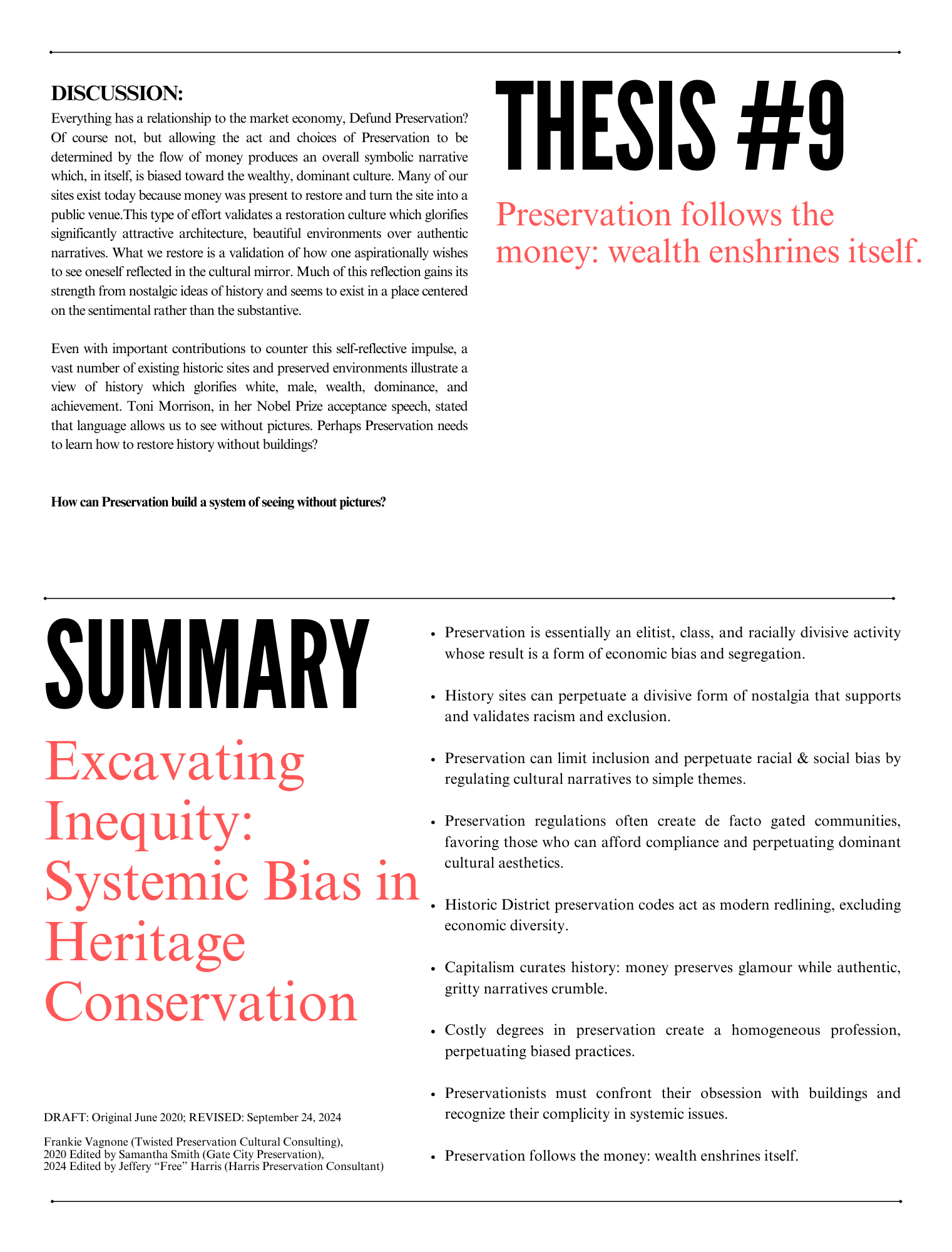
As the author of these essays – which I began writing in 2020 and have continued to develop through thoughtful feedback and reflection – I’ve attempted to explore systemic bias within heritage conservation and historic preservation. My nine interconnected theses suggest we must examine our field’s fundamental assumptions about preservation work, including how our current practices might perpetuate inequities despite our good intentions. The statistics that shaped my thinking are concerning: only 3% of National Register Historic Places represent Black American history, and just 3% of Los Angeles Historic Landmarks represent women’s history. These numbers suggest preservation may be an activity that inadvertently reinforces divisions through compliance requirements and narrative choices.
I was grateful for the opportunity to share these developing ideas at both the New England Museum Association annual conference and the joint conference between The Eastern States Archaeological Federation and Salve Regina’s preservation program in 2024. The document proposes we consider reimagining our practices, perhaps looking beyond our focus on buildings to examine how our processes might affect community access and representation. Through conversations with colleagues, I’ve been exploring how our field’s economic structure – including educational costs and funding patterns – might influence which stories we preserve and which we may overlook. These thoughts are offered as part of an ongoing dialogue about how we might work together to create more inclusive preservation practices.
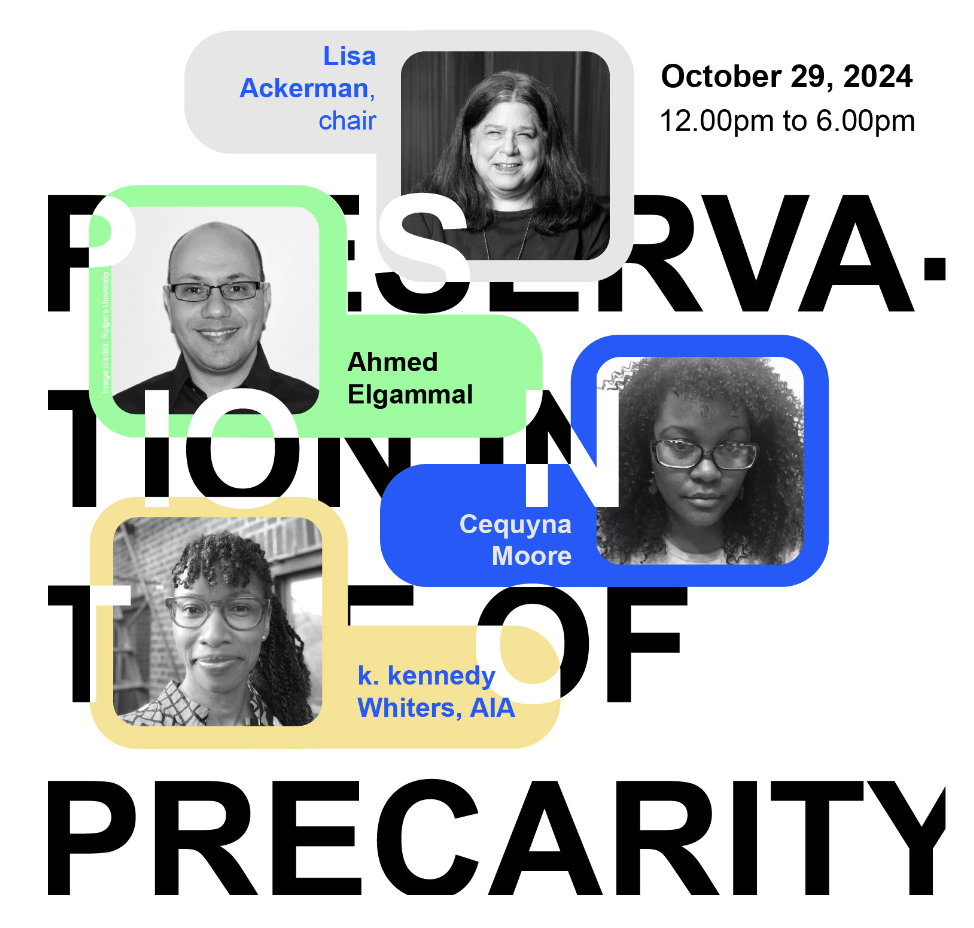
Attending Pratt’s conference on “Preservation in a Time of Precarity: Intersecting Indigenous Intelligence and Artificial Intelligence” laid bare the profound complexities of AI as both a preserver and a transformer of cultural heritage. The day’s discussions examined how our relationship with AI technology mirrors many of humanity’s historical patterns – it can either amplify our capacity for cultural preservation or accelerate destruction.
A central paradox emerged throughout the day: AI offers unprecedented capabilities for cultural preservation while potentially compromising the very essence of what it seeks to preserve. This was particularly evident in discussions about language resurrection, where speakers highlighted the tension between AI’s public, database-driven approach and the intentionally private nature of many indigenous languages. Often held as intimate cultural treasures, these languages raise critical questions about harnessing AI’s preservation capabilities while respecting cultural boundaries and privacy.
The art world’s relationship with AI sparked particularly nuanced discussions around authenticity. Much like historical debates about forgery and reproduction, AI forces us to confront questions about originality, authenticity, and value. Similarly, the presentations on using AI to document and analyze historical monuments demonstrated how technology can help us better understand our past – including which monuments deserve preservation and which perhaps should be reconsidered.
Keynote and Closing Plenary: Nour Abuzaid and Eyal Weizman, Forensic Architecture
The conference starkly illustrated AI’s dual nature through contrasting applications. While AI tools are being deployed to document and protect silent languages and cultural heritage, the sobering keynote presentation detailed AI’s role in modern warfare, specifically its application in Gaza. The speaker methodically outlined how Israel uses AI systems to analyze geographic patterns and movement to determine invading strategies, raising urgent questions about technology’s role in conflict zones.
A crucial insight emerged regarding AI’s limitations: it doesn’t truly create but rather synthesizes existing patterns. As speakers emphasized, AI will inevitably reproduce these biases if the precedent texts contain colonial perspectives or biased historical accounts. This is particularly problematic when dealing with marginalized histories and perspectives, as AI can inadvertently perpetuate harmful narratives rather than challenge them.
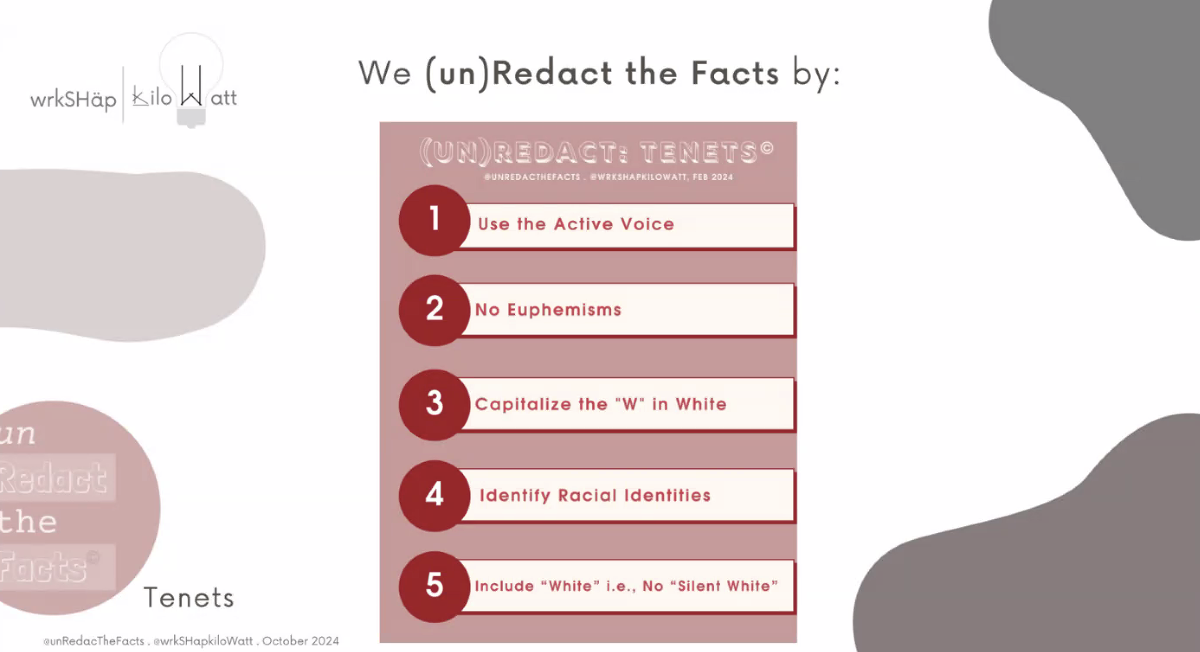
k. kennedy Whiters AIA, (un)Redact the Facts and Black in Historic Preservation.
We must consider multiple challenges:
How do we preserve cultural heritage while respecting its private, intimate nature?
Can we develop AI systems that honor cultural boundaries while serving preservation goals?
How do we address the biases inherent in AI’s training data?
What aspects of cultural heritage should remain private and be passed down through traditional channels rather than digital preservation?
What emerged most clearly was that AI is a mirror reflecting our existing knowledge systems (biases included) and a transformer of cultural knowledge. Unlike human creativity, which can imagine new possibilities, AI is bound by its training data – it cannot envision what has never been documented. This underscores the importance of carefully considering what texts and sources we use to train AI systems, especially when working with marginalized histories and perspectives.
The day served as a potent reminder that our technological choices have genuine human consequences in this time of precarity. How we choose to wield these tools will help determine whether they serve to protect or imperil our shared cultural heritage. The challenge ahead lies in how we use AI, how we train it, and what precedents we choose to preserve and amplify through these powerful but ultimately derivative tools. Most importantly, we must develop more nuanced approaches to cultural preservation that balance the competing needs of documentation, accessibility, and cultural privacy.
Speakers included: Lisa Ackerman, Columbus Citizens Foundation Dr. Ahmed Elgammal, Art and Artificial Intelligence Laboratory, Rutgers University Nalikutaar, Jacqueline Cleveland, Alaska Venture Fund Dr. Harriet Harriss, Pratt School of Architecture Jeffrey Hogrefe, Pratt School of Liberal Arts & Sciences Alex Jimmerson, Seneca Nation of Indians Dr. Robbie Jimmerson, Seneca Nation of Indians and Rochester Institute of Technology Cequyna Moore, Monuments Toolkit Initiative of World Heritage U.S.A. Dr. Chuutsqa L. Rorick, Gesturing Towards Decolonial Futures Collective and University of Victoria Dr. Helio Takai, National Science Foundation and Pratt School of Liberal Arts and Sciences Vicki Weiner, Pratt School of Architecture Dr. Lorna Williams, Gesturing Towards Decolonial Futures Collective K. Kennedy Whiters AIA, (un)Redact the Facts and Black in Historic Preservation.
Keynote and Closing Plenary: Nour Abuzaid and Eyal Weizman, Forensic Architecture
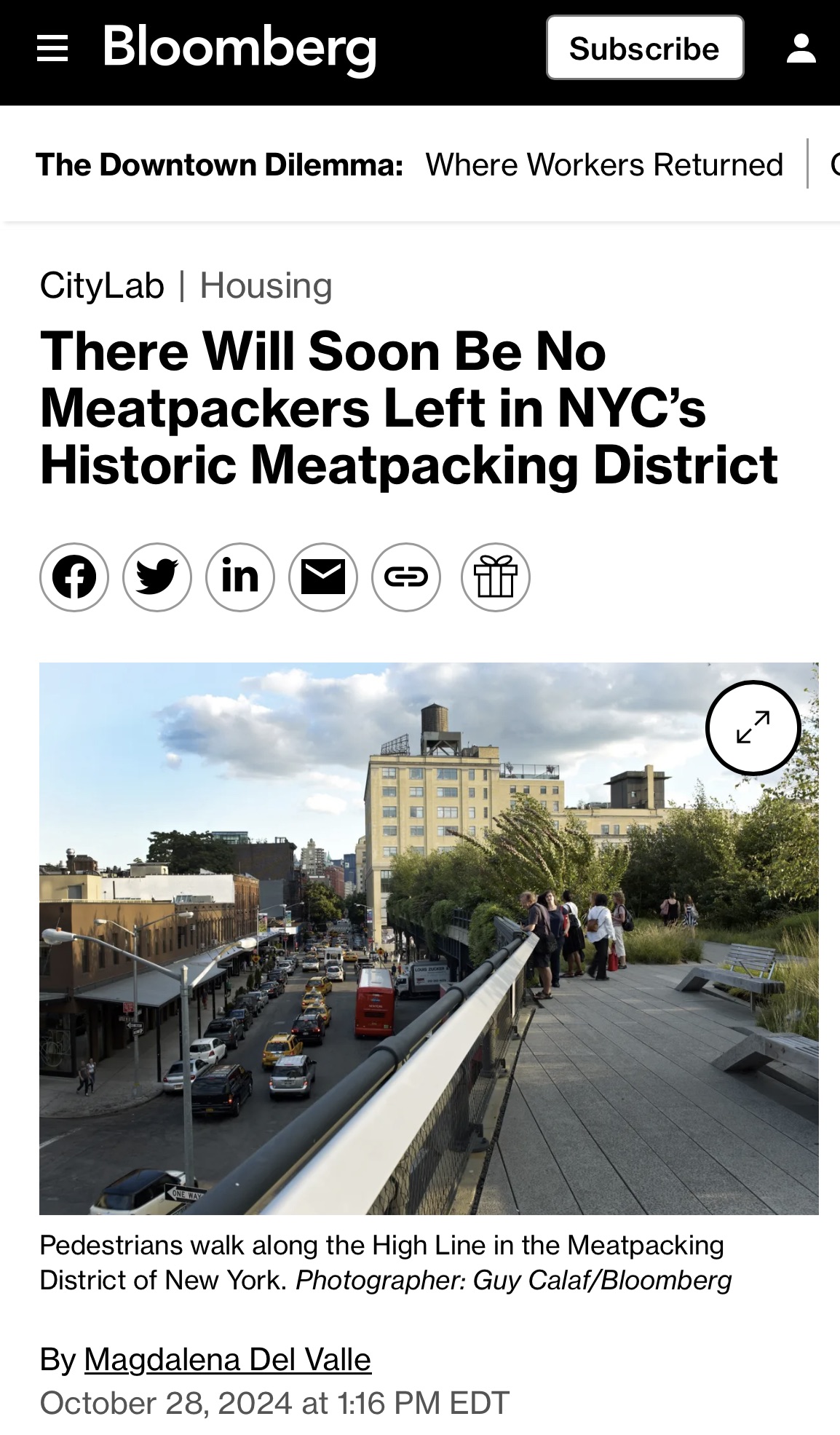
Like a person, a neighborhood carries the weight of its history in its name – a linguistic fossil that can outlive its original meaning. The Meatpacking District is now a paradox: a place defined by an industry that will soon be completely absent from its streets. This phenomenon creates what we might call a “nomenclature ghost” – where the signifier remains but the signified has vanished, like a shadow without its object.
This dilemma mirrors our personal struggles with identity through time. When a lawyer who once dreamed of being a poet introduces themselves, are they still that aspiring poet inside? When a former athlete becomes a business executive, do they shed their athletic identity like a snake’s old skin, or does it remain as an integral layer of their being? Our titles and roles – student, parent, professional – accumulate like geological strata, each layer informing but not erasing what came before.
The mirror presents a daily paradox. In my mind’s eye, I can still see that young man with abundant hair and a metabolism that could forgive any indulgence. Growing up in the South, I moved through the world wrapped in the invisible cloak of cultural privilege, completely unaware of how this unseen advantage smoothed certain paths while my internal reality as a queer person simultaneously pushed me toward the margins. This early experience of existing in the space between appearance and authenticity created its own kind of cognitive dissonance – my outward presentation conferring unearned advantages even as my authentic self remained carefully hidden from view.
The social worlds I inhabited existed in the borderlands between dominant and non-dominant cultures, creating a rich tapestry of understanding that would have been impossible from a position of unexamined privilege alone. Like the Meatpacking District, whose industrial façades now house entirely different realities, I too contained multitudes that weren’t immediately visible to the casual observer.
The body I inhabit now bears the signatures of decades: thinning hair, slower recoveries, the need for reading glasses that somehow keep migrating to forgotten locations throughout the house. Yet this transformed vessel carries not just physical changes but a profound shift in responsibilities. Where once I was the one being cared for, I now find myself in the complex dual role of caring for aging parents – those who once tied my shoes and cleaned my scraped knees – while also nurturing and protecting new life. The energy that once felt bottomless now requires careful stewardship, like a finite resource that must be mindfully allocated.
What describes me now is perhaps best captured not by physical attributes or singular roles, but by this capacity to span time – to hold simultaneously the memory of being cared for and the active responsibility of caring for others. The privilege I once moved through the world unaware of has become a tool I can consciously deploy in service of others, while my experience of otherness helps inform a more compassionate and nuanced approach to understanding different lived experiences.
The desire to preserve a specific moment in time – whether through maintaining a historical district’s name or through cosmetic surgery – reflects a deeply human impulse to arrest change. But this impulse often conflicts with the organic nature of both urban and human development. Just as my own narrative couldn’t be fully understood through surface-level observation, the rich histories of places and communities resist simple categorization or single-story interpretation.
Public history, as a discipline, often struggels with this tension between preservation and evolution. When we designate a historic district or landmark, we’re essentially drawing a circle around a moment in time and saying “this matters.” But in doing so, we risk creating a kind of historical taxidermy – preserving the outer form while the inner life has moved on. The Meatpacking District’s transformation from an industrial hub to a fashionable neighborhood reveals the limitations of this approach.
Perhaps a more nuanced approach to public history would acknowledge that change itself is part of the historical narrative. Rather than trying to freeze neighborhoods or buildings in amber, we might embrace their evolution as part of their story. This would mean moving beyond the traditional model of historical interpretation that focuses on a single “period of significance” to one that recognizes the value of layered histories and ongoing transformation.
Like historic places that carry multiple layers of meaning and significance, we too contain multitudes, our identities shaped not just by time’s passage but by the complex interplay of how we are seen and who we know ourselves to be. The young man I was doesn’t need to be gone for the person I am to exist. Rather, he is a crucial chapter in an ongoing story, one that continues to unfold with each passing day. The chasm between perception and reality, between privilege and marginalization, between past and present selves, isn’t just a void to be bridged – it’s a space where meaningful understanding can grow.
The profession of public history might thus evolve to become less about preserving specific moments in time and more about documenting and facilitating the dialogue between past and present, acknowledging that every historic place, like every person, is not just what it was, but what it is becoming. The challenge lies in maintaining a connection to history without becoming its prisoner – allowing places and people to grow and evolve while keeping their stories alive.
I entered this one-night stand in a state of transition, personally and professionally. I hoped an overnight stay at the Pope Villa would take my mind off my situation and redirect my thinking outward. No such luck.
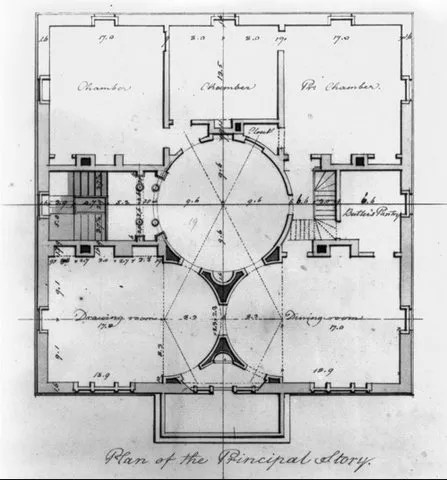
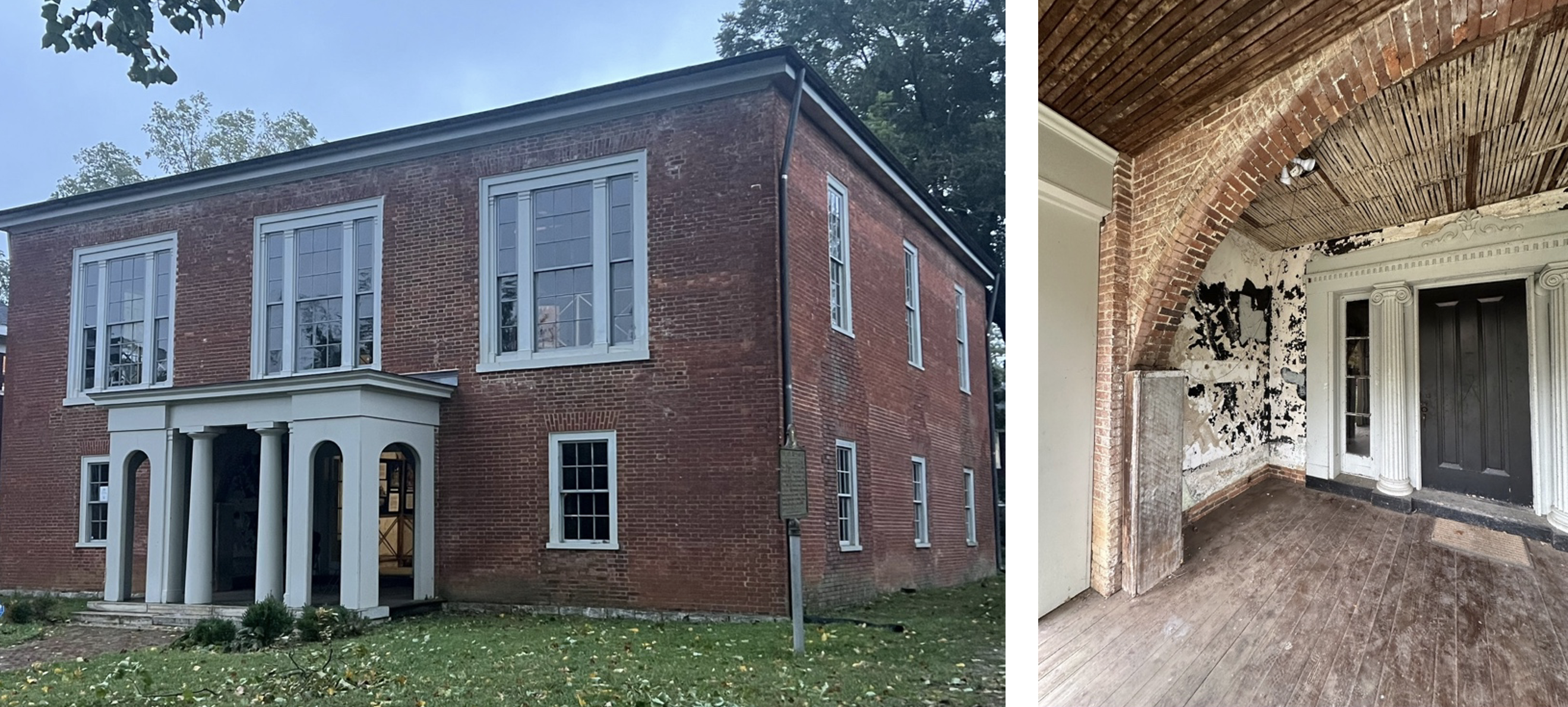
Pope Villa, located in Lexington, Kentucky, was designed in 1811 by Benjamin Henry Latrobe for Senator John Pope and his wife Eliza. Completed in 1813, the villa stood as one of Latrobe’s most innovative residential designs until it was severely damaged by fire in 1987. This Federal-era mansion’s unique cubic form and revolutionary central rotunda plan marked a dramatic departure from traditional American house designs of the period. Now owned by the Bluegrass Trust for Historic Preservation, the stabilized ruins of Pope Villa represent one of only three surviving Latrobe residential buildings in the United States.
Standing amidst Pope Villa’s crumbling remains, I was at a personal crossroads, much like our democracy – both of us seeking direction in uncertain times. As my husband Johnny Yeagley and I walked through the weakened walls, he made a striking observation: these ruins, designed by Latrobe to embody democratic ideals, seemed to whisper warnings about the fragility of our civic aspirations, their deterioration eerily echoing recent assaults on another of Latrobe’s masterworks: the U.S. Capitol. In both structures – one a domestic experiment in democratic space, the other the very symbol of our republic – Latrobe’s architectural optimism now stands wounded, forcing us to confront uncomfortable questions about the durability of our democratic ideals and the shadows that have always lurked within our noblest architectural ambitions.
Pope Villa’s rich architectural legacy and current incarnation as a haunting, stabilized ruin commanded my attention. Yet, I struggled to reconcile what I saw with what I knew of its intended purpose — much as I was struggling to reconcile my current circumstances with my previous life plans.
This Federal-era mansion was meant to be more than just a home—it was conceived as a physical manifestation of democratic ideals, a diagram of democracy in architectural form. Yet, as I explored its ruins, I became increasingly aware of how this ambitious design reflected not just aspirational architectural principles but also the complexities of human nature—and, more surprisingly, my personal journey.
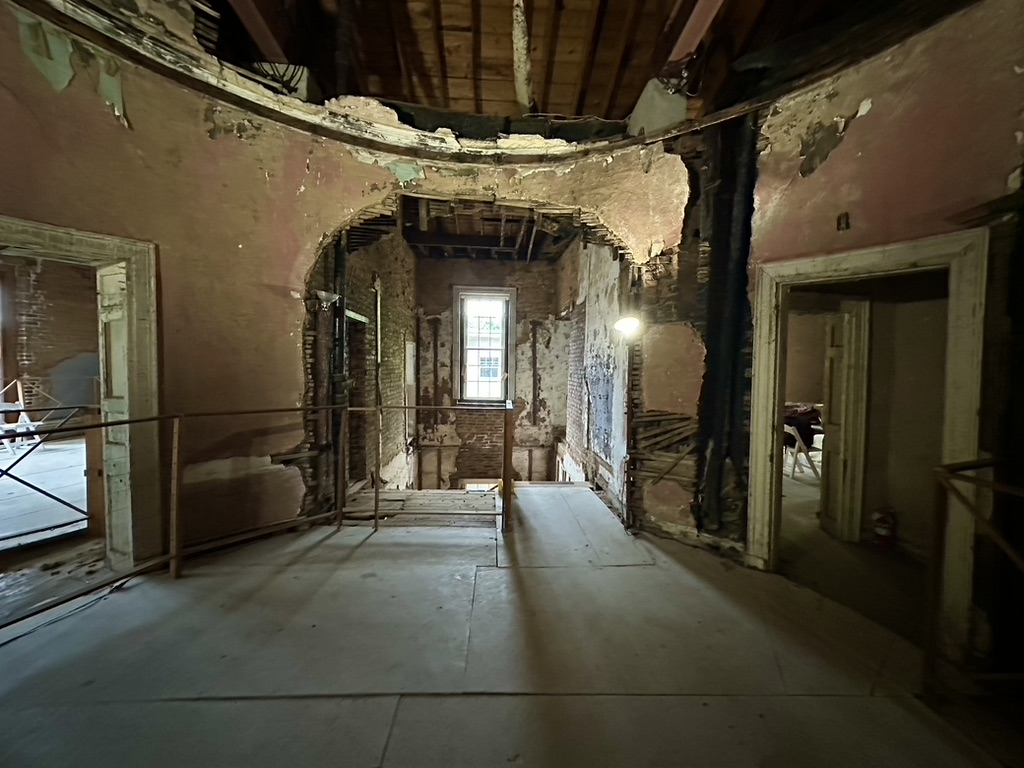
The stark geometries of Pope Villa’s exposed walls, now laid bare by time and decay, spoke of rigid principles and unyielding idealism. As I traced these lines with my eyes, I couldn’t help but think of my life’s carefully laid plans, now exposed and challenged. The play of light through the villa’s fragmented walls created a stark effect, alternately revealing and concealing the silent order, much like the complex interplay of public and private spheres in a democratic society—and our lives. As I moved through the ruins, the sense of a once-private space now open to public scrutiny seemed to mirror the essence of democratic transparency.
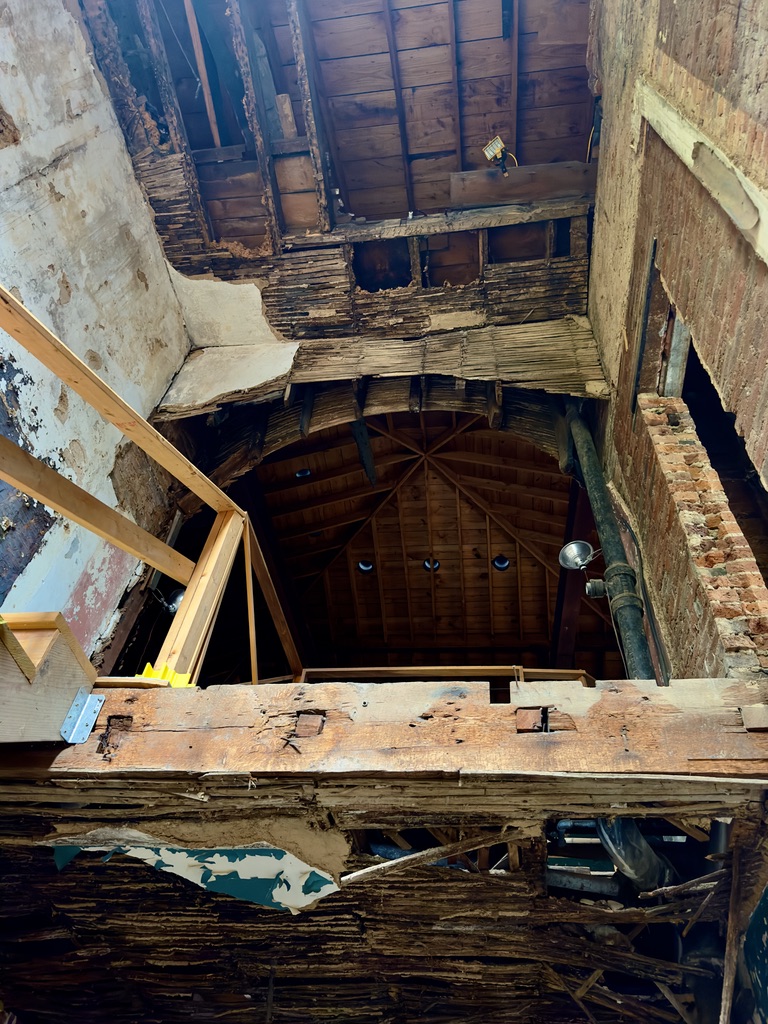
At first glance, the villa’s remaining walls impressed me with their bold lines and innovative design. Latrobe’s vision was clear: this was to be a residence that embodied the principles of the young republic, a domestic space that reflected the ideals of equality, transparency, and civic virtue. The central rotunda, now collapsed, must have once stood as the heart of this democratic diagram, a space where family and civic life could seamlessly blend.
However, as I melted deeper into the ruins, I was struck by an intriguing incongruity: the scale of the villa felt curiously out of sync with its domestic functions. The baseboards stood unusually tall, while the decorative detailing projected a monumentality more befitting a public edifice than a private residence. This oversized ornament created an odd dissonance with the actual dimensions of the building as if the villa was straining to occupy a grander footprint than its physical confines allowed. In this architectural ambition, I saw a reflection of our human tendency to project an idealized image that sometimes surpasses our accurate dimensions.
This tension between scale and function underscored the villa’s unique position in architectural history. In his eagerness to craft a new American architectural language, it seemed as if Latrobe had imbued even the most intimate spaces with civic grandeur. The result was a domestic setting that, I felt, never allowed its inhabitants to forget their place in the larger national narrative. But how, I wondered, did this constant reminder of civic duty impact the daily lives of those who called Pope Villa home?
As I lay in my makeshift bed for this “one-night stand”, I visually explored the layers of Pope Villa’s fire-damaged bedroom chamber, my focus shifted to the minds behind its creation: Benjamin Latrobe, certainly, but also Senator John Pope and his fashionable English wife, Eliza. This Kentucky power couple had commissioned a home that showcased their progressive tastes and avant-garde aspirations. However, this architectural choice came with risks. As tensions with England escalated and the War of 1812 approached, the Villa’s innovative design—influenced by Eliza’s British background and Latrobe’s European training—threatened to appear too “British” for a Kentucky politician with national ambitions.
This realization added yet another layer of complexity to Pope Villa’s identity. Not only was it a bold departure from contemporary Southern American residential norms, but it also stood as a crucial stepping stone in the evolution of American architecture. The villa’s innovative design elements—its central rotunda, unconventional floor plan, and novel use of light—were more than mere aesthetic choices. They were calculated experiments, each informing Latrobe’s vision for the monumental buildings that would come to symbolize American democracy.
Yet, as I continued my mental exploration, I became increasingly preoccupied with a singular question: how did one live in this “diagram of democracy”?
The villa’s innovative public/private bifurcation, once a point of pride, now revealed itself as a complex experiment in social engineering. The ruins exposed the intricate network of spaces designed to keep the enslaved out of sight while maintaining the illusion of an egalitarian household. This revelation highlighted how architectural innovations, even when well-intentioned, can sometimes reinforce societal inequalities rather than resolve them—a sobering reflection of how our ideals can sometimes clash with our realities.
Standing in what was once the heart of the home, I was struck by how the ruins revealed the villa’s attempt to balance multiple, often conflicting ideas. It tried to be a showcase of European sophistication, a laboratory for a new American architecture, a statement of democratic ideals, and a functional family home—all while hiding the harsh realities of slavery within its walls. The decayed state of the villa now laid bare these contradictions, revealing the challenges of inhabiting a space so burdened with ideological weight.
The very internal organization of Pope Villa, with its innovative public/private bifurcation, inadvertently highlighted the deep societal divisions it sought to obscure. The in-between spaces and marginal placements of servant quarters within the house’s formal, public cubic box spoke volumes about the era’s attempts to reconcile high-minded ideals with the brutal practice of human bondage. How, I wondered, did the Popes navigate this architectural manifestation of their society’s deepest contradictions?
These architectural choices revealed a disturbing strategy: to render the enslaved individuals who made the Popes’ lifestyle possible as invisible as architecture would allow. The stark separation between the public areas and the slave-filled servant spaces further emphasized this troubling dynamic, making me question how one could genuinely inhabit a “diagram of democracy” built on such fundamental contradictions. Did the Popes feel the weight of this irony as they moved through their home, or did Latrobe’s clever design allow them to ignore this uncomfortable truth?
In this light, Pope Villa became a physical manifestation of this cognitive dissonance. Its clean lines and revolutionary spaces, designed to showcase a new American aesthetic, simultaneously worked to camouflage the ugly truth of slavery. Latrobe and the Popes, in their pursuit of architectural innovation, seemed to treat the issue of slavery and servitude as an inconvenient reality to be absorbed into an undefinable ether of negligibly discernible forms. But could such a reality be hidden, even in the most ingeniously designed home?
As I continued my exploration, I found myself continually reintroduced to the remains of the villa’s ambitious central rotunda, Latrobe’s artistic centerpiece. In its decayed state, it stood as a poignant reminder of the risks ambitious aspirations which can catastrophically fail to materialize. The rotunda, which must have once impressed visitors with its grandeur, now seemed to caution against losing sight of the human scale in pursuing ideological statements. How, I wondered, did the Popes and their guests experience this space? Did its imposing geometry inspire lofty thoughts of civic virtue, or did it simply make everyday interactions feel overwrought and performative?
This careful separation of public and private spaces, now laid bare by decay, revealed the complex social choreography required to maintain the illusion of effortless democracy within the home. In exposing these hidden mechanisms, the villa revealed how spatial arrangements can shape social interactions, for better or worse. Did the inhabitants of Pope Villa feel liberated by these Euclidian spaces or constrained by their implicit rules and social expectations?
As the day wore on and shadows lengthened across the ruins, I reflected on the villa’s story as revealed, not through its diagram but through its decay. In its ruined state, Pope Villa offered a unique perspective on the limits of idealism, providing insights that might have remained hidden had the building survived intact. Once cutting-edge, the villa’s innovative design elements now seemed to express a rueful wisdom. The ruins appeared to caution not against innovation itself but against the uncritical pursuit of architectural ideals at the expense of livability and ethical consistency.
Latrobe’s design for Pope Villa represented a significant departure from colonial American domestic architecture, particularly in treating servant spaces. Traditionally, these areas were often relegated to an “L”-shaped wing attached to the main house—a feature Latrobe vehemently disliked. His aversion to this common layout revealed much about his architectural vision and the societal tensions he wrestled with in his work.
By absorbing the servant functions into the main block of Pope Villa, Latrobe attempted to resolve multiple challenges simultaneously. On one level, he sought to create a more cohesive, geometrically pure form that aligned with his vision of a new American architecture. This approach allowed him to manifest the ideals of egalitarian democracy in built form, at least superficially. However, this design choice also served a more complex—and potentially problematic—purpose. Latrobe effectively veiled the underlying social hierarchy that the traditional “L” wing made explicit by obscuring the clear delineation between servant and served spaces.
This subtle obfuscation of the household’s actual functional and social dynamics presented Latrobe with a significant challenge: maintaining the necessary separation and functionality within a unified architectural form while still projecting an image of democratic ideals. The resulting design, with its ingenious use of in-between spaces and carefully placed servant areas, reflected this intricate balancing act. I couldn’t help but wonder: did this architectural sleight of hand genuinely serve the cause of democracy, or did it simply allow its inhabitants to ignore the contradictions at the heart of their society?
As the sun began to set on my “one-night stand” with Pope Villa, casting long shadows across the ruins, I reflected not just on the villa’s place in the larger narrative of American architecture but on my life’s unexpected deformations.
Just as Pope Villa stood as a bold experiment in creating a uniquely American architectural language, I, too, found myself amid an experiment – not of my own design, but one thrust upon me by life’s unpredictable nature. The villa’s ruins offered a more nuanced perspective on the endeavor of reinvention, revealing both the triumphs and the contradictions of such ambitious transformations.
The villa’s decay revealed the challenges inherent in trying to forge a new identity, whether in architecture or life. Its ruins highlighted the difficulties of balancing innovation with functionality, ambitious dreams with practical needs, and imported ideas with local realities. In its proportions and details, I could read my struggle to reconcile my private self with public expectations, my local commitments with broader responsibilities, and the comfort of familiar routines with the gravitas of a life taking on new, unexpected dimensions.
As I prepared to leave the site, I took one last walk through Pope Villa. In its ruined form, stripped of pretense and exposed to the elements, the villa offered an unexpected opportunity for reflection and learning that paralleled my journey. Just as Pope Villa in decay presented its successes and failures not as endpoints but as valuable lessons, I realized that my own period of deconstruction and reconstruction was not a failure of my original life plan but a valuable process of growth and discovery – where does one go from here?
The villa’s ruins stood as a testament to the power of honest evaluation in architecture and life. In its decayed state, Pope Villa revealed truths about the process of identity-building and the role of our crafted environments in shaping who we are—truths that would have remained hidden had it survived intact.
I couldn’t help but feel reluctantly grateful for the villa’s revelations and the timing of this visit. In laying bare its triumphs and missteps, Pope Villa in ruins offered a profound meditation on the complexities of inhabiting a space – or a life – designed to embody conceptual ideals. The lessons whispered by these weathered boards resonated deeply with my current struggles: the importance of aligning our aspirations with our lived values, considering the full human cost of our personal reinventions, and remaining vigilant against the temptation to obscure uncomfortable truths about ourselves.
Pope Villa had become more than just a relic of the past – it had become a mirror, reflecting my aspirations, contradictions, and hidden truths. It challenged me to look deeper and think more critically about the life I was building, the ideals I professed, and the often-messy reality of trying to live up to those ideals in my daily existence.
As I turned to leave Pope Villa’s charred remains, I felt a complex mix of emotions. There was a sense of unfulfilled expectation – I had approached these ruins hoping to uncover some profound architectural truth, yet found myself struggling with personal revelations instead. The villa’s innovative diagram of democracy that I had so eagerly anticipated exploring had not yielded the insights I craved about architecture but offered unexpected parallels to my own life’s design.
What resonated most as I departed was not Latrobe’s grand design or the villa’s place in architectural history but the shadows it cast – both literal and figurative. These shadows, stretching across the decaying floors and seeping from the spaces between walls, seemed to embody the unspoken narratives and contradictions that my idealistic life plan sought to obscure. In the villa’s awkward in-between spaces, now exposed by decay, I saw reflections of my own uncomfortable yet potent state of transition.
As I shut the heavy front door of Pope Villa, I felt a certain calm wash over me, tinged with melancholy for what was left behind – both in the villa and in my own life. Yet surpassing that sadness was a landscape of potential and new experiences stretching out before me.
I left with the realization that, like Pope Villa, the true significance of my life might not lie in its original ambitious design but in the exposed questions and stories that surrounded it. As I walked away, I carried with me not the enlightenment I had initially sought but a quiet resignation of the complexities that no ingenious plan could fully capture or resolve.
The villa had not provided miraculous answers or a clear path forward. Instead, it had deepened my contemplation on the mystery of transformation—architectural, societal, and personal. I found myself understanding that, like the villa, I, too, was being deconstructed, my in-between life now made public. It was awkward and sometimes uncomfortable, yet as I left my old self behind, I felt not just sadness but confusion about the new experiences that awaited me.
In the end, Pope Villa’s greatest gift was not as an exemplar of Federal-era architecture or as a laboratory for a new American style. For me personally, its value lay in its ability to reveal the gulf between idealism and lived reality –
The door closed behind me, and unlike Pope Villa, I didn’t have a diagram to orchestrate my next move.
Special thanks to The Blue Grass Trust (Jonathan Coleman). Daniel Ackermann
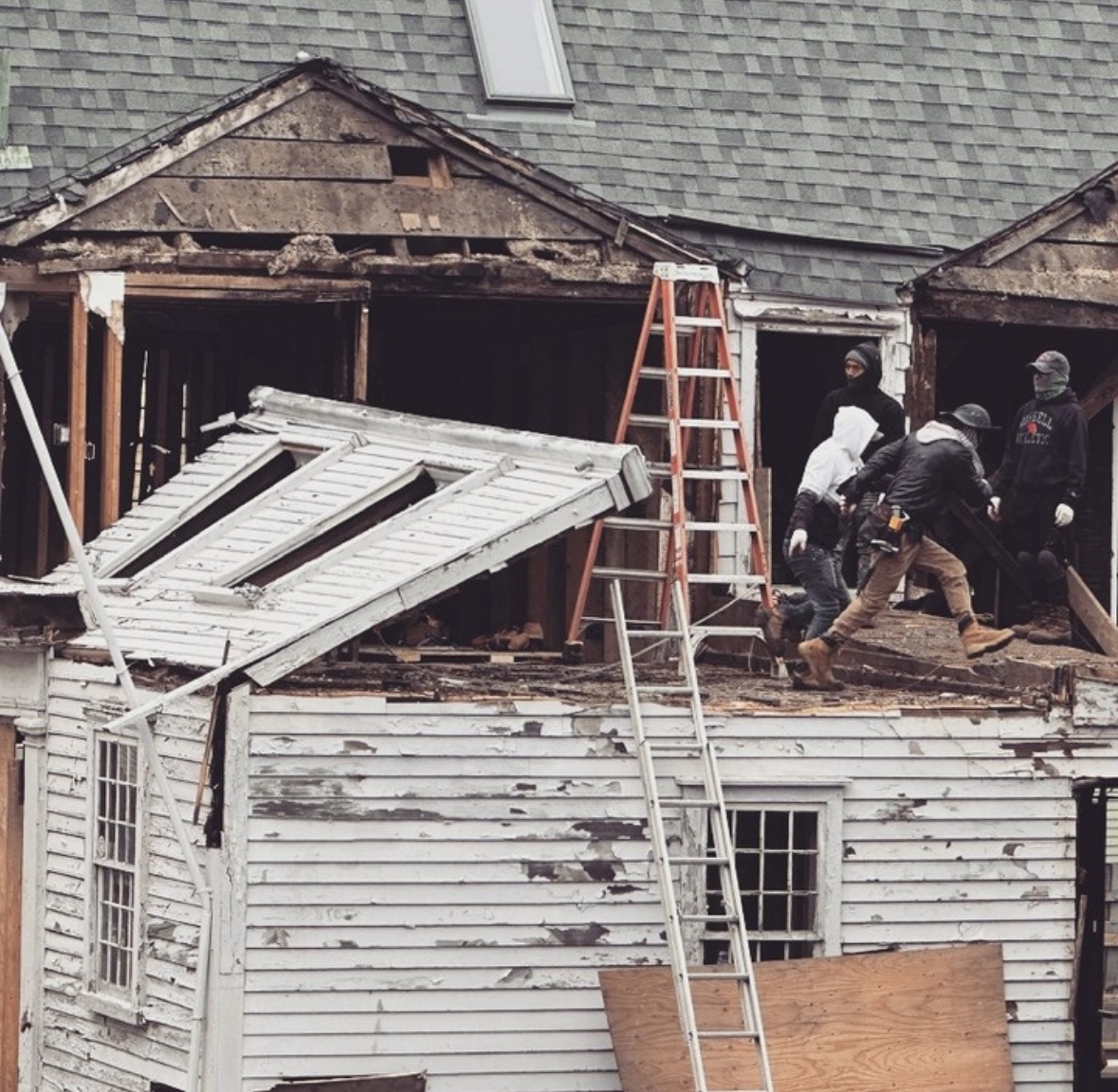
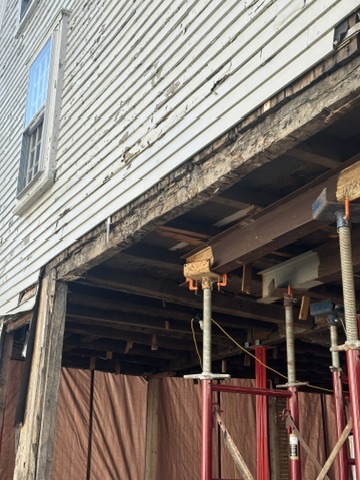
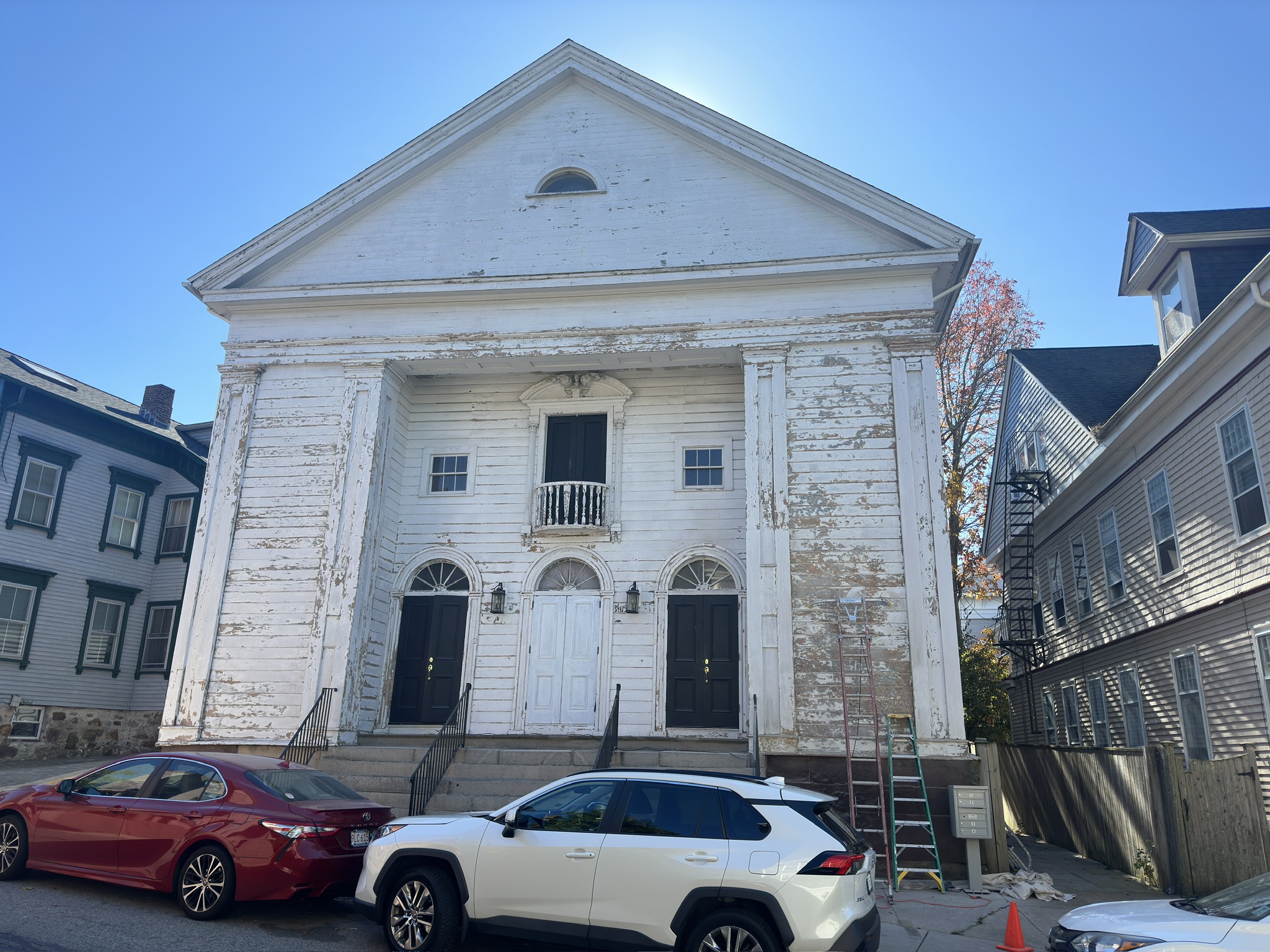
As I walk past the white clapboard building on the corner, watching workers shore up its failing foundation with temporary beams and plywood barriers, I can’t help but feel a deep unease about what will emerge when the work is done. I’ve spent years studying and working in preservation, always wrestling with this fundamental tension between saving our heritage and somehow mummifying it in the process.
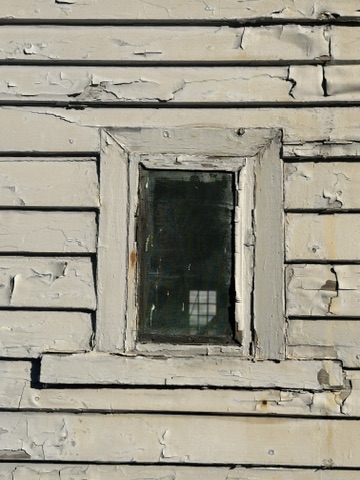
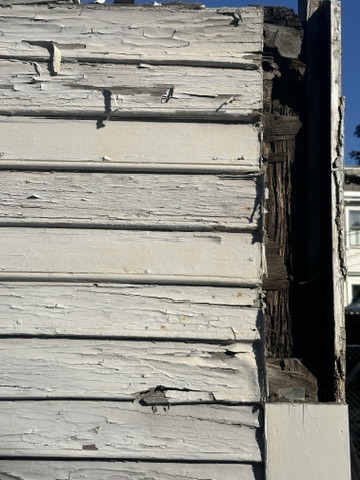
That Fitzgerald quote from The Beautiful and Damned haunts me lately – this idea that we’re essentially force-feeding stimulants to these dying buildings, desperately trying to freeze them in time. When I run my hand across weathered clapboards, each layer of peeling paint tells me stories about past lives, changing tastes, economic ups and downs. Those stories disappear when we strip everything back to bare wood and start fresh.
After all these years in heritage conservation, I’ve become intimately familiar with the smoke and mirrors of our field – the careful curation, the strategic interpretation, the polished presentation we offer to the public. It’s given me a persistent sense of shame, if I’m being honest. Sometimes I feel like my work is a kind of elaborate sham. I physically cringe when visitors ask “Is this all original?” – that dreaded question that reveals how successfully we’ve sold this myth of frozen time. Of course it’s not all original. How could it be? Rot and deterioration come for every building, even the most meticulously maintained ones. It’s as natural as breathing.
Yesterday I watched them remove a section of original siding that had probably been on this building since the early 1800s. Sure, it was deteriorated, but two centuries of rain, snow, and sun had given it a patina that we can never recreate. Each piece they took down felt like erasing pages from a book we’ll never be able to read again.
I’ve been thinking a lot lately about Ise Jingu, the grand Shinto shrine in Japan that has been completely rebuilt every 20 years for over a millennium. There’s something profoundly honest about that approach – keeping the craft traditions alive while completely sidestepping our Western obsession with original fabric. The shrine’s ritual reconstruction, called shikinen sengu, has occurred over 60 times since 690 CE, each time using ancient Japanese cypress and precisely recreating every detail on an adjacent site. In those spaces, nothing is original and everything is original. The form, the craft, the spiritual essence persists while the materials cycle through their natural life and replacement. Why can’t we be that honest about our own preservation work?
Take the Powel House in Philadelphia – we interpret it primarily through the lens of just 24 years of its 255-year existence, a mere 9% of its life story. Even more striking is that over half its life – 133 years to be exact – it served as a factory and horse hair warehouse. Yet in 1932, we literally reconstructed a narrative through Fisk Kimball’s Colonial Revival interpretation, presenting a conjectural 1765 appearance as authentic truth. When someone asks what’s “original” to the Powel period, what are we really saying? The building they’re looking at is largely a 1932 interpretation of 1765, skipping over more than a century of industrial use as if those years didn’t matter. What about all those workers who knew these spaces as a factory? What about the changes, the adaptations, the lives lived during that much longer period of time? When we say “original,” what do we even mean? Original to whose vision – the 1760s residents or the 1930s preservationists? I created a conceptual art piece documenting this concept (image above) as a way of keeping heritage conservation honest.
I understand why we do it – these buildings need to remain structurally sound to survive. But sometimes I wonder if we’ve become too clinical in our approach to preservation. We talk about “periods of interpretation” as if buildings are museum exhibits rather than living spaces that have evolved through time. When we’re done making everything pristine and historically accurate, have we actually preserved anything of the building’s soul?
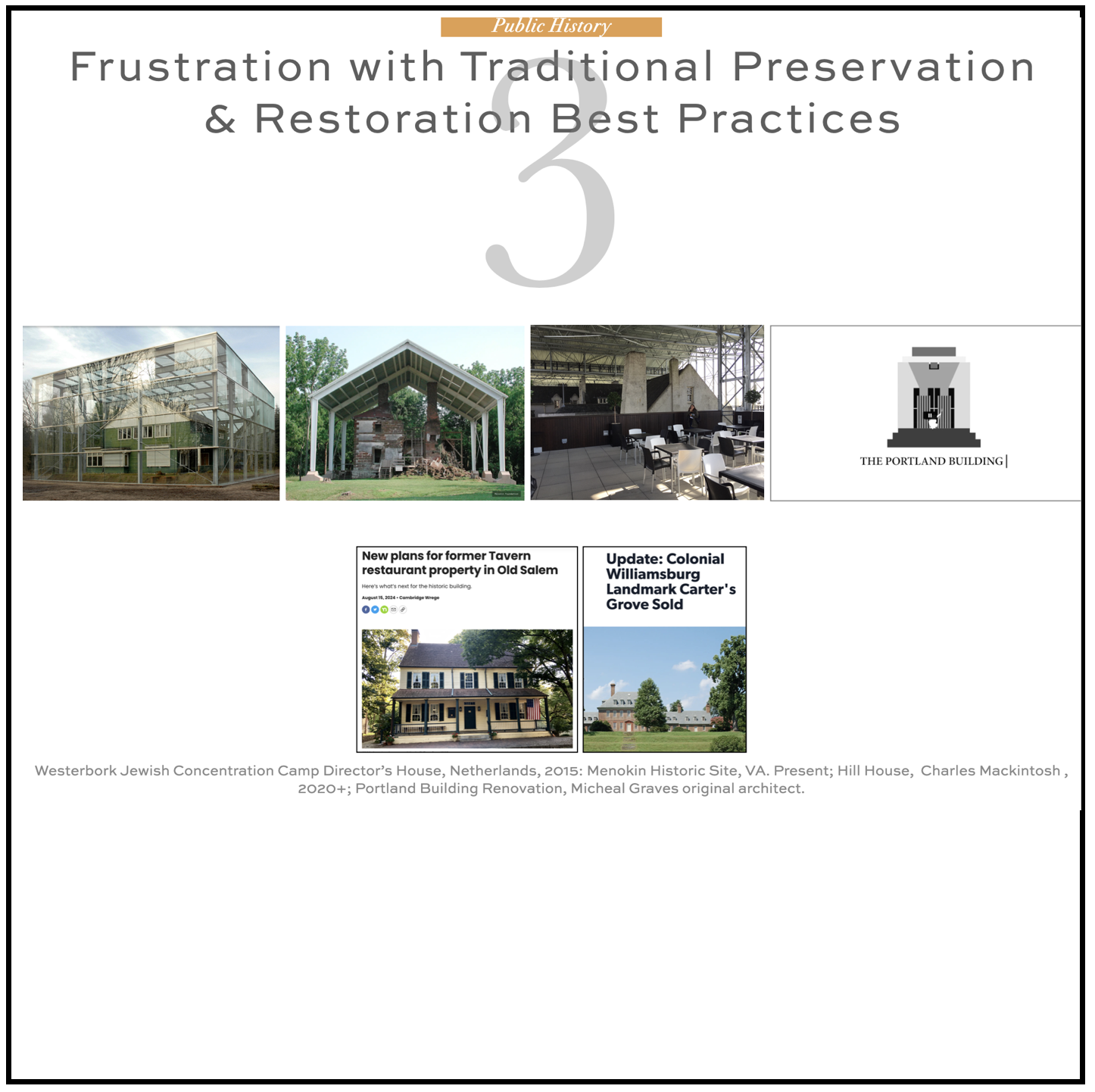
I keep asking myself who we’re really serving when we make these old buildings look brand new. Sometimes it feels like we’re more concerned with creating perfect Instagram backgrounds than preserving real historical character. What if we thought more about preserving the evidence of time’s passage rather than trying to erase it? What if we learned to see beauty in the imperfect, the weathered, the worn?
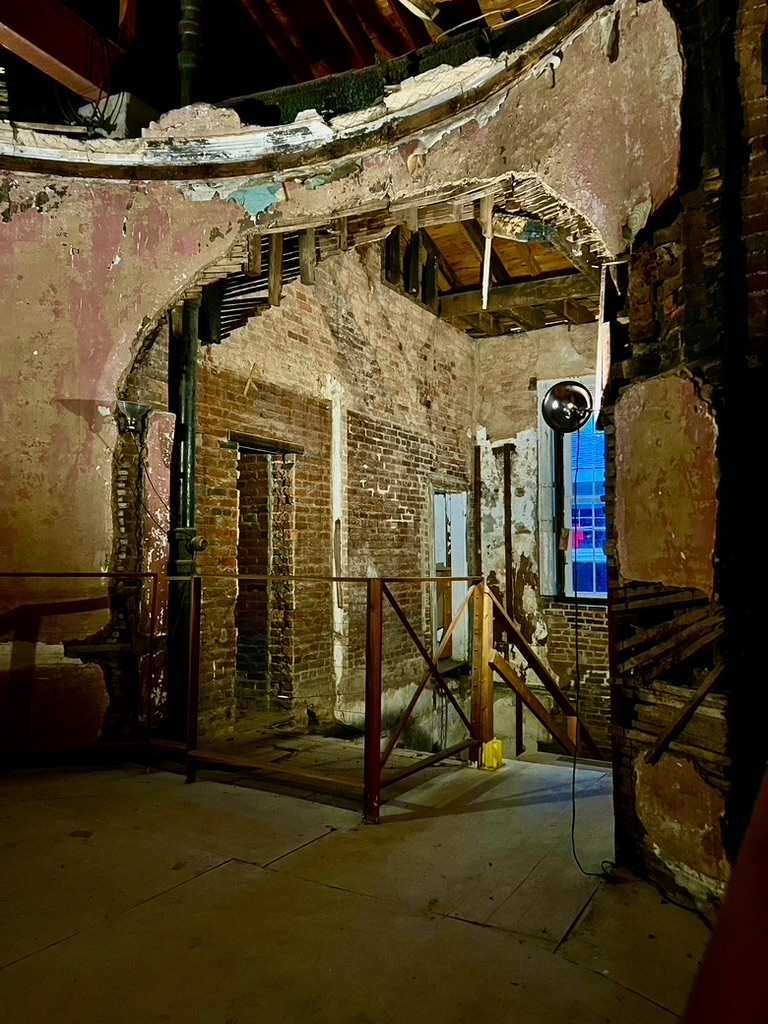
Looking at this building’s exposed skeleton right now, I know hard choices will have to be made about what to preserve and what to replace. I just hope we can find a way to save not just the structure, but also some trace of all the lives that have moved through this space over the centuries. Because once that patina of age is gone, no amount of historically accurate paint colors will bring it back.
How do we strike that balance between necessary intervention and maintaining the soul of a place? I don’t have a perfect answer, but I know it starts with asking these questions and being willing to challenge our assumptions about what “restored” should really mean.
As I watched the old building being repainted, I wondered: Are we too quick to erase history in our quest for restoration? Are the peeling paint and the weathered surfaces also part of the building’s story? I question the common practice of stripping old paint layers on historic properties. Each layer represents a moment in time, a choice made by past caretakers. By scraping it all away, are we not scraping away part of the building’s history?
This line of thinking isn’t entirely new. In fact, it harkens back to William Morris and his “Anti-Scrape Society,” formally known as the Society for the Protection of Ancient Buildings (SPAB), which he founded in 1877. Morris advocated for minimal intervention, urging that we should “stave off decay by daily care” rather than attempting to recreate a building’s past glory ( https://www.spab.org.uk/sites/default/files/documents/MainSociety/Campaigning/SPAB%20Approach.pdf )
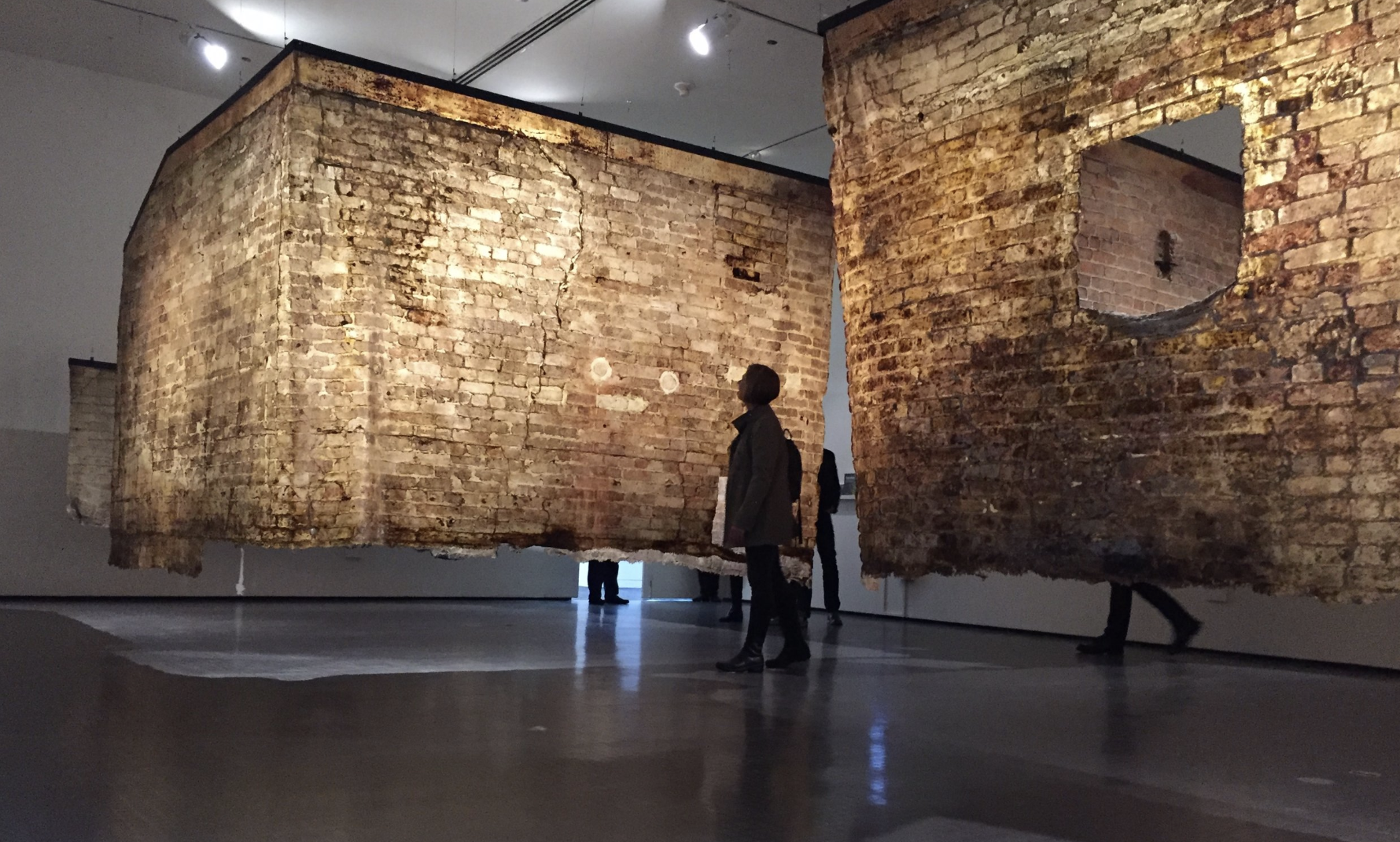
More recently, Jorge Otero-Pailos’ “The Ethics of Dust” series ( https://www.oteropailos.com/the-ethics-of-dust-series#/the-ethics-of-dust-trajans-column/ ) brings this concept into the contemporary art world. In projects like his work at the Doge’s Palace in Venice (2009) or Westminster Hall in London (2016), Otero-Pailos used latex to create casts of accumulated pollution on historic surfaces, preserving and displaying what we typically clean away without a second thought.
But perhaps the most poignant articulation of this perspective comes from an unexpected source: F. Scott Fitzgerald’s novel “The Beautiful and Damned.” In a passionate monologue, the character Gloria rails against the sanitized preservation of historical sites:
“Trying to preserve a century by keeping its relics up to date is like keeping a dying man alive by stimulants. […] Beautiful things grow to a certain height and then they fail and fade off, breathing out memories as they decay. And just as any period decays in our minds, the things of that period should decay too, and in that way, they’re preserved for a while in the few hearts like mine that react to them.”
Gloria’s words cut to the heart of my feelings as I watch the painters at work. The act of scraping away old paint layers is precisely what she’s criticizing – an attempt to keep a building perpetually young, denying it the dignity of its age and history. When she says, “I want it to smell of magnolias instead of peanuts, and I want my shoes to crunch on the same gravel that Lee’s boots crunched on,” isn’t she expressing a desire for an authentic experience that goes beyond mere visual preservation – and a fresh coat of paint?
As I watch the painter’s work, I can’t help but think about the stories hidden in those old layers of paint. The changing fashions, the economic ups and downs, and the technological advances in paint production are all recorded in those weathered surfaces we’re so quick to cover up. Each scraped-away layer is like a page torn from the building’s biography.
Of course, I recognize the practical concerns. Paint protects buildings, and allowing them to deteriorate isn’t a viable long-term strategy. But perhaps there’s a middle ground—a way to honor both the original design and the building’s journey through time, as Morris suggested and Gloria yearned for.
Maybe it’s time we broadened our view of what’s historically significant in our buildings. Perhaps the peeling paint and worn surfaces aren’t imperfections to be corrected but valuable records of human interaction and the passage of time. How might this shift in perspective change our approach to preserving our architectural heritage?
Can we find a balance that respects the need for preservation and the value of visible history?
As Fitzgerald’s Gloria puts it, “There’s no beauty without poignancy, and there’s no poignancy without the feeling that it’s going, men, names, books, houses—bound for dust—mortal—” In our rush to preserve, are we inadvertently erasing the very mortality that gives these buildings their profound beauty and meaning?
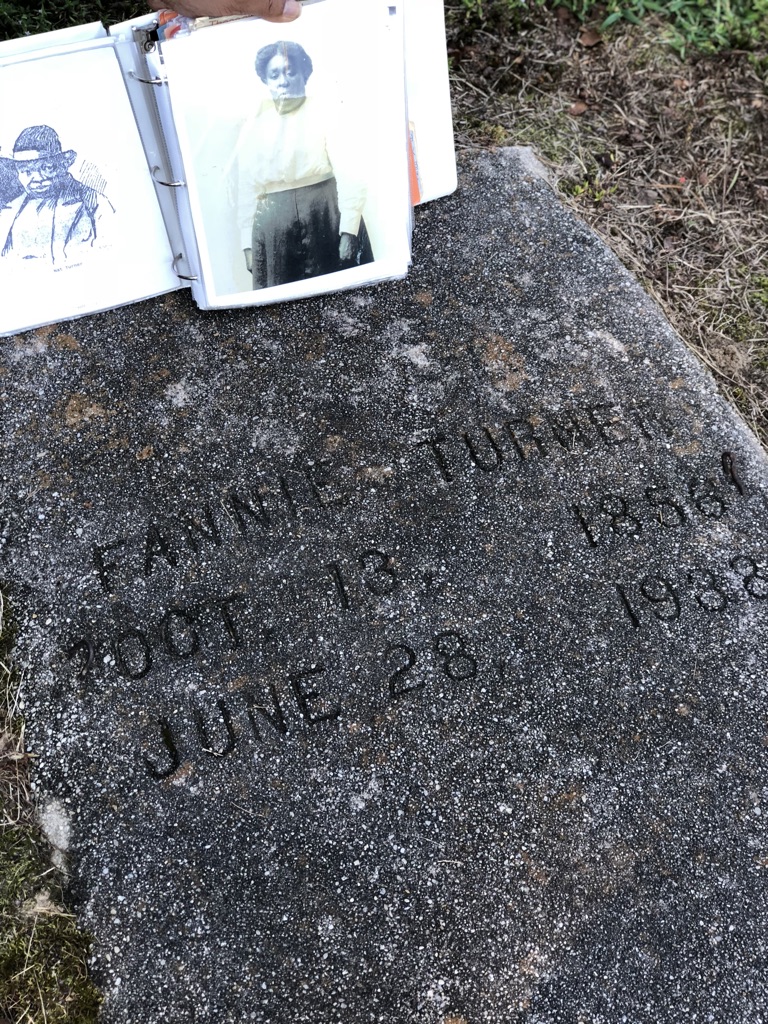
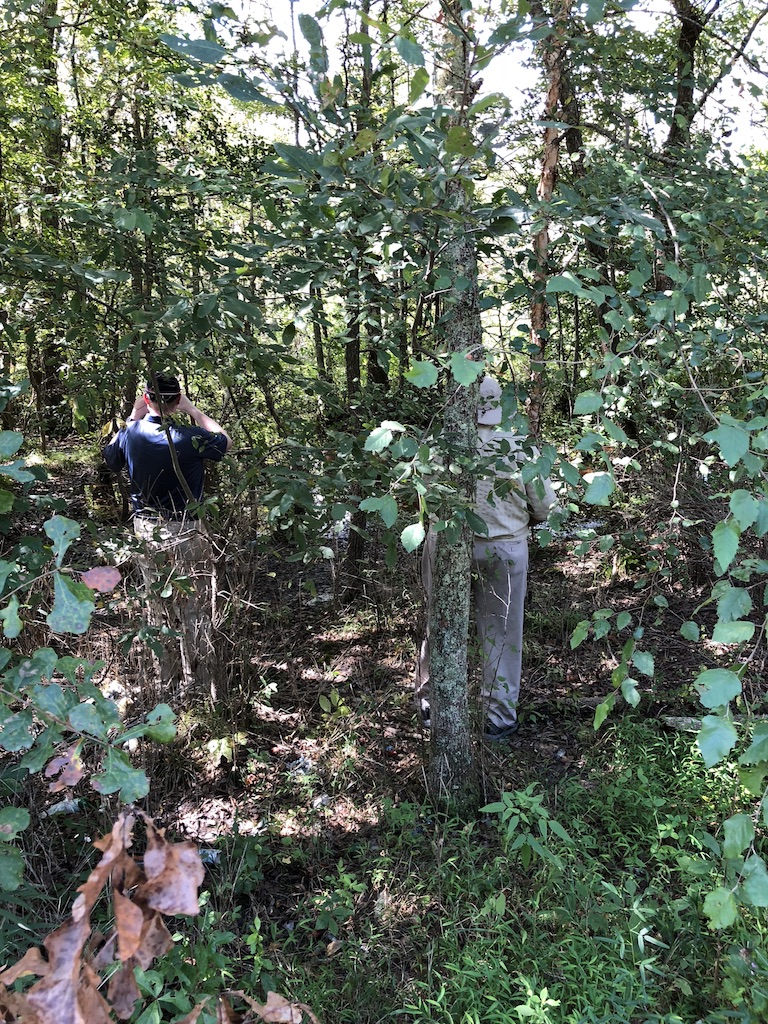
Twisted Preservation embarked on a profound and challenging journey through the haunting landscape of the Southampton Slave Insurrection, an event so raw and contentious that even its name remains a point of debate. Some refer to it as the Nat Turner Rebellion, while others argue for terms like “uprising” or “revolt” to better capture its nature and significance. Guided by Bruce Turner, the great-great-great grandson of Nat Turner himself, a small group of public historians and scholars confronted the complex legacy of this pivotal moment in American history. The controversy surrounding the event’s designation underscores the ongoing struggle to interpret and come to terms with this difficult chapter of the past.
The day began solemnly in a local cemetery, where the weight of the past hung heavy in the air. As we traversed dirt roads cutting through the rural countryside and ventured into dense wooded areas, each step brought us closer to the raw, unvarnished truth of the rebellion.
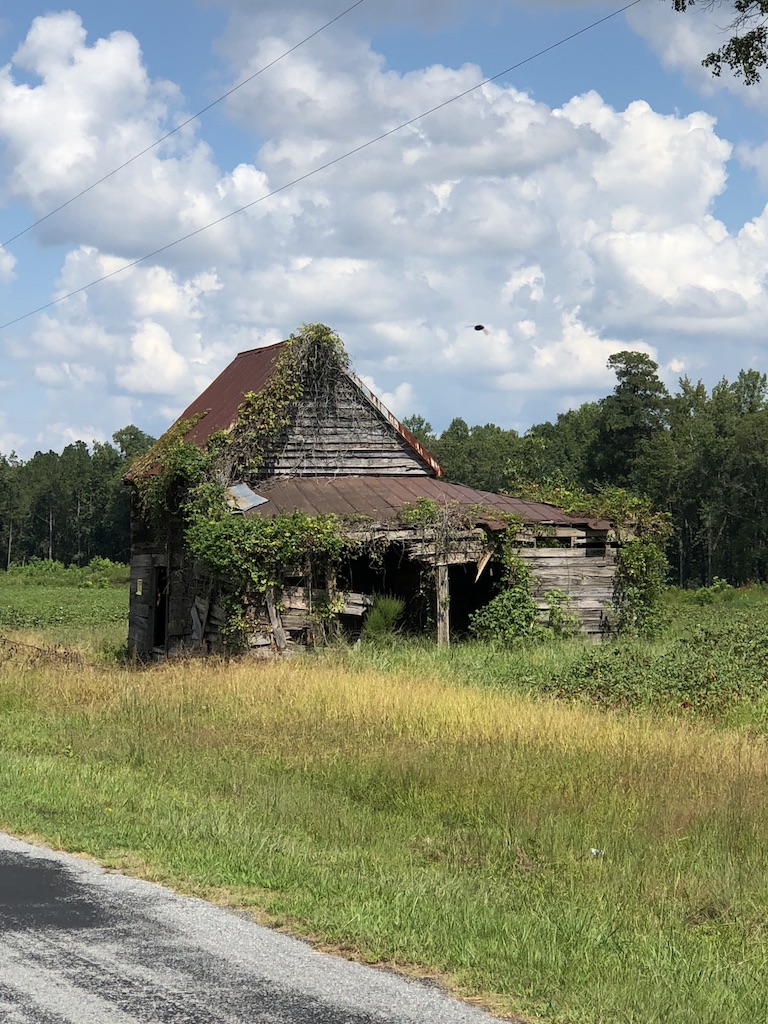
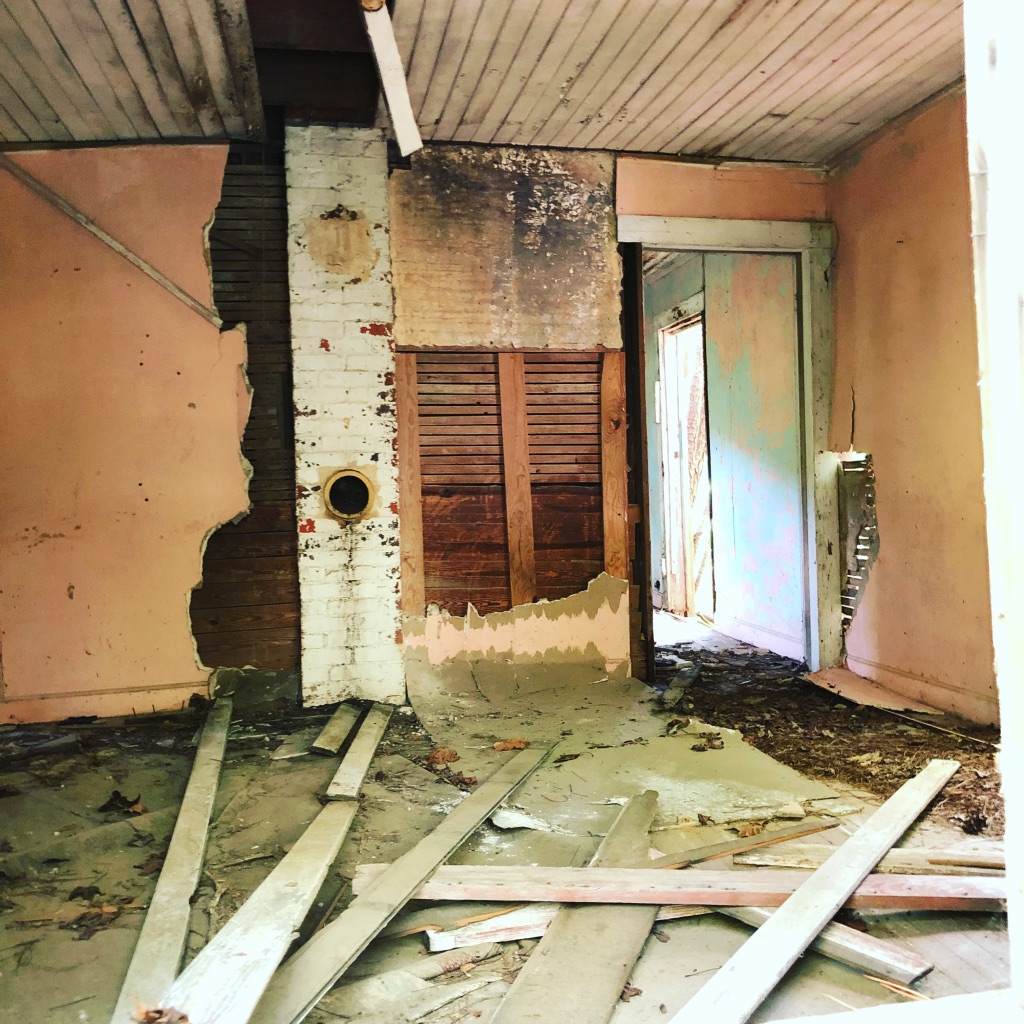
Throughout our journey, we encountered a series of abandoned and decaying dwellings scattered across the rural landscape. Each of these dilapidated structures stood as a silent testament to the violent events of the rebellion. As we approached each site, Bruce Turner would recount the grim details of the murders that had occurred there during the insurrection.
One after another, we stood before weathered farmhouses, collapsing cabins, and crumbling outbuildings. Their sagging roofs, broken windows, and rotting timbers seemed to echo the weight of their tragic histories. In each location, we learned of families who had fallen victim to Turner’s band of insurrectionists – parents, children, and in some cases, entire households (55 people in total were killed during the revolt), whose lives were abruptly ended during those fateful days in August 1831. Following the end of the revolt, an estimated 55 black enslaved were tried and killed as conspirators, with well over 200 black people murdered as a result of the white hysteria.
The state of these buildings, slowly being reclaimed by nature, added a poignant dimension to our understanding of the rebellion. As we moved from site to site, the cumulative impact of seeing multiple locations where such violence had occurred was profoundly affecting. It drove home the scale and intensity of the uprising in a way that no textbook or lecture could convey.
These abandoned dwellings, once homes and now reluctant monuments to a troubled past, forced us to confront not only the historical events themselves but also the complex legacy of how this history has been remembered – or forgotten – in the intervening years.
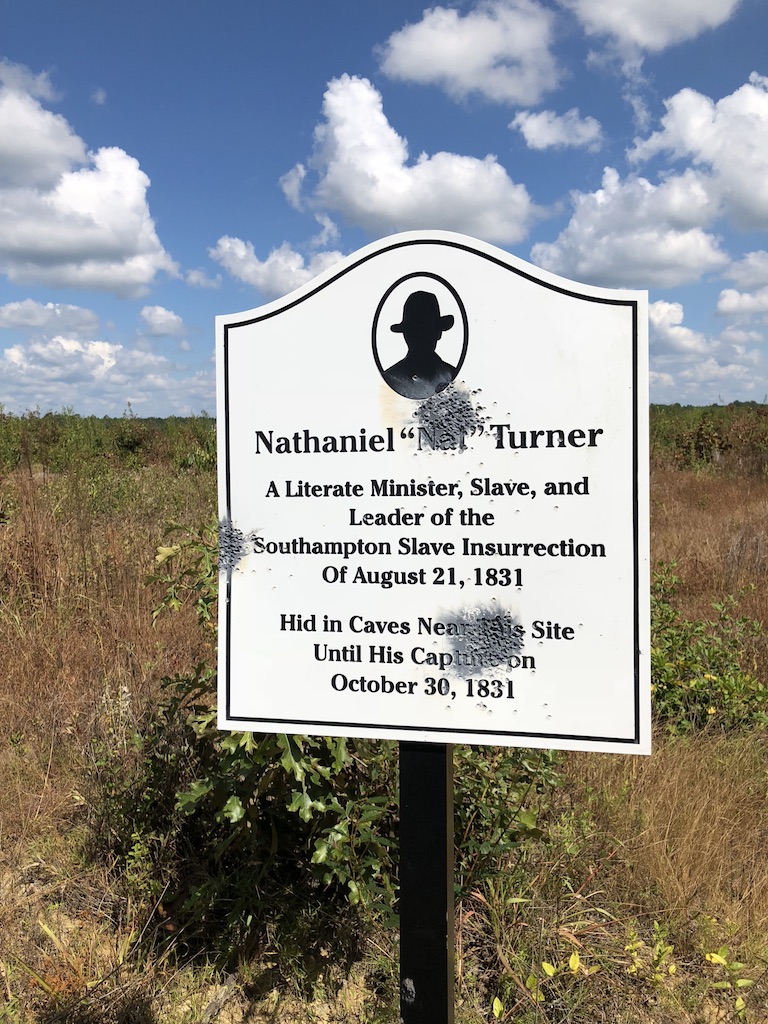
The sole official acknowledgment of this history was a historic marker, its metal face marred by shotgun blasts – a visceral reminder that this narrative remains deeply contentious. The defaced sign spoke volumes about the resistance some locals harbored towards memorializing this chapter of their past.
As we reflected on the day’s experiences, the inherent biases in preservation efforts became glaringly apparent. This consulting visit, while immensely valuable in its unflinching examination of a difficult history, also underscored the challenges of confronting and commemorating such a complex and painful legacy. It left us with profound questions about how we choose to remember, what we preserve, and the ongoing struggle to reconcile with the darker aspects of our shared history.
Our subdivision was surrounded by abandoned farms. I used to ride my bike along the eroded red dirt gullies determined to reach the gutted farmhouse and the massive barn and outbuildings. Thinking back, it was a dangerous but incredibly rich way to spend my time. This one particular farm looked like the residents just left without packing a thing. Drapes were still on the windows, dishes in the kitchen cupboards, and clothes still hanging in the bedroom closets. As I walked around the abandoned farm buildings exploring the half-furnished rooms, I would pick up artifacts and imagine what they might be used for. It was a life and world I knew nothing about, and I felt sad that these buildings would just collapse, and no one would remember them or the people who lived in them.
I had just finished 5th grade and we moved down to the Southern United States and we were living in Charlotte, North Carolina from Pittsburgh, Pennsylvania. I didn’t understand why it was an issue, but in 1976 we were the first “Sicilian Catholic” family to move into the neighborhood and it caused some upset to our white Southern Baptist neighbors. Even at this time, it must have been clear that I was destined to be a member of the Queer Community so all of this made me a loner and I didn’t have any friends. I would stay in my room or I would ride my bike through the abandoned farms that surrounded our isolated cul-de-sac street. Our house had a very large deep wood deck, and because the backyard dropped away quickly from the house, the deck hovered well above the lawn. I could stand up under the deck. The shelter it provided was cool and dry in a way that the hot humid Carolina summers made even more inviting. I felt like it was my secret spot. Away from people who would comment on how “tan” I was, or whisper in a loud voice “fairy”.
I wanted to build a fort under the deck. It was a place that I could hide away – be me. It was mine. I began to take as many trips to the abandoned farms as I had time for. I gathered anything I could carry and brought it back to create my fort under the wood deck. My unconscious attempt was to somehow create a safe place out of an intangible world that existed before my time. I was a maker. A doer. I was too young to be philosophical about my actions. I learned about things through the tactile engagement of my hands. I look back on this moment as a time I was most authentic. No one had yet told me that being gay was wrong, that created out of discarded items was considered “low art”, and I was not yet aware that my dyslexia would make it much more difficult to understand and communicate to the dominant culture.
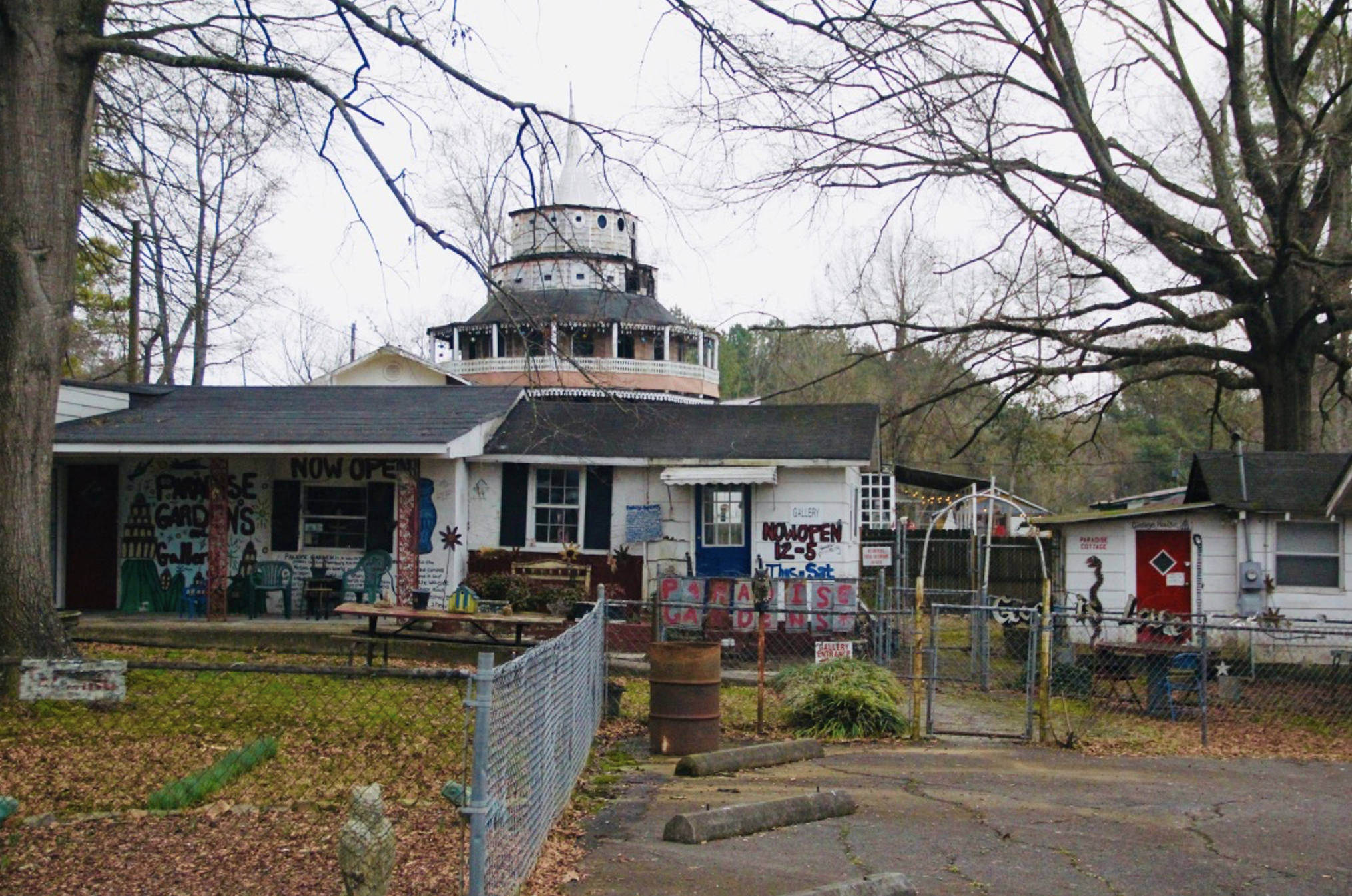
Easily by this age I already understood, in a very unspecific way, that the way I looked at the world and the people around me was different from others. Looking back, I can already see everything that would define my life – a love of history, the built environment, architecture, lost and hidden stories, and a creative drive to reuse seemingly useless items in new ways. It is from this childhood memory that I opened the car door and first saw Howard Finster’s ragged, artistic landscape, Paradise Garden.
I Love Howard Finster, Willie Nelson, and JESUS
This “One-night Stand” experience was much more difficult than I expected. To try to understand Paradise Garden you have to hold several opposing ideas at the same time and with equal validity. I didn’t come to Howard Finster’s Paradise Garden without some background and understanding of vernacular forms of artistic practice. Fascinated by the works of Joe Mitner in Birmingham, Alabama, St. E.O.M in Pasaquan, GA, Charles Williams, Hazard, Kentucky, and Minnie Evans in Wilmington, NC. (just to name a few), I am particularly drawn to the spiritual and philosophic foundations of these artists. As an artist who learns from doing and creating, I can understand the innate drive to create even when it makes no contextual sense to others. I guess I traveled to Paradise garden expecting that I would share some creative understanding with Finster, but as I get older, I am finding that I mostly see things which I don’t understand – those things which are known are boring to me and I pay attention to the mysteries. It’s an odd transformation. From a young know-it-all to an old know-nothing. As my life moves forward, out of my control, It seems more and more that I am left behind, too slow to keep up. That’s how Paradise Garden made me feel. Like I was supposed to remember what I was seeing, but the passage of time had rendered me at a loss with memory bookmarks pulled out of the novel. Without the bookmarks, I couldn’t locate where I left off reading.
To add to my confusion, most historic sites have clearly defined boundaries. These boundaries tend to be both literal walls, manicured landscapes, as well as tightly narrowed narratives that have been isolated and run through an Instagram filter. They tend to look really nice, only even better. Other than a chain-link fence cutting through the landscape, the town fabric ebbs and flows over Paradise Garden the way waves invade the dry sandy beach. The term “context” doesn’t apply in this case, as Paradise Garden is in itself more the context of everything around it – as opposed to the other way around.
This is really the key to gaining cognitive access to Howard Finster’s garden. Paradise Garden appears as if it is the physical manifestation of a lifelong’s worth of social media tweets that face off with the world around with snappy, confusing, incoherent, yet possibly meaningful message vignettes. Like clues in a scavenger hunt, you are never really sure where this all is going to lead nor if the entire experience will turn out as significant as you expected. The answer is, for me is, that it took time for me to mature enough to become receptive to these messages. But that has more to do with me than Howard. More on that later.
To tell you the truth, I think Howard himself had difficulty in finding his garden. I’m not so sure he totally knew what it was that he, or his life, would become. I don’t think he was any more complicated than the rest of us, it’s just that he wore that messy complication on the outside. Like many vernacular artists, Howard found a part of himself in religion. His faith permeated everything he created and every conversation he had. The tapestry of Howard’s core seemed to surface in his 13th year when at a Church revival meeting in Violet Hill, he believed his soul was saved. The same year as he found the holy ghost, he was baptized in the Gifford Spring Branch. From that point onward, specifically 2 years following the baptism, he found a calling to be a pastor.
Howard’s life speeds up and he notes in interviews that right after he was saved, he began noticing girls and after dating one girl, he meets his future wife Pauline at church and at 18 years old he is married. By the first year of marriage, they start having children. The young family traveled around the rural countryside from small churches to revival meetings preaching and baptizing the faithful. There are 1940’s images of Howard baptizing people in creeks and preaching as a traveling pastor.
Communicating Messages
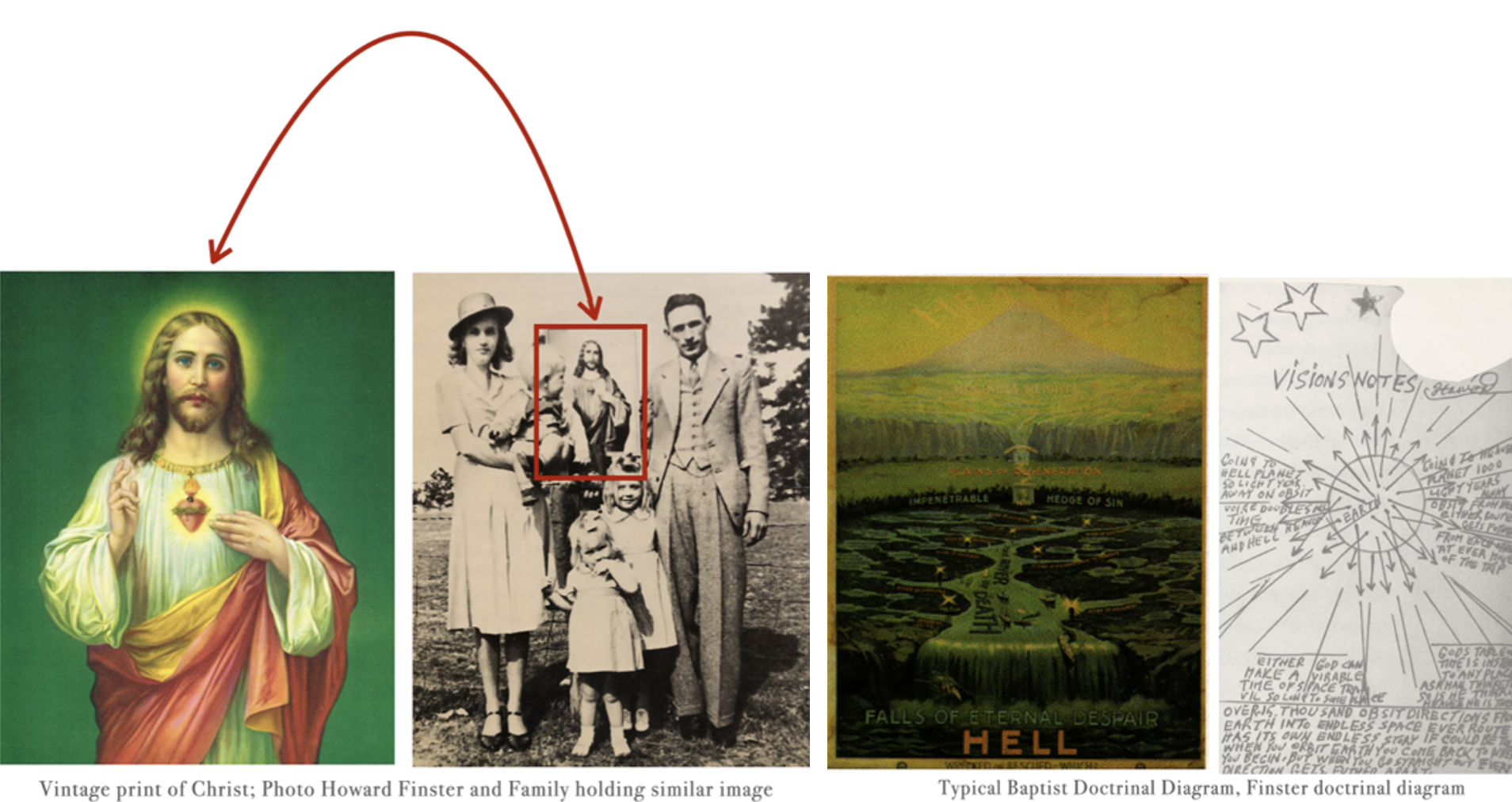
As Howard matures into his pastoral work, he, and his young family experiment with how his calling is executed. How exactly do you save souls? Part of the answer to this question comes from the rural Alabama landscape that Howard lived within. He experienced a world of Church revivals, Billboards, and visual communication. It was a world that was not unlike our present world of social media – everyone pushing for recognition and the label of “influencer”. Howard Finster might be called one of the first social media influencers before such a thing existed. While using old-fashioned communications tools, even before the creation of Paradise Garden, he managed to become a local celebrity. In one photograph of Howard with his young family, we can see him holding onto a matt lithograph of the Sacred Heart of Jesus c. 1930’s. Jesus is illustrated in classic Christian outfit wrapped in a red cloth trimmed in yellow. The background is a vibrant lime green and while documenting the Christian symbolism, still adheres to the 1930’s era of color use and aesthetics. It is very much of its time.
It seems important for Howard to clearly state, in physical form through embracing the framed illustration, his dedication to the Holy Ghost and his pastoral work. The lithograph is a very common, easily affordable, object of religious iconography from the period. His pride comes not from the value of the print, but from his and his families’ membership in the body of Jesus. The image becomes the billboard of his faith. For those unknowing of his calling, it is clear to whom his allegiance is drawn. Image matters. A direct picture illustrating faith, indeed speaks across time. Howard seems to be finding his spiritual voice, and that voice is through the use of the physical projecting a billboard of his faith.
Howard seemed to understand and take note of the power of words and mass communication. Starting in January 24, 1934, at age 16, Howard began paying the local Fort Payne Journal Newspaper by the column inch to print short sermons. His first column was entailed “The Ways of Life”. In this first tentative move toward mass communication, Howard sets up a dichotomy that would follow him the rest of his life – there are two ways to live your life, one is to serve the Lord and the other is to serve Satan. He is very clear that there is no in-between place to exist between these polarities. As mentioned already in this essay, Howard used to drive his car, which he called his mobile church, from town to town preaching the gospel from a platform built on the roof. You get the sense that to Howard, preaching the gospel was active and took place in the present moment. Never afraid of being the center of attention, when he painted on the side of his car “The wages of sin is death. Don’t Put God Off” and “Your soul is most precious seek Jesus Today”, he is loudly preaching in the moment. Sure, the result of these choices is life eternal, but the way to get there, Howard is telling us, is to stop what you are doing right now – this second – and choose another path. There is an urgency and speed about his preaching. The clock seems to be ticking, the odometer is turning, gas is running out in the car, and the timing of all of this matters.
Inventing Fabrications
It’s a hard task to tease out if at all, the cultural influences of Howard Finster’s art practice. The best way to describe it is as ‘cultural ad-hock-ism”. He seems to have been captivated by individuals such as inventors, acclaimed geniuses, pop culture icons, and uber-successful industrialists. The second category of influences might best be labeled as prescient cultural environments that garnered excitement and were considered innovative at the time.
The first category of individuals can be exemplified by Howard’s love of inventors. He often spoke of them as divinely sent to help humanity’s progress. One such inventor was Henry Ford, a lead industrialist in the mass production of the automobile and founder of the Ford Motor Car Company, who became one of the richest and most notable men of his era. Howard’s dedication to Ford seems to stem from a vision he had in which Henry Ford had driven through his family’s farm. In this vision, he surmised that Ford’s invention of the automobile was in fact the horseless chariots that were foretold in Ezekiel’s vision in the Bible.
“Now as I looked at the living creatures, behold, a wheel was on the earth beside each living creature with its four faces. 16 The appearance of the wheels and their workings was like the color of beryl, and all four had the same likeness. The appearance of their workings was, as it were, a wheel in the middle of a wheel. 17 When they moved, they went toward any one of four directions; they did not turn aside when they went. 18 As for their rims, they were so high they were awesome; and their rims were full of eyes, all around the four of them.”
From that point onward, Howard painted Ford, his Model T, and continued sculpting using wheel parts, car wheels, and hubcap covers. Howard’s love of the wheel is undeniable. Everywhere you turn in the garden is another ad-hock creation using circular objects of some type. One can only assume that Howard’s interest may have been fueled by his intimate knowledge of Ezekiel’s multi-layered, symbolic vision. In any case, it is clear that he considered inventors gifts from God. Particularly so Henry Ford. Ford could do no wrong. One can only imagine the ways that Henry Ford served as a role model for Howard in his career as a pastor. It is by no accident that Howard, for many years, used his second-hand automobile as his sanctified mobile church. To those who do not have Ezekiel’s vision in mind, the use of the car as a method of proselytizing may seem strange, but to those who understand the mystical qualities of the invention it takes on the mythology of a Greek God. Just as Ford was a Master of Mass Production, Howard also seems to have also absorbed the possibilities of mass production in his pastoral artistic work. Eventually, Howard would take this concept and begin his assembly line production of the signature Finster artworks, clocks, and objects. I can only surmise that he felt that his artworks would produce the same tectonic shift as Ford’s horseless carriage.
The second category of influence for Howard seems to have been large-scale environments that miniaturized and encapsulated a philosophy. Once again, we can look to Henry Ford seeking examples. Ford was responsible for creating Greenfield Village. Dedicated in 1929 opened to the public in 1933, it was the first outdoor living history site of its kind in the United States. Starting with a Tabula Rosa, Ford designed the complex to house historic buildings, which were moved from all over the country, in a format that would replicate a traditional American rural town and serve as educational tools of communication through public visitation and interpretation. Formulated through a tight personal, and biased filter of selected history, Ford crafted the narrative to fit his message of American exceptionalism and inventive spirit. Greenfield Village was a manifestation of a distinctly Henry Ford perspective of the American landscape. I can only surmise that Ford’s highly crafted and nostalgic Greenfield Village would have sparked awareness in Howard in the power to communicate through a heavily nostalgic, and culturally reductive environment.
In addition to Henry Ford and Greenfield Village, Howard spoke of the roadside stop of Rock City as inspiration for Paradise Gardens. The attraction is located at Lookout Mountain Georgia close to the Tennessee state line and Chattanooga. Rock City, opened in 1932, consists of over 20 separate location-based themed narratives, A Gnome Village and Cave, a Fairyland Clubhouse, 10 cottages, all connected together through winding paths and bridges. Names of odd rock formations were listed as “Balanced Rock” and “Fat Man’s Squeeze”. The resulting creation is a mixture of natural history, Appalachian folk tales, Fairy Tales, all mixed with Gnomes. Rock City’s success was the direct result of an extraordinary marketing and public relations effort. Much of its messaging came from the novel idea to paint over 900 barns and roofs enticing people to visit “The World-Famous Rock City”.
There is significant visual and experiential DNA that is shared between Greenfield Village, Rock City, and Finster’s Paradise Garden. For instance, you travel to a remote location that consists of a series of isolated vignettes, each having its own narrative but tied together by a common theme but sprinkled with nostalgic and aspirational longing. There is a mixture of entertainment and education which produces experiences that necessitate a suspended sense of reality and suppressed context. The power of a controlled message, shared symbolism, and language to drive an audience was a strong lesson learned – Howard’s purpose was to save souls, but first he had to catch their interest. As you will see when you visit Paradise Garden, Howard took mental notes of how powerful language and signage can be in fulfilling a mission.
Writing Stories
More than a built physical environment, Paradise Garden produces an experience similar to inhabiting a book. As you wander around the grounds you are violently attacked with quotes from the bible, quotes from Howard himself – you don’t know if a sign is revelatory or simply wayfinding. Perhaps it is both? Much like Rock City various sign text messages are threaded together to form disparate narrative experiences, Paradise Gardens pulls you from one Sunday school lesson to another. Walking through Paradise Garden forced me to recall the imagery of Robert Venturi & Denise Scott-Brown, important Architects of our modern era, in which they investigate the use of bold, pop imagery as a form of proselytizing commercialized as well as symbolic meaning. One of the more powerful analyses of this concept can be found in the formative, 1972 “Learning From Las Vegas”. The investigation maps out the entire Las Vegas strip not in terms of architecture but in terms of messages and text of all of the signage. It is from this conceptual point I jump into Howard Finster’s experimental and imaginary world of crafted, miniature, heavenly cities of roadside attractions.
Paradise Garden resists being viewed as merely an eccentric grouping of objects. It refuses the fetishizing visual gaze of the onlooker in favor of the cerebral literary mediation found in a cloister. It’s this dialogue between the visual and the literary that Paradise Garden contains meaning. It is not an easy world to simply visit as a tourist, taking a few photographs with your smartphone and then going on your way. It requires silence, contemplation, and time. Time is needed to consider all of the ramifications of the decaying physical mass of the landscape. The existing built environment feels like a medieval city, built over centuries, with an ecclesiastical Folk-Art Church and cloister complex in the center filled with memorials, tombstones, small reliquaries, stained glass windows, rooms within rooms, all illuminated with a complex layering of philosophical and environmental visual context. It is difficult to get a complete understanding of the Folk Church complex as it’s accumulated additions and subsequent landscape additions seem to have expanded and blended with the other parts of Paradise Garden like mold in a bowl of fruit.
Composing A Visual Language
Throughout Howard Finster’s life, he was known to convey complex spiritual ideas through visual language. Not unlike the traditional Southern Baptist diagrams used in Sunday School and Doctrinal Classes throughout the South. Finster’s diagrams however took on an almost pop quality about them. Blending text, symbols, drawings, and color, he would craft visual stories that surpassed simple locational diagrams. He continued to develop his complex layering as he began painting his visions of the spiritual world. The compositional organization takes on a symbolic visual of stages and layers of spiritual existence. You can see this in most of his paintings. He has a lower (earth) band; a middle (existence/Life) band; and an upper (Heaven) band. The colors retain these bands, and his character placements reinforce these bands.
FOLK CHURCH
Perhaps the single most iconic element of Paradise Garden is The Folk Church. Howard spent much of his public platform establishing creation mythology that nicely fit into his well-crafted life narrative. The story goes that Howard was finding it difficult as a pastor in other churches because of his notoriety. After leaving a pastorship over this issue, he began thinking about building his own church – one that wouldn’t restrict his more liberal, accepting views of humankind. There existed a church building adjacent to his Paradise Garden land and the congregation had vacated that building in favor of a newer larger building. If he could afford to buy it, Howard imagined his new church congregation housed within this building. After a bit of negotiation, Howard purchased the old, wood frame, church building and combined the land with his existing Paradise Garden landscape complex. Starting in 19?? And based upon the visions that Howard had, the simple wood church was added on to and expanded multiple times until it resembles some extent the building that greets you today.
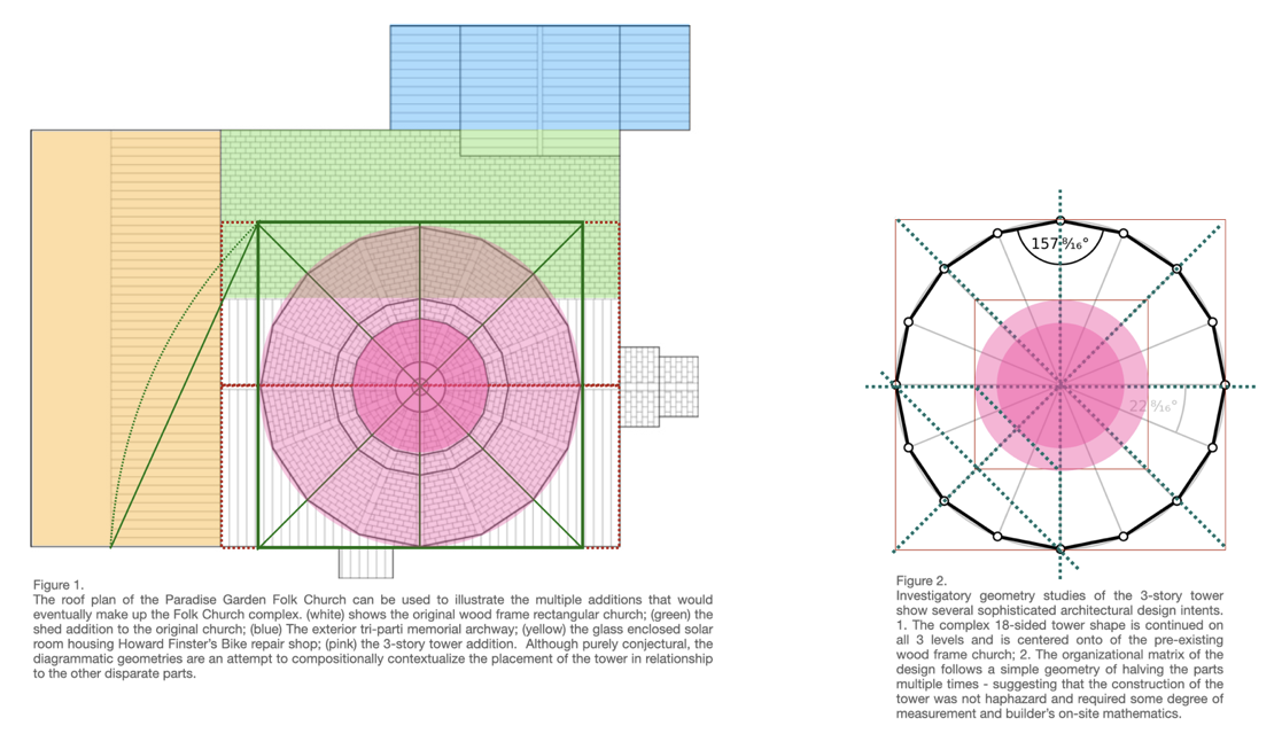
According to Tom Patterson’s personal interviews with Howard, no rulers or measuring tapes were used. Howard pulled a stray plank of wood out of a woodpile and that was the only measuring tool he used to build the Folk Church. Howard told Patterson that God had guided his every cut and measurement in the construction of the Folk Church additions. The Church structure consisted of the pre-existing rectangular single gabled building, a shed addition that expanded the interior, a glass window enclosed solar room addition, an exterior memorial tri-part archway, and of course the five-story, 3 tiered, 18 sided highly decorated tower steeple.
Today, although a full restoration is in the planning stages, the church structure is failing, missing elements, sagging in multiple directions, and no one is allowed to enter the building as it is unsafe. Its appearance resists a formal architectural composition study because, on the surface, it seems obviously cobbled together using elements that were on hand. During this One-night Stand, I forced myself to approach this building as a manifestation of Howard’s spiritual and life philosophy – indeed not an ad-hoc construction built by an untrained architect. It seemed to me that the Folk Church, even in its present state of decay, deserved a more intentful analysis than merely fetishizing it for its “outsider art eccentricities and free associations”. I am glad I did.
In performing conjectural architectural analysis on the floorplan, I quickly began to see formal connections between the seemingly incongruent additions. Certain design moves that seem natural need to be considered within the context of Howard Finster’s personal education as a designer, painter, and sculptor. The most fundamental design move is that Howard centers the tower bi-laterally pushing the diameter of the lowest tower step to the outermost walls of the original wood-frame church. He then centers the other dimension as well which maintains equal spaces on both sides of the tower’s footprint. These may seem like simple moves, but I would argue that they illustrate a clear and distinct attitude toward design and context. The various additions also show some relationship to the imaginary bi-lateral symmetry of the tower geometry (see diagram).
In looking at the tower geometries one can see that the simple center lines of the tower are geometrically halved twice to arrive at the respective tower dimension. The 16-sided geometry of the tower is far from a simple move and one that would take constant reference taking as the tower construction rose upward. In fact, it’s interesting to note that the tower maintains the 16 sides all the way up the 3 levels. Another geometric action of note is that the centerline organization of the tower results in a structural column – not an opening. The openings occur between the columns. Howard could have shifted the entire plan ½ bay and aligned the windows with the centerline and the primary entry door on the street level. In many forms of architecture, the centerline results in an opening, such as the example of the Pantheon where the centerline results in the access opening. As an architect, the centerline resulting in the door opening for access expresses an acknowledgment of the human element, placing the structure at the centerline speaks of a different priority. Howard’s tower, in his mind, was not bound by the pre-existing conditions of the original church. His Folk Church, just like Howard himself, was to stand apart from the structures and dogma of Southern Baptist confinement not blend in with it.
Although Howard made it clear that he had only his visions from God to guide the design of the Folk Church, we can find architectural precedents as comparisons. These comparisons may seem farfetched as Howard was not well-traveled. However, by this time he had a constant flow of visitors from all over the world coming to experience his Paradise garden. There are also many examples of people bringing postcards and images of churches from their travels or homeland. Today you can see one of these gift images displayed in the gallery loggia (a gift photograph of Bath Abby Nave interior, Bath, England). It can only be conjectural that these postcard images influenced Howard’s design choices. His ravenous visual appetite paired with his ability to successfully and bombastically combine discarded fragments end up producing a fog-like mythological visual landscape. One never knows if it is brilliant, or derivative, or full-on fiction – perhaps it’s all of the above.
Just like Howard Finster absorbed Southern Baptist Christianity and made them his own, he did the same with the small wood-frame church that was to become the Folk-Art Church. Tracking the evolution of additions to the church gives us an idea of the process and intent Howard gave to his environmental creative practice. If one pays particular attention to the limits of each preceding phase of construction, you can read between the lines and understand how Howard started with the limitations of a situation and then used those limitations to create entirely new and unexpected opportunities.
Howard’s ability to capitalize on limitations seems, to me, to be at the core of his creative practice. He didn’t start his “sacred art” until he was about 59 years old and he had accumulated decades worth of lessons gained from Henry Ford and his use of mass production, Rock City and the effectiveness of mass communication, and a lifetime of experimentation with turning trash into something that would garner attention. Certainty he was creating as far back as when he was a teenager and then as a traveling pastor sitting atop his modified automobile preaching to passersby, but it was really later in life that these things seemed to coalesce into a representative package.
The path of his creative activity makes it hard to cite one era or period of significance to Paradise Garden. He didn’t start this version of his religious art until later in life and in some ways his earlier life’s work was more deeply centered on his religious practice and family. There was a point in Paradise Garden’s appeal that the public was so drawn to visiting that Howard and his wife had to vacate their house, move off-site to another home miles away. Howard would return to greet his visitors, but his direct everyday creative activity and work on the garden would diminish until the garden environment slowly started to be sold off and decay. His daughter, Beverly states that the decay of the garden became so upsetting to her that she had to stop visiting. She was sad that visitors would never really understand the vibrant experience of the garden when Howard was on site daily, adding to its messages and touching up and repairing the quickly eroding textural sermons.
Great strides have been made by the present stewards of the garden to bring everything back to life, the present state keeps one aware of the fleeting and transitory relationship between ideas and the built environment. A quick comparison between what the garden looked like during Howard’s lifetime and what it now appears as insists on a moment of pause and reflection. This pause forces us to consider fundamental concepts of preservation, restoration, and meaning. To what degree is the value of Paradise Garden found in Howard’s intellectual stamina and not in the physical manifestation of that effort? Maybe Howard’s efforts simply delay the certain decay and disintegration of things back into the landscape and any intent on our part to prop up his work would run counter to his original intent?
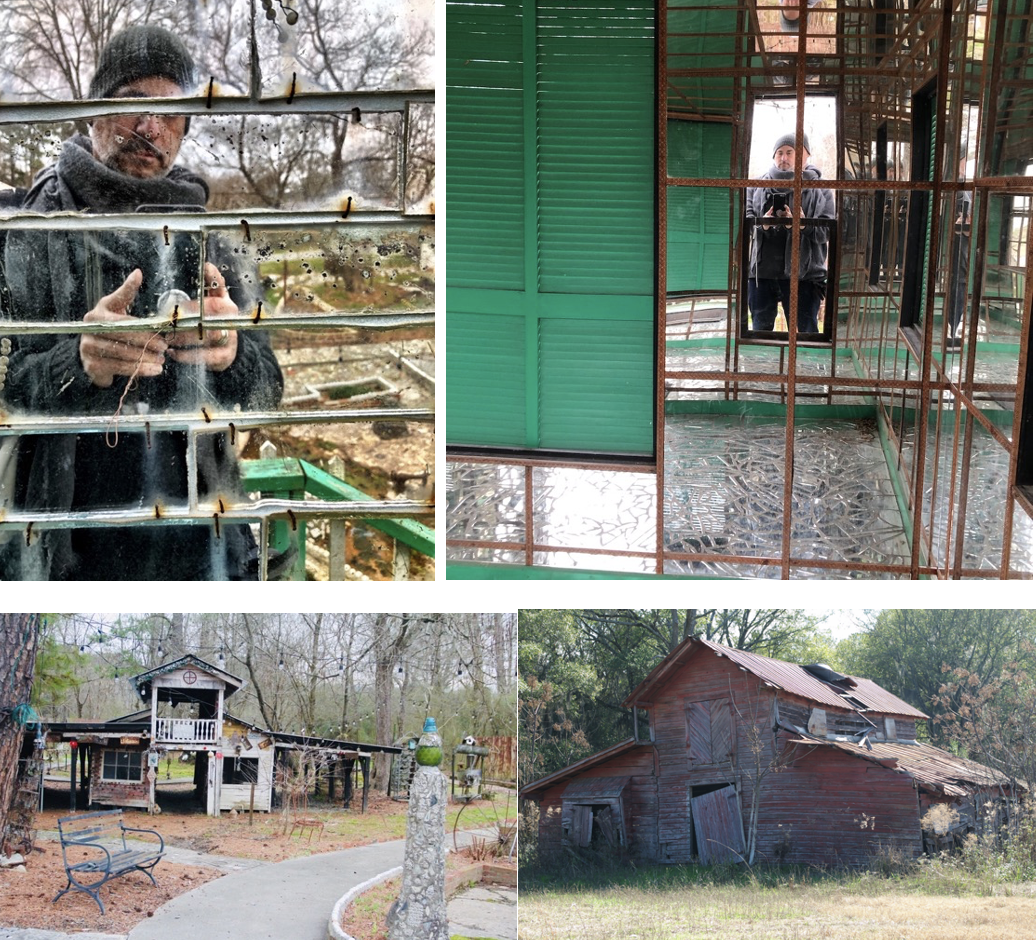
As I walked around Paradise Gardens, I couldn’t shake the feeling that I was 5 years old again and I was exploring those abandoned farmhouses and barnyards. The same contradictory visual landscape existed between the two experiences. There was a readable intentful placement and hint of purpose, yet nothing absolute nor definitive. Just like the half-inhabited farmhouses with kitchen plates still on the tables and canned food in the cupboards, The Paradise Garden landscape felt equally confusing. I knew Howard’s purpose was embedded in everything he crafted but there was still an element of disjuncture about his placement and connective tissue.
I suspect a discarded object became the catalyst for an entirely new-themed experience. Each creation fed off of the others yet also by some artistic magnetic opposite attraction kept things from feeling continuous. There is a sense of experiences and objects having their own center and discrete “thingness” while at the same time, confusingly, blending with everything around it. I didn’t get a sense that Howard worked off of a grand plan. No dogmatic theory or concept. This is not to say that Paradise Garden is meaningless, rather the environment forces you to appreciate its meaning not only from the physical but from higher levels of perception. After all, it’s just junk.
When Howard wrote on his rusty, metal donation box, “Donators help write the Bible story”, he really meant it. Contributions to Paradise Gardens would continue his work in writing the sermon of his life through plywood cutout paintings, junk sculpture, hand-painted signage, and decorated sheds, and the broken and recombined mirrors throughout the landscape kept reminding me of my personal place within this constantly moving vibrating and decaying fairytale.
SPECIAL THANK YOU:
Johnny Yeagley – Research & Logistics
Tina Cox – ED of Paradise Garden, for inviting us to stay on-site at the new lodging and review of this text.
All images are used for educational and non-commercial uses.
I have imagined how museum folks felt as they stood in the gallery halls of the Louvre, Uffizi, or Victoria & Albert Museum moments before they started to remove the artwork from the walls or began covering them with sandbags so that they could store them safely away from the threat of German bombs. I try to imagine the moment of hesitation and internal dialogue that might have taken place – perhaps asking themselves whether or not they were overreacting? Everything they had spent their lives protecting, interpreting, and making public – now had to be removed and hidden from the public eye. Of course, in hindsight, this was absolutely necessary to protect the cultural property for the long term. The world as they had understood up until that moment had ceased to be, and a new situation was upon them. They had to look past the boxed Mona Lisa and the sandbagged David into the future and envision a time when those artifacts would once again be placed openly and lovingly in public view. What a moment of sadness and, at the same time, a moment of robust, proactive power and urgency.
Although not as physically devastating as war, I believe we are called on now to make similar proactive and emotionally counter-intuitive operational choices.
The 2020 COVID-19 Pandemic lockdowns have been devastating to cultural institutions in both the human cost as well as to organizational operations. This part of pandemic is now quickly becoming history, but what we are in at the present and what is on the horizon seems even more daunting to me. Why?
As I write this, it is 2021-22. Mass vaccinations are taking place, things are slowly opening back up, and there is noticeably more activity on the streets and sidewalks of our towns. So why the concern? I believe that at this moment we are in the eye of the economic storm that is the COVID-19 pandemic. The initial economic shock of the storm included the physical death and destruction to so many lives, the fear and dread of our new day-to-day realities, and how they might unfold – and for cultural institutions, the stark realization that our survival depended on a new and as yet unwritten blueprint for how to operate. At this pivotal inflection point, we are starting to see the sunshine, and that sense of hope might have us convinced that the storm has now passed by us completely. Most cultural sites rely on various types of earned revenue to survive, even those with sizable endowments. As someone who runs a large living-history site, I think 2021-2023 will include a different set of prevailing winds from the COVID-19 storm. “Open up!” is the increasingly vocal call heard from many sides. Cultural institutions are being thrown in to this loud arena – struggling to regain their footing and find balance. Persistent public calls to get “back to normal” belie the economic realities of budgets, staffing, attendance, funding, and safety of staff. Simply returning to normal is a losing proposition for many.
The best-kept secret is that some cultural institutions, because of unsustainable pre-COVID operations, may in fact be in a better position temporarily closed and using this to their advantage for the longer haul – rethinking an operations model that pays a living wage, is empathetic to staff, anti-racist, and includes shared collaborative leadership. Staying closed may not be popular, but do organizations really want to jump back into their outmoded top-down, financial & attendance driven models of the before-time. This is a difficult opinion to voice. In fact, I haven’t seen much in the public press about this perspective. We are at a crucial moment in our social and economic progress. We either see the present moment as the end of the storm – or we see it, as I do, as merely the eye of the hurricane, and prepare for the reverse winds. Now is not the time to let our guard down, take down the plywood coverings protecting the windows, and the sandbags protecting the cultural property. Now is the time to check to make sure those protections are still useful. We should reflect upon our operations and policies looking toward new organizational forms and behaviors.
I realize that my perspective does not reflect the current “back to normal” zeitgeist. My feeling is, simply put – if we want our organizations to be around 10 years from now, serving our communities & staff in significant ways, and providing opportunities for an ever-expanding constituency, then we need to pause.
Think about this moment. With as much care as we gave the secret removal of the Winged Victory of Samothrace from the grand stair hall of the Louvre, plan for when the other wall of the storm arrives and re-envision a response that speaks to our higher selves.



































 Twisted Preservation