Visualizing a new form of organizational relationships and behaviors in non-profits

Samantha Smith: Reader/ Contributor, Watson Harlan: Contributor

“L’amour est à réinventer. (Love must be reinvented)”

Délire I: Foolish Virgin, The Infernal Bridegroom”,  Arthur Rimbaud, Photographs used for educational and non-commercial purposes only.

When Rimbaud stated, “Love must be reinvented”, he was speaking of how standard models of relationships and behaviors did not fit with his needs and desires.  As a man who was same-sex attracted his poetry struggles with imposed expectations and how those expectations bring him to levels of despair and self-hatred.  I don’t think he was only speaking about the intimate system of love between individuals, I take his statement to call out his frustration with all systems of structure that didn’t operate in a way that benefitted those encased within its walls.  It is from this perspective that I make a uniquely queer connection and speak about this need for reinvention in reference to non-profit leadership and management structures. For me, it’s not such an unreasonable leap.  I have long realized that one of the ways to understand and operate within the established non-profit field is deeply influenced by numerous dominant & marginalized experiences.

This is my first step in visualizing a new organizational form to non-profit structures and leadership, that is to embrace the fuzzy margins and edges of these operations rather than more illuminated and formalized center. In order to imagine an existence, we must visualize new forms within which we can experiment with, as Dr. Porchia Moore stated in her recent article CARTOGRAPHY: A BLACK WOMAN’S RESPONSE TO MUSEUMS IN THE TIME OF RACIAL UPRISING, https://incluseum.com/2020/06/10/cartography-a-black-womans-response-to-museums-in-the-time-of-racial-uprising/,  new cartographies.  When Dr. Moore speaks of cartographies, she is discussing a full spectrum of intangible policy, leadership, and Board of Trustees relationships, but I believe in order to more easily build an anti-racist organization we need a new fundamental way to visualize the change we seek.  Self- perception is so important in producing real change.  It also seems important that how we visually document and present that idealized change needs to grow out of the behavioral structure of the information we seek to convey – and not be applied to a pre-existing visual model.  In many ways, the visual model shouldn’t look like anything that came before as the change we are seeking is organizationally transformative in a way that the very form of, as Dr, Moore argues,  our new “cartographic directions” should appear as physically indicative as the change we seek.

Recently I participated in an online Preservation Conference (Dismantle Preservation) organized by Sara Marsom.  The panel that I was a participant in, Identifying and Tackling Implicit Bias In Preservation,  was organized by Jeffry Harris and contained Melissa Jest, Sam Collins, and myself. I also was an attendee to the entirety of this conference and also was an attendee in another online conference, Death To Museums.  Death To Museums was created by June Ahn, Rose Cannon, and Emma Turner-Trujillo.  Engaging in both of these conferences, and learning from others such as LaTanya S. Autry, Mike Murawski,  Michelle Moon, Margaret Middleton, Joe McGill, Joan Baldwin, Nina Simon, Elon Cook, Monica Montgomery Nyathi, and Taylor Stoermer (and the list goes on and on),  are pushing me into a deeper understanding of the ways in which our non-profit organizations are not serving those who work at and engage with them.  This core idea is not new to me, as a member of the Queer Community my relationship with the established system has been somewhat tentative and I have often found myself silenced in ways that even I couldn’t verbalize or document.  Following these conferences, I began re-visiting organizational visual experiments that have followed my non-profit practice.

I wanted to ask: What might a decentralized leadership model be. What about Co-Leadership Model? How would it work if you placed Visitor Service/Educators at the center of the organization rather than all the way at the bottom?  What would a Collaborative organizational structure look like? When non-profits are not neutral, then how do we visually represent that component in form?  How are our present visualizations suppressing these models of shared leadership and allowing for continued systemic bias in the very operational fabric?  How would new funding models assist in these changes? So many questions and the first thing I have always thought was that the way we see ourselves didn’t match up with how we were illustrating ourselves.

This experiment is an attempt to, in a naive way, try to assist in moving forward and amplifying Dr. Moore’s thesis.  The basis of this idea rests on the assumption that visualizations matter in documenting and formalizing change.

How We Visualize Ourselves Matters

As a sculptor and architectural designer (my life before going into museum practice),  I see how much an idea changes once it is constructed in a 3-dimensional form.  Concept to form is a tricky translation.  All we have to do is look at how the sphere of the Earth has been visualized by various cultures.  It is really clear that the dominant culture latently produces visualizations that place their power and control at the center all others in the margins. As an example, take a look at two maps of the Earth. The map on the left is the one that most of us grew up seeing in school.  The map on the right, created in 1999 by Japanese Architect Hajime Narukwaw – https://www.intelligentliving.co/most-accurate-map-of-the-world/ ,  shows a visualization of the Earth with landmass sizes accurately depicted and de-centralizes dominance and power. Traditional biases are removed by shifting concepts like top/bottom; left/right/; and large/small.

 Another mapping comparison can be viewed when looking at political distinctions. In the four other maps, I am comparing a map of native indigenous peoples in both the continent now occupied by Australia and the North American continent.  As one can see the map of the traditional Native American populations are far more complex and nuanced than the present political boundaries represent.  This has a direct relationship to the type and forms of political organizations, behaviors, and processes of these groups. One is a fluid map of relationships while the other is a highly defined map of control and dominance. Photographs used for educational and non-commercial purposes only.

To better understand how these two maps document drastically different forms of governance, I asked Watson Harlan, Cherokee Nation Member & Advisor, to explain the collaborative quality of Native Cherokee governance in this way. Photographs used for educational and non-commercial purposes only.

“Historian Differing ideals on the hierarchy are common within the North American continent, especially within native cultures. The Cherokee Nation is one such entity that from its early period has been largely democratic and consensus-based, with the only hierarchy present being one of geographic limitation. The colonial Cherokee Nation of the 18th century and earlier had a democratic Council House any people were allowed to attend and participate in. The representatives of each clan were all women, and the two representatives of the town for diplomatic and civil purposes were men, with the eldest woman in town having supreme executive authority over decisions, but having little say in the creation of laws, other than a supreme veto that demands reconsideration. The Nation then is divided and subdivided based on geography and demographic regions. The four regions of the Cherokee Nation were the Lower, Middle, Valley and Overhill towns, with each having a major commercial and political town as a hub called a Mother Town, where each smaller town then answered for matters military or civic. Each town is then divided into clans that act as both demographic units of representation and kinship systems of family, with each clan being of equal importance.

The equity of Cherokee society can be seen in one of its oldest myths, concerning the Anicotani, a group of sorcerer-kings who once held power and hereditary office over the Cherokee. A warrior once returned from his campaign only to find his wife had been abused by a man of the Anicotani. Fearing his power, the warrior spoke to a friend and found that his friend too had known others abused by the Anicotani. Eventually, the men and women of the nation realized that they all had been abused in some way by the clan, and there was a great uprising wherein the warriors and men slew every single Anicotani, and forbade offices of import or power from ever being hereditary again. So ever since democratic representation and representation of women has been paramount within traditional Cherokee politics. This also has resulted in a distinct collectivist attitude towards problems and the sort of situations that arise in daily living, with group harmony and sense of community being large concepts in Cherokee political and social thought.”

“I must create a system or be enslaved by another mans

William Blake, Jerusalem: The Emanation of the Giant Albion

Many of us are quite used to seeing the typical taxonomic, hierarchical organizational chart.  Human Resources uses them to equalize salaries, managers use them to better understand oversight reach, Presidents and CEO’s use them to chart strategy, COO’s use them to organize functions and resources, and payroll uses them to keep order to all of the many staffing and labor compliance issues.  There must be a better way to visualize an organization.

I don’t speak about this issue without a lot of frustration.  One of the first things we do when consulting is to create our own organizational chart.  It forces us to better understand the parts and how they connect.  Many times, we will create the manifest org. chart and then create one that illuminates the latent relationships and alliances between the parts.  We have never had a moment where both of these org charts looked the same – never.
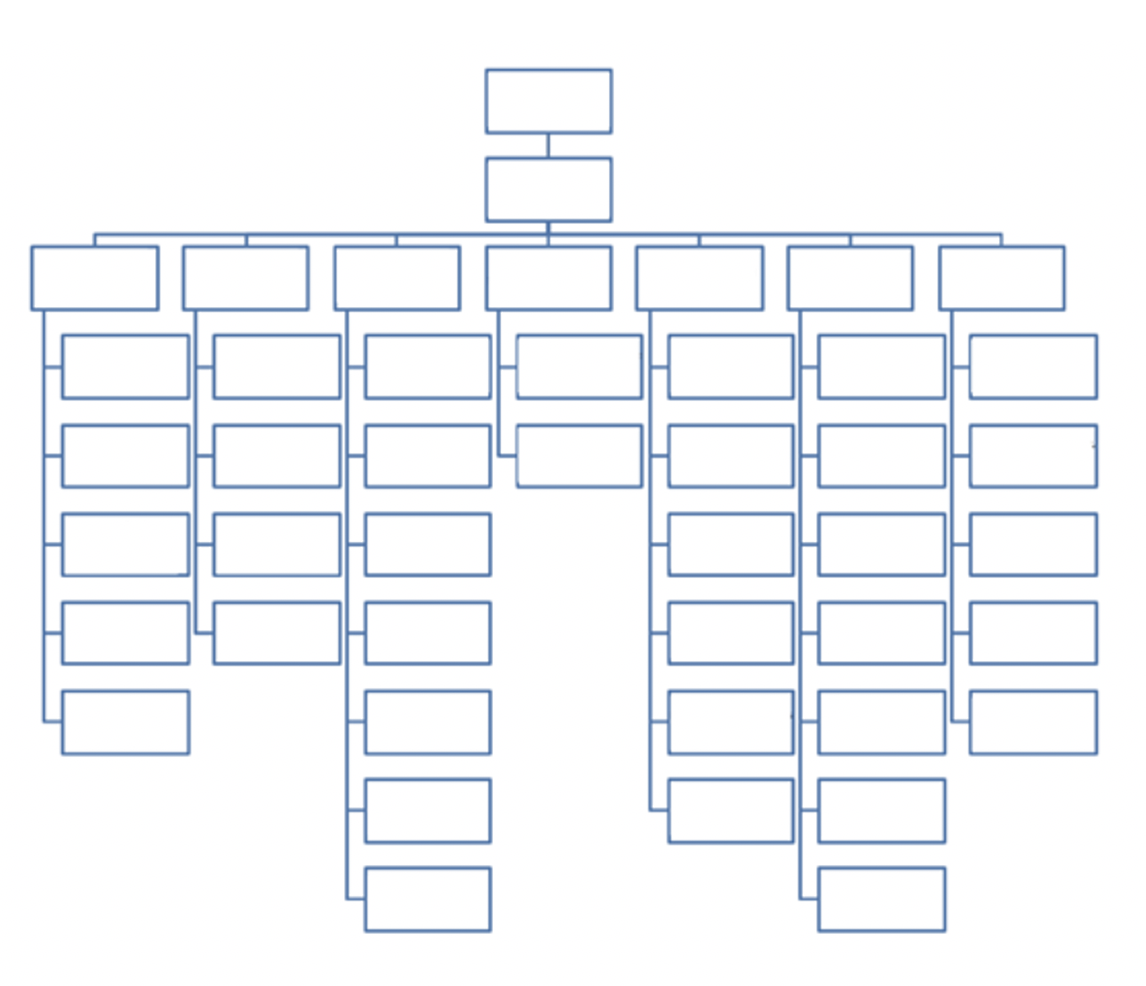
This has led me to appreciate a systems-based understanding of non-profit organizations.  This management understanding sees non-profit organizations, not as their formal org chart depicts, but rather as a mesh of interconnected relationships, behaviors, and collaborations.  I often would continue to re-imagine organizational structure in new experimental ways.

 Where to Start?

This type of re-evaluation is not new to the business and organizational specialists.  In August of 1964, Paul Baran, writing about communications networks for the RAND Corporation, outlined three types of communication structures, 1. Centralized, 2. Decentralized, and 3. Distributed.  This idea is appealing to me as a basis for re-envisioning a non-profit organization because it starts from the perspective of an intangible (communication) and not physicality. At this point in our experiments the longer we can stay in the conceptual the better.

In Henry Mintzberg’s “The Structuring of Organizations”, 1979, he outlines that one of the most fundamental aspects of organizational structure is how “tall” or “flat” the hierarchy is designed.  A tall leadership structure keeps decision making at a distance and relies on top-level leadership executives to create procedures and pass it down the structure as policy.  The flatter leadership structure attempts to keep the decision-making more collective, yet still maintains a top-level leadership structure.

In 2007, Brian Robertson, founder of Ternary Software, worked with his company team to present a decentralized management process in which decision-making and operations were distributed throughout the entire company team rather than flow down from an Executive Leadership team. In June 2015 Roberston wrote a book, Holacracy: The New Management System For A Rapidly Changing World.
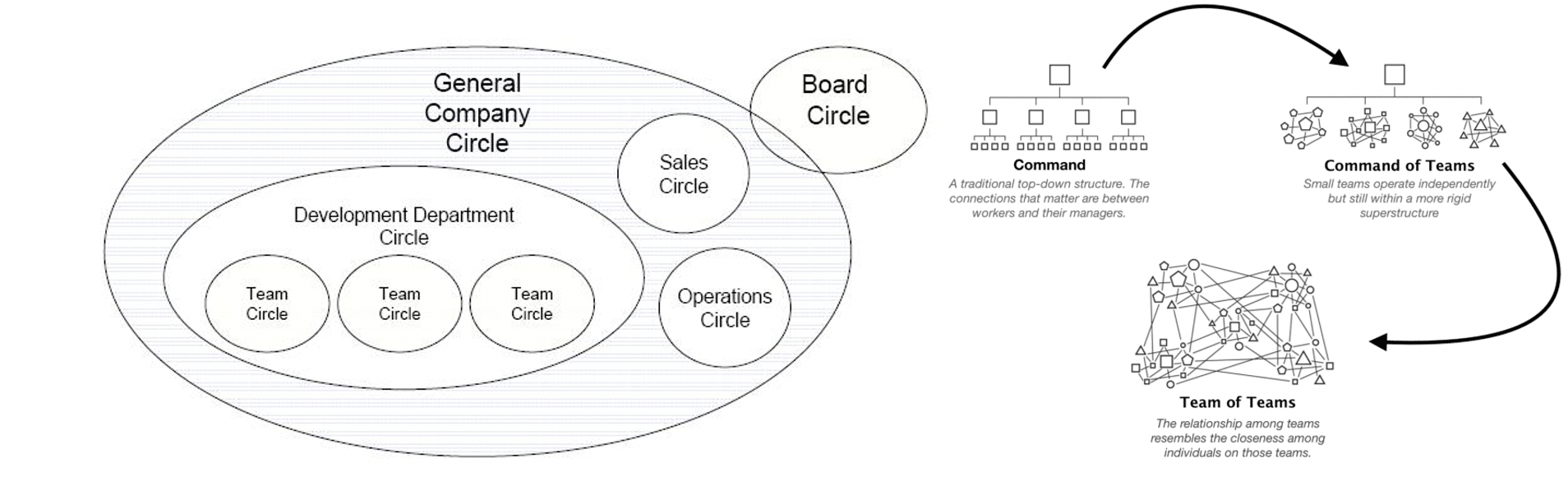
In 2015, 4-star General Stanley McChrystal, in his book Team of Teams: New Rules of Engagement For A Complex World, wrote of the need to re-envision an organizational structure that was nimble, fast-paced, and engaged a grass-roots communication path to allow for a more informed decision-making procedure.  He argues for a system of micro-teams acting together to form a macro- team. Photographs used for educational and non-commercial purposes only.

But, What About The Rest Of Us?

One thing to take note of is that all of these organizational models are products from the perspective of the cis-male dominant culture.  In 2015, Deborah A. O’Neil and Margaret M. Hopkins presented, “The Impact Of Gendered Organizational Systems On Women’s Career Advancement” and in this article, they outline that existing hierarchical systems promote a male form of aggressive, competitive behavior that, although not as overt a form of bias, produce a potent, latent system of bias against females.  I would add the same results appear for BIPOC, and the Queer Community through exclusionary and formal structures.  Even in the more “team” oriented governance structures there is inherent competition between the parts and suggests a lack of collaborative mentorship.

To many marginalized populations, these traditional organizational structures are seen as non-supportive of the needs of those employees & talents not having membership in the dominant culture. One of the reasons that we don’t find many women, BIPOC, Queer leaders at the top levels of our organizations is because the systems within which one has to operate are created in ways that promote one type of behavior (Individualistic & Centralized) over another (Collaborative & Decentralized).

Not only do organizational structures suppress mobility, they also act as a filter through which perceptions change. In The Leader-in-Social-Network Schema: Perceptions of Network Structure Affect Gendered Attributions of Charisma (2015), Raina A. Brands, Jochen I. Menges, and Martin Kilduff show that within the hierarchically structured organization the leadership trait of “charisma” is attributed to male leaders, However, when viewed from within a decentralized and collaboratively structured organization, women are perceived as holding greater “charisma” placing the male leaders at a disadvantage.

From a Queer perspective, the highly defined and classified, hierarchical organizational structure is fundamentally at odds with a more fluid and amorphous world view commonly understood by the queer community. Contrary to classical taxonomic cataloging and itemization of parts, most LGBTQ+  understand that absolute labels and categories hold within themselves bias and politics.  Highly formalized structures tend to suppress individuality and difference in favor of the collective.  In Julie Gedro and Robert C. Mizzi’s article, Feminist Theory and Queer Theory: Implications for HRD Research and Practice (2014), they suggest that normative organizational structures reinforce gender (male) and sexuality (Heterosexuality) privilege and that traditional models of leadership methods privilege some and significantly disenfranchise marginal populations in ways that negatively affect performance and success. This is where the visualization of the organization matters.

Evelyn R. Carter writes in , Restructure Your Organization To Actually Advance Racial Justice (2020), that it is not enough for a traditionally structured organization to simply acknowledge systemic bias and racism, the organizations must deconstruct the very methodologies that are used to train and advance employees. Carter suggests that employees feel a sense of belonging and commitment to the organization the more the leaders of the organization check in with them in an authentic manner.  BIPOC feel outside of the traditional hierarchical structure.  Traditional organizations lack connective tissue that binds the parts together in ways that value difference.  One example of this is the manner in which projects are assigned, managed, and communicated through a system of degrees that separate the creator from the leadership evaluating the project. This separation acts to suppress achievement and mobility within a system that is biased toward those who can satisfy the unconscious biases of the system.
Let’s Try This

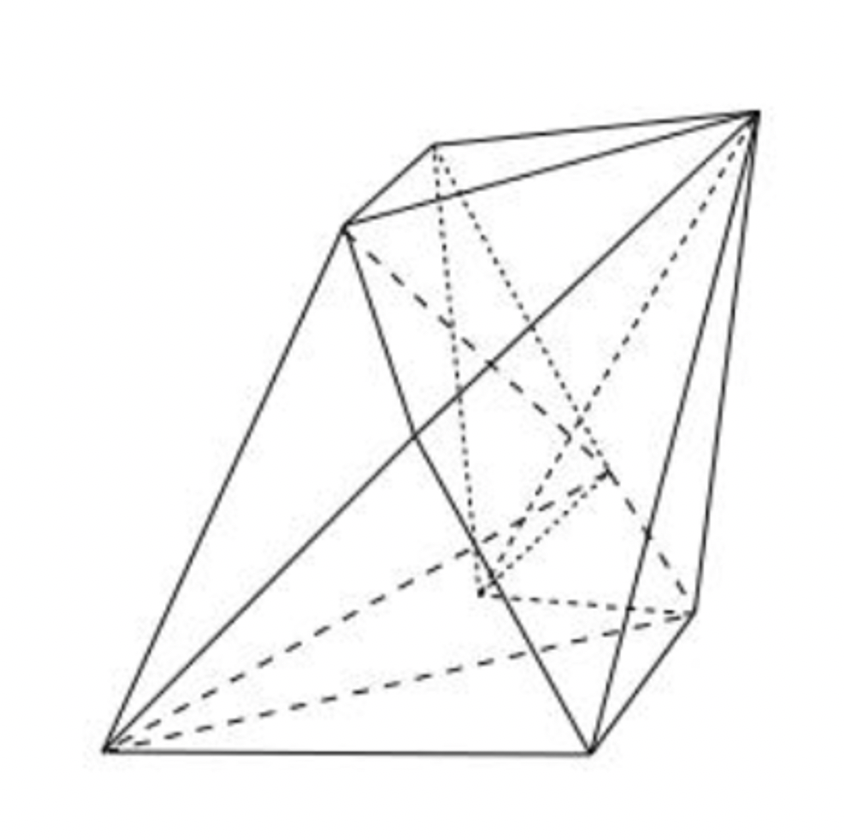
A nonrigid polyhedron may be “shaky” (infinitesimally movable) or flexible (continuously movable).”

Wells, D. The Penguin Dictionary of Curious and Interesting Geometry. London: Penguin, pp. 161-162, 1991. Photographs used for educational and non-commercial purposes only.

Due to my interest in new ways to visualize non-profit organizations, I have experienced several situations where my Supervisor/Board Chair would look at me as if I had just written in another language and told, “I don’t understand you or the way you think”. I learned to keep my visual experiments to myself as I started to realize that there was something about my understanding of the world around me that allowed me to visualize new structures in ways that were clearly off-putting to the dominant culture.  What seemed natural to me appeared to be a perversion of standard ways of thinking.

At this point I must beg for tolerance as now is when I ask you to take the great leap into considering two opposing concepts simultaneously. 1. A centralized mission, and 2. A decentralized organizational structure. I have a hard time imagining what such an organization would look like.  Being dyslexic I always explore these ideas through tactile kinetic learning experiences.  These two concepts began to co-exist in my mind as soon as I read about a Flexible Polyhedron.

In 1897, Bricard constructed several self-intersecting flexible octahedra (Cromwell 1997, p. 239). Connelly (1978) found the first example of a true flexible polyhedron, consisting of 18 triangular faces (Cromwell 1997, pp. 242-244). Mason discovered a 34-sided flexible polyhedron constructed by erecting a pyramid on each face of a cube adjoined square antiprism (Cromwell 1997). Kuiper and Deligne modified Connelly’s polyhedron to create a flexible polyhedron having 18 faces and 11 vertices (Cromwell 1997, p. 245), and Steffen found a flexible polyhedron with only 14 triangular faces and 9 vertices (shown above; Cromwell 1997, pp. 244-247; Mackenzie 1998). Maksimov (1995) proved that Steffen’s is the simplest possible flexible polyhedron composed of only triangles (Cromwell 1997, p. 245). Connelly et al. (1997) proved that a flexible polyhedron must keep its volume constant, confirming the so-called bellows conjecture (Mackenzie 1998).

Why does this matter in our discussion about experimenting with a new non-profit organizational visualization? If we see a non-profit a community formed of its interactions and behaviors, rather than by its hierarchical power structure, we can begin to imagine a far more complex way of noting in graphic form the structure and relationships between the parts.  The Flexible Polyhedron theoretically exists with solid, clearly defined surface shapes, but because of the way it is joined, it is infinitesimally movable and flexible.  Guess what? As a scientific theory, this strange 3-dimensional form has as one of its characteristics that it 1. Has a unified collective shape (purpose), while 2. Allowing for continuous changeability between those ridged parts (de-centralized individuality).  This odd little polyhedron might be just the thing to help us visualize a new form of non-profit organizational structure.
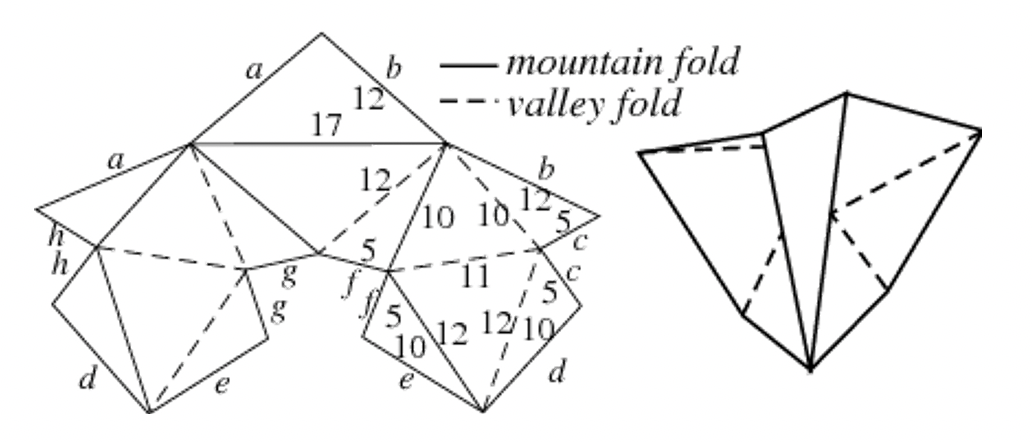
Taking this 3-dimensional idea and flattening it out into a 2-dimensional diagram we can begin to make direct comparisons to the traditional organizational chart.  By replacing the rectangular boxes of the traditional organizational chart with triangular surfaces of the polyhedron, and by replacing the singular lines of oversight from the standard organizational diagram with multiple, lose connections between all of the parts, we arrive at a single surface entity whose parts are all collaboratively connected in multiple and flexible ways. In this new experimental visualization, everyone is connected with everyone else in multiple and flexible ways. Since this new 2-dimensional visualization is also a 3-dimensional object, there is no up or down, no primary and secondary, no ultimate path of mobility.  All of the parts play a role in the central mission of the organization in unique relationships.

Ok, so now I am sure you think I am nuts.  I know that this is just an imaginary form created by mathematicians and has nothing to do with management or organizational structure. But – maybe it can be the unexpected creative catalyst that will allow us to finally break free of our traditional visualizations of non-profit structures and allow us the ability to imagine how our ideal non-profit organization might function. Imagine how concepts like Equity, Diversity, Pay Parity, Mission-centric, Policymaking, and Communications would exist within this new visualized structure of collaborative and flexible relationships.  These important issues are no longer the appendage to the larger structure, but now they are the connective tissue between each of the faces of the collective body (the folds of the 3-dimensional model). It becomes almost impossible to separate one item from the other.  It forces all of us and keeps us honest in our Equity, Inclusion, Diversity work.

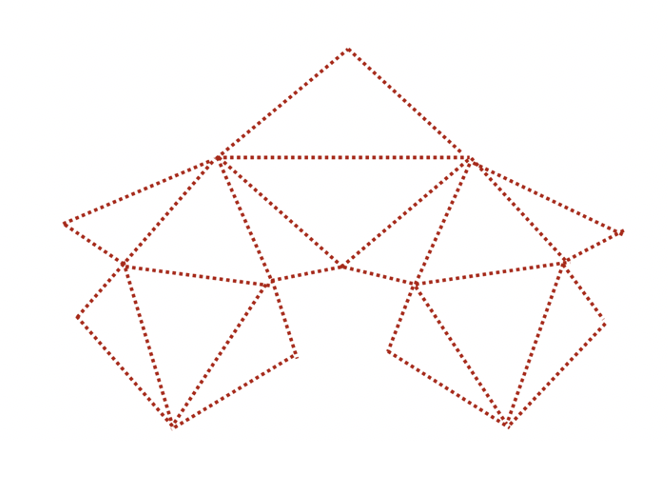
As an example, I have just taken an imaginary non-profit historic site organization and placed its traditional divisions and parts within this 3-dimensional system. Yes, it’s just a shape, but what it does allow is for us to be visually and mentally free from a system that keeps us bound by hierarchy, dominance, structure, and control.   How Might this look in actual use?  Let’s experiment.  Instituting new policies & procedures within an established, highly entrenched system is that the possibility for success is reduced because the system was not designed to accommodate flexibility.  The problem with new flexible behaviors is that certain forms of hierarchy and power must recede and become pliable in order for the system to move into a new set of relationships.
Now What?

How can this wonky 2-dimensional form be used to fuel a revolution in non-profit operations? I do believe one of the first steps in transforming our non-profit organizations is to be self-reflective and visualize them, both graphically and in terms of the policy as having different behaviors.  In addressing the systems within which we operate, biases and leveraged power dynamics can be reduced. In using a visualization such as the one example cited above, we might be able to re-envision the system to produce the types of interactions, and decision-making that is desired.  I am always open to new ideas from my colleagues!

Photographs used for educational and non-commercial purposes only.
One-night Stand: Burying the Lead

GETTING TO PASAQUAN
You don’t just happen upon Pasaquan Estate, the built environment created by the visionary St. E.O.M.  You really have to make a committed effort to get in a car and drive through the two-lane backroads of rural Georgia to find it.  I knew that Georgia consisted of miles and miles of pine barrens, and I, mistakenly, imagined them as quiet forests of tall pine trees, gently blowing in the breeze while growing out of a floor of soft, welcoming brown pine needles. Instead, while driving along the isolated road, I saw jagged loblolly pines in a dense and choppy landscape that looked, as I then surmised it felt, prickly and adversarial. This desolate area of Georgia has a history of being a land of escape, seclusion, and dissent. During the American Civil War, the pine barrens were a destination for wartime deserters and those trying to avoid the destruction of war.  I wondered what imagination must have been able to see this inhospitable landscape and envision a dreamscape. I sensed that this One Night Stand at Pasaquan would be unlike any others I had experienced.

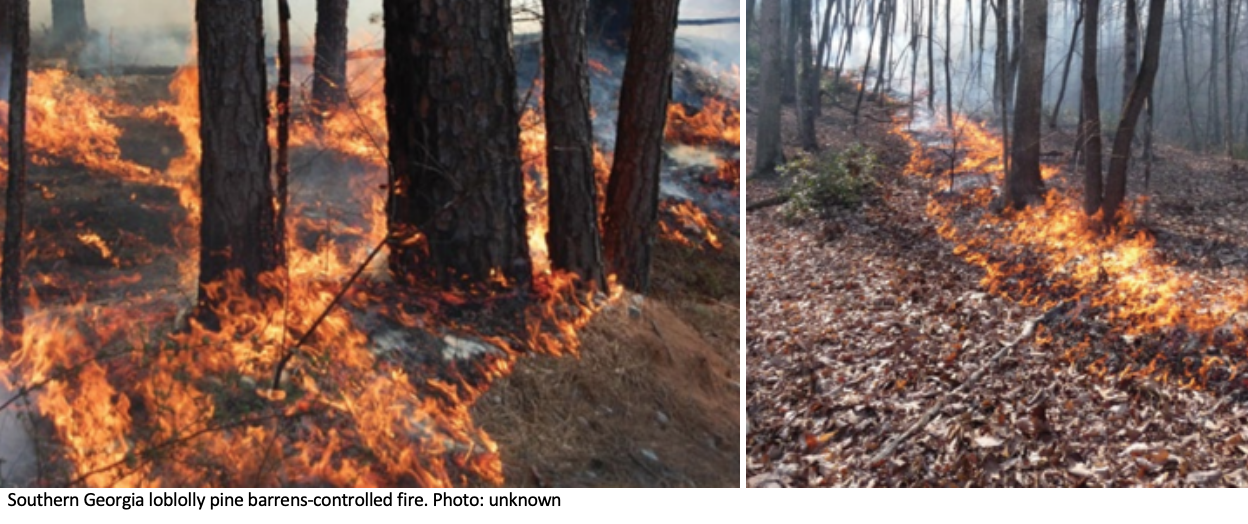
The landscape in February 2020 was composed mainly of browns and grays.  The weather was typical of a mild Georgia winter, and the green of the tall pines penetrated the blue sky, making the vista appear like the skyline of a dense city whose chimneys and church steeples floated above the mass of buildings below.  It was impossible to gain a long view as I stared into the pine forests. In fact, the lower levels were almost dusky because of the lack of light, giving the entire forest the appearance of a matted coat of hair on a dog. In areas, I could see vast acreage that had been selectively scorched.  The remaining landscape resembled the outline of a city that had been through a war.  Occasional burnt pine trees with no needles poked up through an undercover of completely charred shrubs and saplings.  I later learned that state and local governments often facilitate this type of controlled fire-induced underbrush clearing because it is the only way to protect pine barrens from unexpected vast forest fires. Although controlled burns bring about new growth, thus making the pine barrens attract and maintain wildlife and plant species, the initial results are a blackened, desolate landscape. As the Dadaist artist Picabia suggested, the only way to save something precious is seemingly to destroy it – transform it. In a way, one must re-make it into something else.  Remember that.

DESTINATION
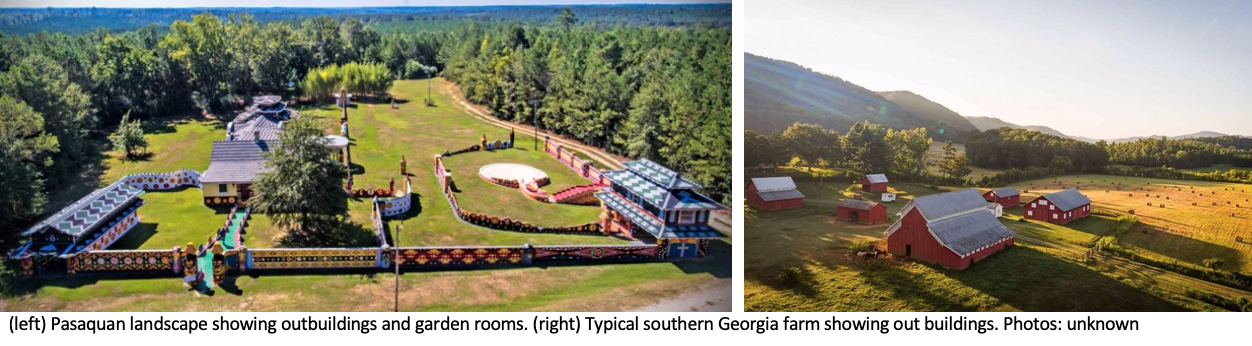
This bleak landscape is part of the compound that was once home to St. E.O.M, originally named Eddie Owen Martin (1908-1986). He was the charismatic visionary who designed and built the singular Pasaquan Estate. The crafting of his unique compound did not begin until 1957 when, after decades of travel, sex work, illegal activities, fortune-telling, underground life in NYC, and brief prison stints, St. E.O.M. left NYC and moved permanently to a Georgia farmhouse on four acres he had inherited from his mother.  He started building the walls of the estate in 1957 and continued the site’s creation up until his death in 1986. In its final form Pasaquan emerged as a 19-room expansive organism consisting of open-air and enclosed spaces. Much like a traditional rural Georgia farm with barns, outbuildings, and fenced off pastureland and crops, the built landscape of Pasaquan consists of outbuildings and fences, but instead of functioning as farm spaces, they are walls and platforms that define multiple theatrical stages, honorific stairways, processional pylon gateways, remote meditation studios, and a caretaker’s house.

Pasaquan was used by St. E.O.M. as the center of his fortune-telling business.  So well-known was his ability to tell the future that he often had multiple cars parked beyond his front yard, with drivers and passengers waiting their turn to get their fortunes told.  Visitors arrived unannounced, wanting to experience not only St. E.O.M. himself, but also the mystical grounds of the estate. In forming his own spiritual idea of “Pasaquoyanism,” St. E.O.M. combined a wide mixture of religious concepts and philosophies with aesthetic principles from across the world.   Separate from the site standing out as one of the most complete visionary landscapes in the United States, it, like a fortune teller, asks many more questions than it answers.

ARRIVAL
This landscape of endless pine trees made my arrival at St. E.O.M.’s Pasaquan all the more impactful.  After meandering down multiple miles of lonesome two-way roads, I suddenly came upon a vibrant, graphic sign.  With the exception of the new colorful sign and the high chain-link fence surrounding the complex, the entrance road has changed very little since St. E.O.M. lived at Pasaquan. It is still unpaved and framed by the pine barrens.  As I turned into the unpaved road, the tight vista of the pine forest opened up to a wide clearing.  In the middle of the clearing was a vividly present and intentful landscape. I can only describe it as shocking.  I had seen photos of the complex, but I assumed the photographers had used strong, highly saturated Instagram filters to produce the bright colors. No, those intense pictures were accurate.

Entering more fully into the clearing, I spotted the main landscape standing boldly to my right.  What I saw was a farmhouse peeking through the accretions of a vast, interconnected exterior wall system.   Bright colors, faces, mandala, genitalia, and shapes of all types sang and danced in a constant opera of storytelling.  My questions began as soon as I opened the door of the car, and they are still with me today as I sit in my little office and write this. The colorful orgy of built form rebelliously mocked the pine barrens that surrounded it.  The dull green and brown trees of the shadowy backdrop seemed to withdraw, like homely spectators at a dance, and understand that they were in the presence of an impenetrable avant-guard spectacle.

There was no mistaking where to park and where the front entrance was located.  Everything about the built landscape led me to the massive androgynous spiritual guardians of the complex. These pillars are decorated with two-dimensional imagery of beaded, tattooed warriors wearing headdresses that culminated in a fiery flame poking towards the sky.   Often confronted with large numbers of unscheduled visitors, St E.O.M. himself placed signs by this front entrance giving visitors clear instructions on what was expected of them: “Beware of bad dogs. Please blow horn and stay in car until I come out” or “Blow horn….”  After a bit of a wait, visitors would be met by St. E.O.M. standing between these pillars, greeting them in one of his colorful bespoke garments and beads, with hands in prayer.  St. E.O.M. clearly understood the importance of an impactful arrival, the symbolic strength of initial impressions, and the power of keeping people guessing.

The site was exactly as I had expected and not at all what I imagined.   I was greeted at the gate by Pasaquan’s Caretaker, Charles Fowler, who was appropriately accessorized with a St. E.O.M. beaded necklace and bright red-frame glasses.  Quiet and thoughtful, Charles started to walk me around and give me the background of the site. We explored and walked from garden room to garden room.  Each space seemed to have a different set of symbolic definitions and boundaries – oddly discordant but still related. I had numerous questions; I won’t lie. I wanted to understand the site, and initially I wasn’t having an easy time of it.  The more answers I got from Charles, the deeper the riddles became. Things were only getting “curiouser and curiouser.”  I asked to see a site plan, in hopes that I could better understand the bones of Pasaquan. No such luck.

Since I was here for a One Night Stand overnight stay, I decided to unpack my bags in the visitor greeting room.  There were two daybeds that visitors had once sat upon while they spoke to St. E.O.M. and heard him tell their fortunes.  Occasionally these beds would be the place visitors slept. I changed into more comfortable clothes and started to walk around the oozing house. As I roamed, I finally began to find some answers. 

THE MAIN HOUSE
The main house at Pasaquan had very ordinary beginnings.  Originally the landscape held only a small, typical four-room Southern farmhouse (c. 1885) with a large open porch and central fireplace.  It had a shed addition at the back comprised of two small rooms bisected by an open-air passthrough.  Both the house morphology and the evolution of the rear shed addition correspond to other 19th-century Georgia farmhouse designs (see examples below). In fact, although greatly modified, today the now yellow house is clearly visible as the seminal generator of the built landscape surrounding it.

St E.O.M.’s mother secretly saved money for years so that she could buy the house and 100-acre property.  It represented freedom and protection–freedom from her life as a housewife and protection from an abusive husband. The core of this little house served as the emotional, architectural, and germinating cocoon for the Pasaquan one sees today.  I tried to imagine the mind that could see the simple farmhouse and create a landscape swirling around it of such different character and personality. The original house and the site today seem not from the same world.  The “Re-garmenting” of this little farmhouse into Pasaquan could have been facilitated only by someone who understood deeply and personally how exteriors may not always reflect the true essence of identity. The true meaning of our existence can be found through honoring the power of that which is not seen.  Beyond merely eccentric, St E.O.M. was in constant motion, questioning the solidity, accuracy, validity, and genitalia of all that he experienced and was told to be true.    This is Pasaquan.

 THE EDUCATION OF EDDIE
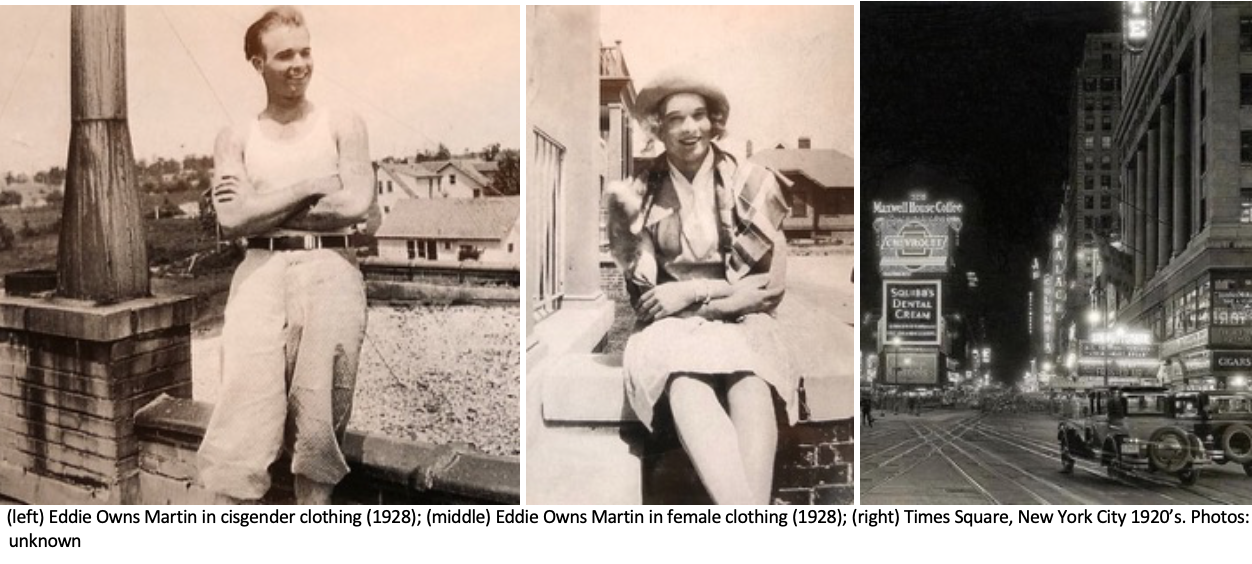
Like many of us, St. E.O.M. spent his 20’s experimenting and searching for himself, attempting to contextualize himself within the world.   Running away from his abusive father and rural Georgia lifestyle, he eventually moved to New York City in 1923 as a teenager and lived the life of a street hustler, drag queen/cross dresser, illicit gambler, and enthusiastic frequenter of a myriad of nightclubs.  The complexity of this life in NYC was explained by St. E.O.M. himself,

“For a while after I got to New York I was confused in my mind ‘bout whether I should be on the gay side or on the other side, and I had that complex about this manliness stuff they try to lay on you in this society….But I got over those complexes later, when I decided it was really just a matter of getting’ experience and knowin’ people and knowin’ things.” 

SEX, HUSTLING, CRUISING, AND DRAG

Between 1923 and 1957 St. E.O.M lived intermittently in New York City. During this time he jumped from apartment to apartment. Many times his location was determined by a lover or a pick-up’s kindness.  Some of the time, starting in the early 1940’s, he lived on West 52nd Street (aka Hell’s Kitchen), above the jazz club The Famous Door. From his home he could hear Count Basie “swingin’” all night.  This area of NYC was considered the heart of jazz and nightlife. During the 1930s and 1940s, West 52nd Street was called “Swing Street.”  It began as a series of speakeasies and then jazz clubs, which eventually gave way to burlesque houses.  At its height the area held sixteen jazz clubs in two blocks. The West Side in the 1950’s was still full of shipping yards and docks with warehouses and commercial establishments mixed with residential upstairs. And all of this was only a few blocks from Times Square. Clearly, St. E.O.M.’s life education was occurring in a classroom of complexity, vibrancy, sound, dance, and crowds.  His world consisted of high art, base sexual desire, and capitalism joined onto one messy sidewalk.

The early period of St. E.O.M’s life in NYC is a period later described as the “Pansy Craze.” Pockets of the city like Greenwich Village, Times Square, Union Square, and Harlem contained nightclubs, theaters, drag shows, drag balls, and gay street hustlers.  This was the world within which St. E.O.M. matured. I can only imagine how this atmosphere helped shape his aesthetic and environmental view.  His was a world of theatrics and unbounded possibility.  The boundaries of sexuality and gender became fluid, and the manifestation of these ideas in the physical material world could be altered to present whatever image he desired.  The original quality of a situation did not dictate the end result. Either for survival or as playful possibility, the power of imagination could re-define any situation.

So formative was this period in St. E.O.M.’s life, that once he returned to his mother’s farm in 1957 and began creating his masterpiece, he designated a wall of honor to it at Pasaquan.  Placed directly in the entrance courtyard for everyone to see, he crafted hand-drawn, incised portraits of “Drag Queen Warriors.”  Each face was dedicated to a particular friend from his time as a hustler and drag queen in NYC.  This powerful tribute illustrates a past life full of androgynous, multi-ethnic, bejeweled identities – gallantly defending a world of choice against a culture of suppression and absolutes. One can imagine the crafted, layered meanings and costuming that sliced through, segmented, and re-defined this world of alleyway sex, peep shows, pageants, and balls.  I suspect that if we begin to look at Pasaquan as an extension of NYC’s 1920-1930’s drag and jazz culture, filled with gender-bending, honorific pageantry, voluptuous clothing, sensuous interpretive jazz, and flamboyant theatrics, we can see how Pasaquan fits clearly within this microcosm of counter-normative, sexually fluid urbanity.  He simply brought it all back to the pine barrens of rural Georgia.

GENITALIA
When I was walking through the Pasaquoyan landscape, the built form and imagery were repeatedly asking me questions. It feels as if the literalness of the physical world is playing a trick on you by recombining in such a way to produce another message entirely.  The domestic environment looks like things you know and understand–a fence, a house, a door–yet how they are combined, resurfaced, colored, and shaped is askew and inverted.  Similarity flows into differences, which then flow into the unique.  Recurring themes thread throughout the landscape and house.
One of the most asked questions at Pasaquan has to do with gender and its relationship to genitalia.  Myriads of penises are depicted in the Pasaquan built environment.  They are of all sizes and shapes.  The human forms from which the penises extend seem more like background noise.  Each is decorated individually with varying colors and shapes that extend into the surrounding circle mandala medallions and eventually become part of the larger Pasaquan wall system and overall landscape. At times they alternate between female bodies and genitalia, as if to say the sexes are interchangeable – or possibly that they don’t matter at all – or yet, on the other hand, may be the most important thing above all else.

Long before “gender fluidity” was acknowledged, and on the heels of the widely read Kinsey Reports, (Sexual Behavior in the Human Male [1948] and Sexual Behavior in the Human Female [1953]), St. E.O.M. seemed to be manifesting the very concept of sexual fluidity in built form.  In interviews he makes it clear that in his hustling days, he could just as easily have had sex with a woman as with a man, as long as he was aroused by the individual.  He seems to have held a very sex-positive approach to intimate relationships.  It is interesting to note that a large portion of Kinsey’s subjects were pulled from the Times Square area of NYC, and it is not unreasonable to imagine St. E.O.M. as a part of that experimental study population.

In St. E.O.M.’s early NYC hustling days, sex was a commodity. There was no moral judgment placed on the act. Time was money, and he attributed his psychic ability, in part, to being able to assess men he would see on the streets: “ I was always lookin’ for eyes, to search people out that wanted me…But I would know they was out for somethin’. I could tell by the way they looked at me.  That’s when I started learnin’ to be psychic.”
After viewing Pasaquan initially, I found myself standing in front of a large site plan of the Kohler-facilitated restoration work that took place at Pasaquan.  I kept blinking my eyes, re-focusing, and then walked farther away from the drawing.  To my eyes, St. E.O.M. didn’t just decorate Pasaquan with sculptures of penises – Pasaquan was a penis. In fact, in speaking to friends who often visited Pasaquan during St. E.O.M.’s lifetime, I learned that the front drive entranceway meadow was often, with the use of a lawn mower, shaped into the form of a large penis.  The road that visitors arrived upon, unknown to the guests, morphed right into the penis shape.  The tall grass meadow surrounding the mown phallus disguised the symbolic gesture. In hindsight, one friend jokingly noted that St. E.O.M.’s audience for this phallic landscape, instead of being actual visitors seeking fortune telling, might have been all the military men flying in and out of Fort Benning looking down from the sky. Today, in studying at the site plan and subsequently walking around, I envisioned how many of the outbuildings resemble the interaction of egg and sperm. The shape of the built environment evolved from that inherited simple farmhouse into a large multi- penis-shaped complex. St. E.O.M. was experimenting with gender fluid, sexual macro-symbolism.


HAIR
In addition to phallic representation, one of the most noticeable physical features of the faces, pylons, and symbolic imagery of Pasaquan is hair and how it is illustrated. These forms show vertical, tall, pointed hairdos that draw the faces and bodies upward to the sky.  St. E.O.M. describes the importance of hair and the forming of it as a fundamental aspect of his religious concept of Pasaquoyanism.  From his study of ancient civilizations, St. E.O.M. deciphered that uncut hair held spiritual power.  Hair could become a receptor for spiritual feelings and truth, if it was knotted, tied, and swept upward in a vertical manner.  He describes an instance of particular importance:

So, I looked at the ancient art in museums, and I got holt of this book on Mayan art called the Kingsborough Edition, where some Englishman copied all these inscriptions and hieroglyphics. And in that book, it shows this God Quetzalcoatl sitten’ with his legs crossed and his hair all bound up, and this thing stickin’ out of it, and he’s got his finger pointin’ at his hair, like this.  And when I saw that, I said to myself, “well that’s a message there It’s tellin’ you somethin’ ‘bout the hair…the hair up in these designs was just like lines of trees, ‘cause if you keep pullin’ ‘em up, they’ll stand up.”

The particular book he “got holt of” appears to be the 1830-1831 six-volume Antiquities of Mexico (a facsimile of an original Mexican painting is housed at the Royal Library at Dresden).  Although there are many illustrations that could substantiate St. E.O.M.’s explanation of the origins of the Pasaquoyan up-hair symbolism, I was able to locate one that, conjecturally at least, seems to be the type of image that he describes.

This was the moment that I started to “get” Pasaquan. It was several things simultaneously.  It was both a dwelling and a symbolic landscape.  It was both a place to live everyday life, as well as a theatrical, sexually charged setting for a spiritual drag ball of one. The walls, genitalia, hair, and symbolism were created out of his need to transform the pine barrens of Georgia into Webster Hall of New York City.  Genitalia, both male and female, as audience and spectators with faces and hair all centered on St. E.O.M.

 THE HEART OF PASAQUAN
One can easily get lost in the individual details of Pasaquan–such as the depiction and symbolism of genitalia or hair–but I wondered what, ultimately, was really the heart of Pasaquan? Of course, it was St. E.O.M. himself.  But how did he define himself when no one else was there?  When he didn’t have an audience or a fortune to tell?  As I moved deeper into this One-night Stand, experiencing the house and landscape, I wondered what it was like for the man to live there.  As I settled into the evening and made my bed, I found myself wondering where he had slept. In his most private moments, how did he define his inner world?  I discovered that these questions could only be answered in the bathroom.  More specifically, the answers were suggested by a basic, unadorned, white-painted wooden corner cabinet in the bathroom.

Throughout St. E.O.M.’s time living in NYC, he would regularly travel back to Georgia to assist his mother in harvesting the crops on the farm.  According to an interview conducted with a St. E.O.M. family member, his bedroom always remained in the shed-roofed addition on the back of the farmhouse. Although he may have moved into different rooms within this shed addition, he resided in this section of the house throughout his life.  Even after he moved back to Georgia permanently in 1955 after his mother died, he continued sleeping in the same space as he had done a decade before.

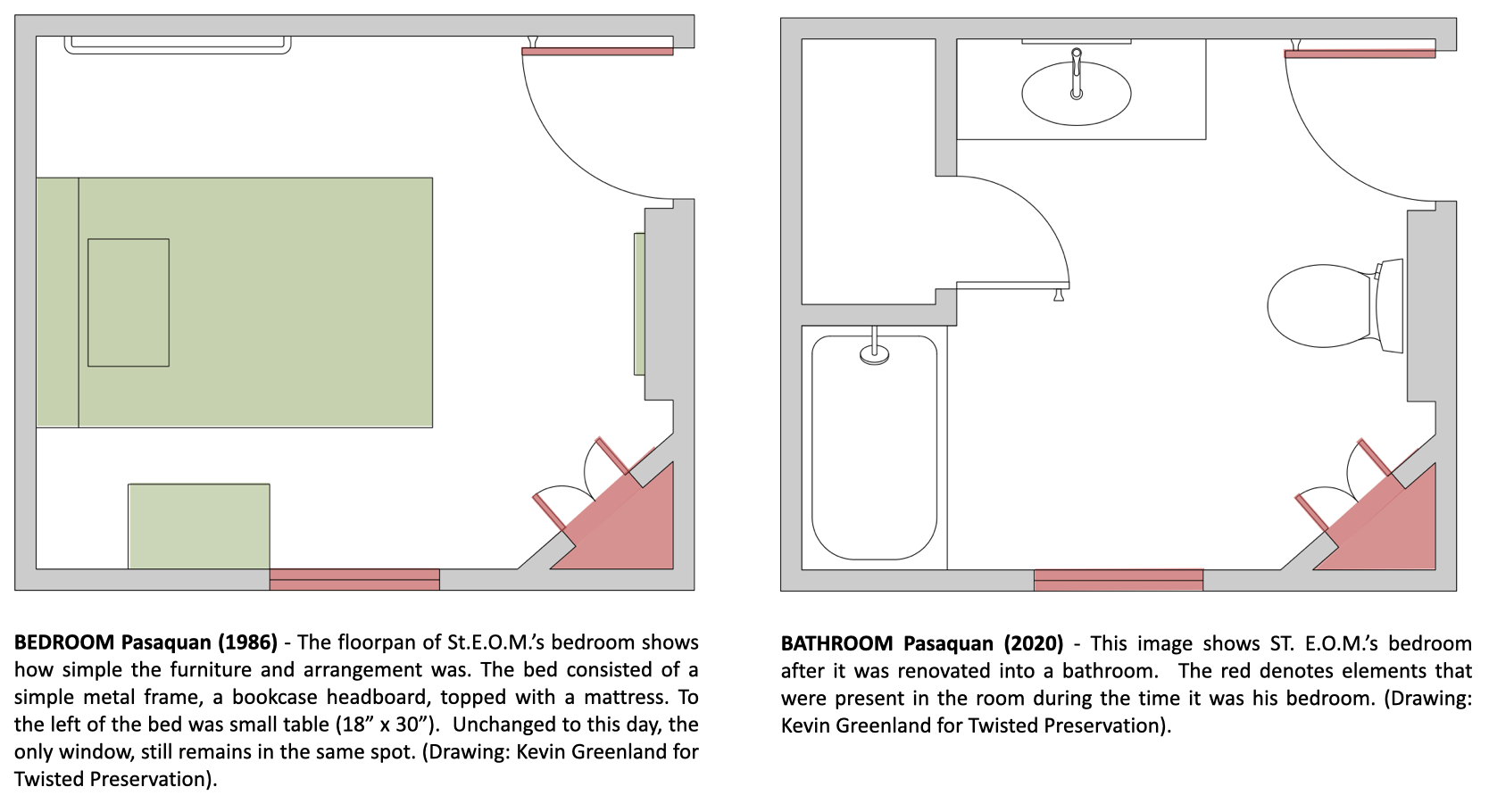
There are no photographs of his bedroom – he was very private about this room.  Locating his long-term bedroom on a floor plan results in some startling revelations.  His former bedroom has now been turned into the Pasaquan bathroom.  It contains a toilet, shower, and sink within a space that before was empty of built-in appliances and furnishings, except for the small wooden cabinet in the southwest corner of the room.

Once, when exiting the shower in the room that had previously been St. E.O.M.’s bedroom, I noticed the nondescript corner cabinet and opened it.  I optimistically thought that it would contain some meaningful relic display or important artifacts.  It did not.  It held basic bathroom articles such as toilet paper, hand towels, soap, etc.  I wrongly assumed that its functional use connoted an immaterial existence.  I closed the door and didn’t give the cabinet another thought.  It wasn’t until later that I learned the bathroom was, in fact, St. E.O.M.’s bedroom for the entire time he lived at Pasaquan, and the cabinet was the only remaining element in the room from its time as his bedroom. The cabinet was the clue in helping me understand Pasaquan as a home, and it allowed me to more closely investigate the room that used to be St. E.O.M.’s bedroom.


The bedroom as St. E.O.M. occupied it was tiny, almost square.  It had only one small window facing south with the built-in corner cabinet.  The only decoration in the room was the window surround; it was painted with an abstract multi-colored design.  The rest of the room was painted white and had a polished linoleum tile floor.  Descriptions of the room’s furnishings during the time he lived there suggest an uncharacteristically sparse decoration scheme.  The furniture arrangement was simple with the bed resting on an unobtrusive minimal metal floor frame with an attached bookcase headboard, and nearby stood a small rectangular side table. The corner cabinet I found in the bathroom existed much as it does today, serving as a spot for functional everyday items.  Interviews suggest that the corner cabinet was filled with fabric and bedlinens – nothing unusual. Overall, the room’s almost monastic-like simplicity would have stood  in stark contrast to the rest of colorful Pasaquan.


The white walls were bare except for one painting.  The painting, produced during 1938 in his apartment on West 52nd St. while he was residing above the Famous Door Jazz Club, was a self-portrait of St. E.O.M. as a child walking down Main Street in his hometown of Glen Alta, Georgia.  In the upper right is the country store and in the bottom left is the small train station.  Eddie Owens Martin painted himself walking, detached and separated from everyone.  He seems to skim through a small opening between the train station on one side and a moving horse-drawn wagon pulling a bale of cotton on the other.  This painting represents a beginning, a middle, and an end.

The placement of the little boy, either symbolic or accidental, shows him at the center of a moving hub of activity.  One direction would take him out of rural Georgia and perhaps to New York City and his activated life as a gay man.  The other would most likely return him to his upbringing: back to the agricultural sharecropping life of his family.  There he is, stationed in the center of this motion.  It is almost as if he is documenting his moment of choice – should he stay in Georgia, or should he take the train to an unknown world outside of Glen Alta?  Today we call this type of image a memory painting.  In 1938, Eddie Owens Martin, then 30 years old, painted the image while living in New York City. He had already hopped the train to an expansive future – he was living the dream of that little boy walking down Main Street.  The simple environment of the small-town contrasts with his new life of neon, celebratory Drag Balls and Jazz Clubs in New York City.


Just a few feet right of the corner cabinet is the only window in the bedroom.  The singular decoration in the entire room exists on the window trim.  It still exists today in the renovated bathroom.  The trim is painted a red base color with hand-painted black undulating dual lines.  The wood windowsill has been shaped and sculpted to reflect the same undulation as the painted trim.  This window must have held a special place in St. E.O.M.’s mind.

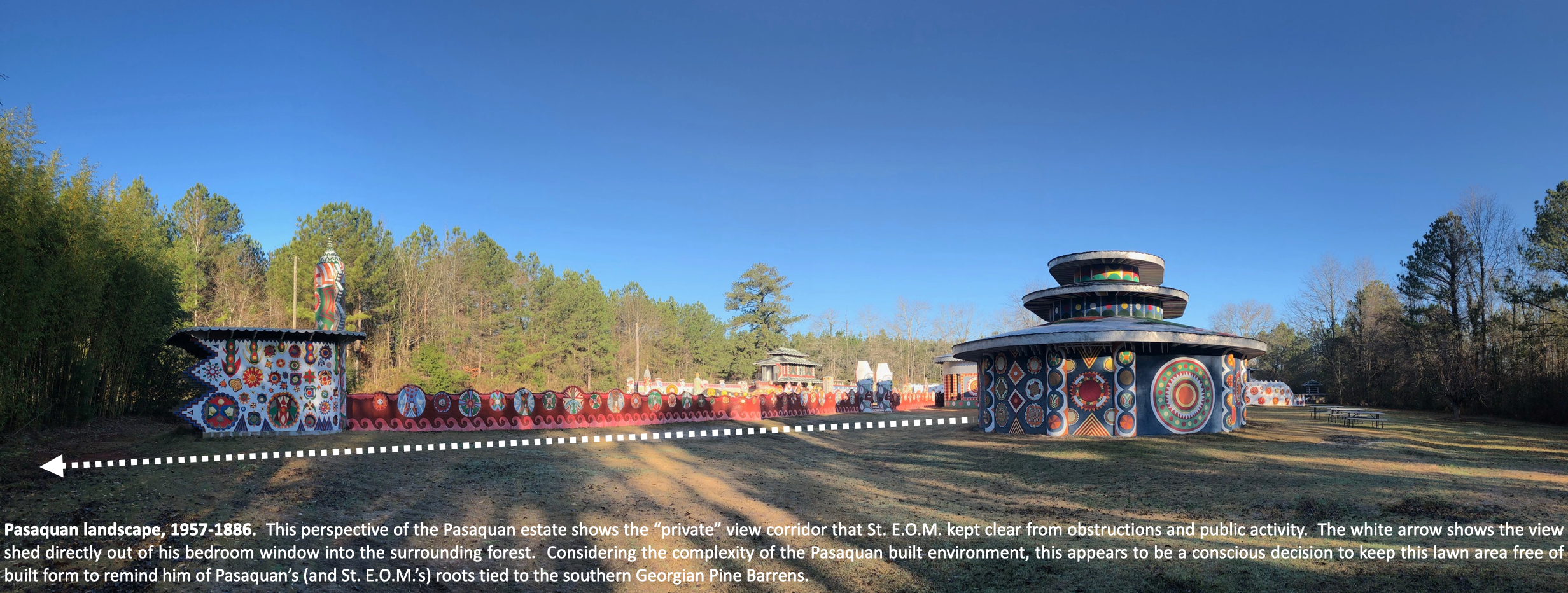
From the bed looking through the window, the outside landscape was easily visible. The vista consisted of a long-range view across the grassy lawn into the forest.  It was protected from the public’s gaze on one side by the sanctuary wing of the house itself and on the other side by a long, decorated barrier wall.  A closer look at the site plan of Pasaquan reveals that St. E.O.M. was consciously careful not to infringe on this view, which included the shed out of his bedroom window.  The walls of the sanctuary wing respectfully remain subservient to this private landscape space by pushing what should have been an architecturally centered massing off-center.  The importance of this should not be minimized.  It seems a clear design directive to maintain the original built form of the farmhouse bedroom window as an important symbolic fragment of St. E.O.M.’s past. What remained primary in the entire generative process of Pasaquan was a single, tiny window that was set into a wall enclosing a tiny room on a back-shed addition to a Georgia farmhouse.

I can imagine St. E.O.M. spending much of his time alone in his bedroom. He often spoke of having spiritual visions that directed his artistic production while sleeping alone in his bedroom.  I see him either viewing the long vista out the small window, or instead, looking forward to the wall in front of him at the painting of his hometown showing the train station that took him out of Glen Alta.  I sensed that the room allowed him to retreat within himself and exclude the outside world of visitors and fortune telling.

 Could it be that everything which surrounded the simple bedroom was the protective layer that garmented St. E.O.M.’s internal world? All the landscape walls, theatrics, color, and symbolism served to keep people at a distance, both figuratively as well as literally.  Surrounded by the painting of his hometown, and a single long vista reaching out into his past, this space must have felt the most emotionally raw of all of Pasaquan.


At the end of his life, he sat in the kitchen, wrote a letter to his friends, left it on the kitchen table, walked to his bedroom, and shut the door. Surrounded by his masterwork of Pasaquan, he chose part of the original farmhouse – his un-decorated, simple bedroom as the safest and most uncluttered spot in which to take his own life. Given the spare clarity of the room, St. EOM’s final thoughts could have been focused either on his painting or the view out the window. His letter left on the kitchen table explained, “Nobody is to blame but me and my past”.

 Maybe these are the last questions St. E.O.M. was trying to share.  What is the past? How does it shape our actions today – our choices? We just need to answer them for ourselves.

THE END
Pasaquan is the shiny object floating in a sea of brown and grey.  On the one hand, the reason you are drawn to visit the site is its fabulousness: the color and eccentric environmental experiences that come from walking the many garden rooms and meditation sanctuaries. However, once that surface excitement settles, you can either go away, content with the other worldliness of the environment, or you can stick around and ask deeper questions and listen to the poetry. The truth is, if you stick around you get a bit melancholy – and you don’t know why exactly.

After a while, Pasaquan begins to feel like a sad memoir.  It is the life story of a person who lived deeply, fully, made mistakes, and kept the results of that life accessorized by colorful paint, bespoke costumes, and resplendent, shiny metal tiles. Just like one of the warrior drag queens, Pasaquan is layered in make-up and sculpture in an onion-like expression of architecture, landscape walls, and spaces.

Ultimately, at the core of this complex, is a tiny undecorated room with one small window.  When all the costumes were off, the visitors had left, and the fortune-telling was complete, St. E.O.M. retreated into the simplest of Pasaquan’s environments.  Lying in bed, he simply looked onto the wall opposite his bed and could see his hometown illustrated in one of his own paintings.  He painted himself as a child in the middle of this painting, as if to remind the fabricated personae of St. E.O.M. of his roots, where he came from, and what created Pasaquan.

Understanding Pasaquan from this perspective pulls us into the darker niches of its creator’s narrative.  Everything here is not full of sunlight and beauty.  There are real corners of silence just off to the side of blinding rays of brilliance.  Pasaquan is several things at the same time. It makes perfect sense that the historic site takes on an emotional fluidity that speaks to a life fully lived. From giving blowjobs to men in dark alleyways of New York City to telling fortunes as the center of Pasaquan, St. E.O.M. was many things.

As a queer person I understand this code switching and the need to be whatever those around need us to be.  For many of us, we will always be that little boy in the middle of the painting, walking through Main Street worried about who and what will happen next.  For people like St. E.O.M. and me, we never really see a place for ourselves in this world – we must create it ourselves.  Out of the discarded and thrown away debris of others, we can make a marvelously special world of color, materials, and theatrics.  Not all of you will understand this, but the concept of “drag” is a medicine that saves lives. It builds a defense around that little boy so that he can walk through a life of pain and suffering and still stand in power, substance, and control.

Visiting Pasaquan gave me a moment of understanding–of myself, my jewelry, bracelets, and silk scarves. All of us, in our own way, must find our own Pasaquan in a sea of browns and grey.

Special Thank You Goes To:

Dale Couch – Review
Ruthie Dibble – Review
Charles Flowler – Caretaker at Pasaquan
Fred & Cathy Fussel – Review
Kevin Greenland – Architectural Drawing
June Lucas – Editor
Annie Moye – Chair of Pasaquan Board of Trustees
Tom Patterson – Author
Jon Prown – Review
John Yeagley – Research & Logistics

Systemic Bias & Racism of Preservation

Who Told Us That History Is Dead? It’s Very Much Alive, In Our Faces, and We Don’t Like It.

As someone who has been privileged to help run history & preservation organizations for the last 30 years, I feel compelled to call out, from my limited experience,  what I see as not only my own, but external institutional bias, racism in the preservation field.

Please don’t respond defending preservation or historic districting, or Main Street Preservation Projects etc.  I know there are good things about the field – but these have come later in its life and are exceptions rather than the underlying structure to the effort.

  1. Preservation is essentially an elitist, class and racially divisive activity whose result is a form of economic bias and segregation.
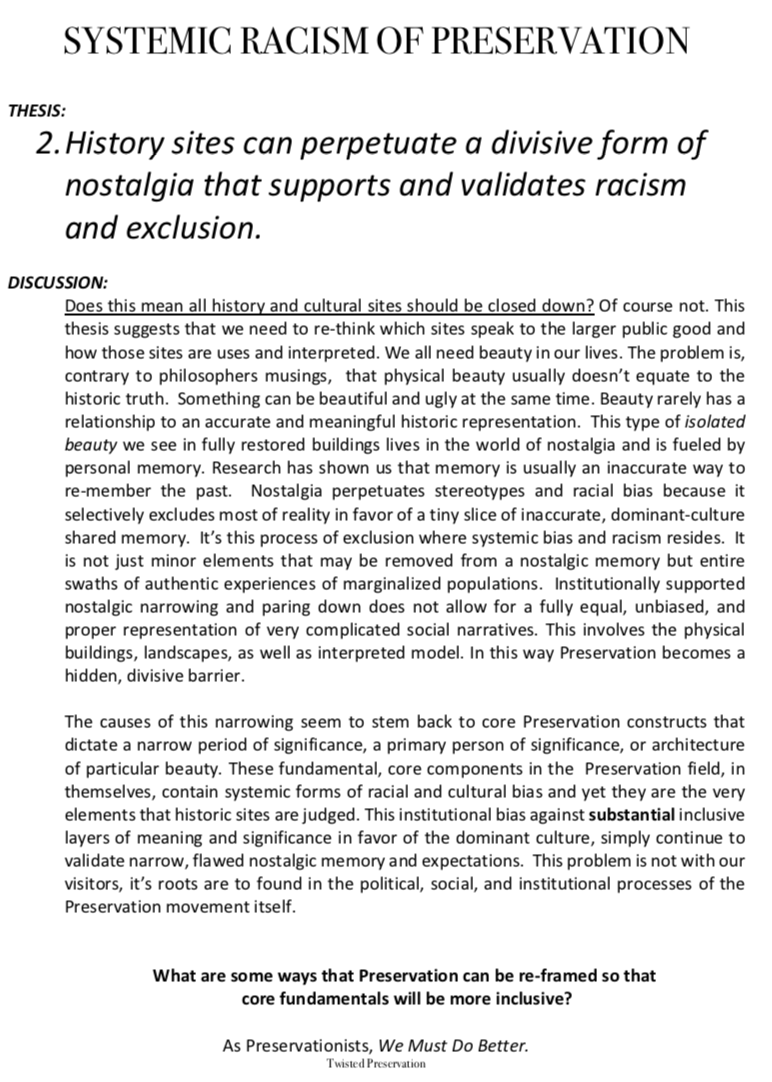
  2. History sites can perpetuate a divisive form of nostalgia that supports and validates racism and exclusion.
  3. Preservation can limit inclusion and perpetuate racial & social bias by regulating cultural narratives to simple themes.
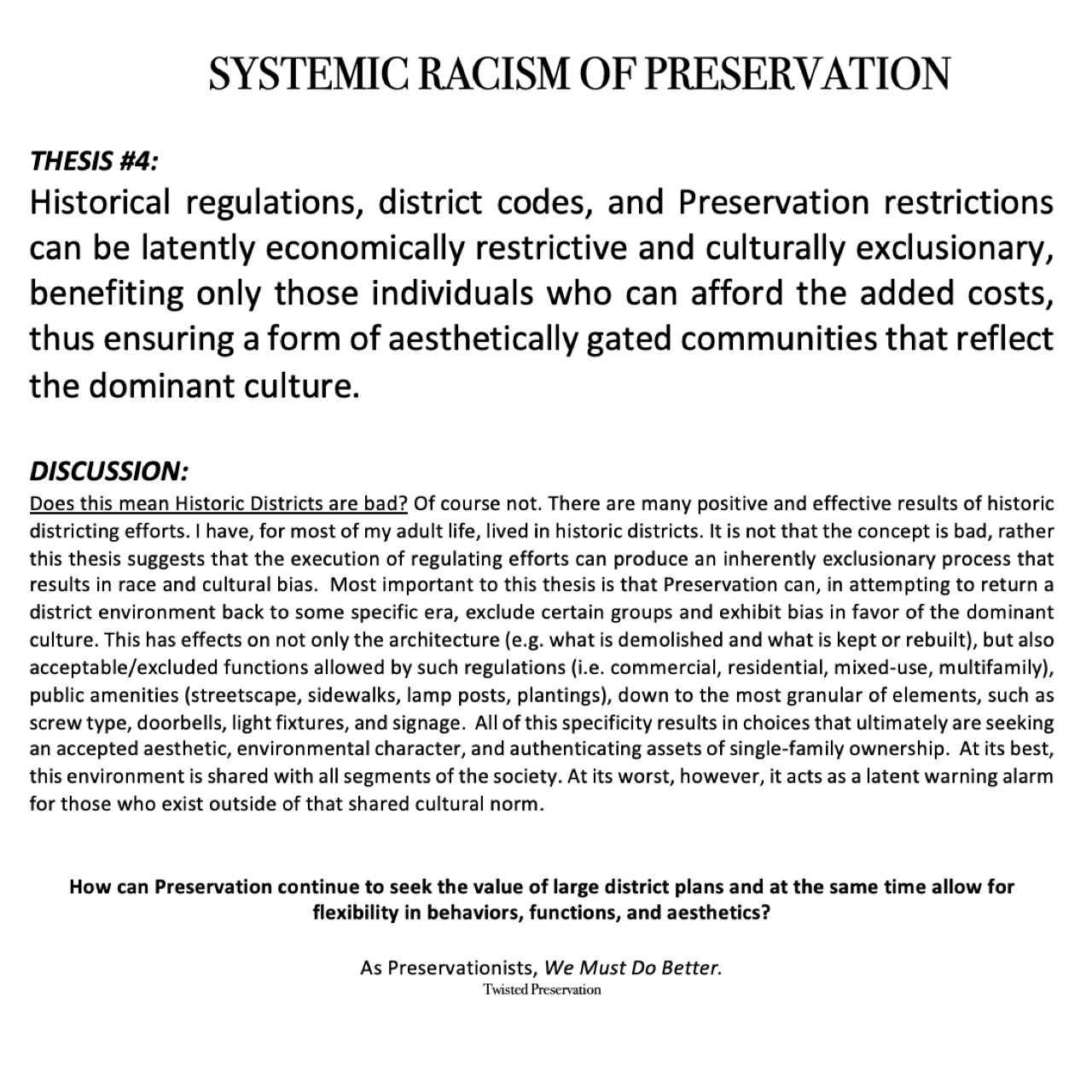
  4. Historical regulations, district codes, and Preservation restrictions can be latently economically restrictive and culturally exclusionary, benefiting only those individuals who can afford the added costs, thus ensuring a form of aesthetically gated communities that reflect the dominant culture.
  5. Historic districting and preservation code requirements can be a contemporary form of “redlining” which excludes a diverse economic group of people from land ownership.
  6. Preservation is susceptible to the harshest form of capitalism in that only those historic sites that are targeted with money actually get preserved.  Preservation choices are a matter of economics, not just history. The most revealing, unglamorous sites have rarely survived, nor have they been preserved.
  7. As Preservation has become more professionalized and can require a four-year degree, college has become more expensive and thus constricts the possibility of a racially, culturally, and economically equitable pool of professional practitioners. As a result, professional practices are sometimes biased.
  8. Preservationist, right now today, need to stop fetishizing the built environment and begin considering how preservation itself is part of the problem.
  9. Look at the money in Preservation. A budget reflects our priorities.  Money goes where it is told.  There is nothing natural about the market economy or what gets preserved. Wealth Preserves Wealth.
  10. Language as a tool of bias in Preservation with a weak notion of the appearance of diversity rather than full systemic representation. *

As Preservationists, We Must Do Better.

These posts were written by Franklin Vagnone, Twisted Preservation and edited by Samantha Smith, Gate City Preservation

The Usefulness of Things

I don’t suggest that this is the most professional way to experience museum collections, but I love getting lost in collections storage spaces.  Although I am aware of various structural ways that collections are divided and assessed, I think breaking down those divisions can produce new realizations. I interact with libraries in a very similar way.  I walk through unguided by intent, drawn to new and unusual things. 

The best part of this experience is that I allow myself the freedom to make conjectural associations between seemingly unrelated artifacts.  Initially convinced that I was the first to make such connections, I am happily amazed at how often I am proven wrong.  Guess what? That spoon on one shelf (covered in acid-free glassine) actually has a relationship with the chair ten rows down, third shelf up.

It was during one of these moments of unexpected connection that I began seeing artifacts as letters in an alphabet.  They are fragments of a language that, when combined in certain ways, can be the difference between the poetry of Emily Dickenson and e .e. cummings, and the nuances of the subversive lyrics of Cole Porter and Chicago rapper Noname.

I don’t come to this realization from a deeply intellectual background.  Reading was difficult for me.  Because I am dyslexic, much of my knowledge comes from experience and physically engaging in situations.  Rarely can I engage in a situation without understanding the basic parts and behaviors.  I find it odd that others consider me theoretically minded and without practicality, when quite the opposite is true.  Anyone who has worked with me knows that I arrive at theory and strategy by way of tactile engagement and experience.

I think that is why I so love artifacts.  As physical things, I can get to the narratives through the “thingness of the thing.” My interest in collections, in addition to long-term stewardship of their physical condition, is centered on how those things can illuminate stories, make connections, and span generations, class, economics, race, and gender. 

The bigger questions I have now, relate to how the “alphabet” of collections and artifacts can be combined in the digital text of social media. I think of artifacts as isolated letters.  In themselves they are part of a larger alphabet; they contain histories and evolution for their use.  Beyond that, they hold potential–vast potential to express anything. I think this potential can be realized by creatively combining four concepts:

  1. Narrative
  2. Methodology of communication
  3. Connections to contemporary life
  4. Intangible histories

NARRATIVE: The best collaborative projects I have worked on are ones in which the curator of collections/artifacts reaches into the present day, spans time, and engages inclusive voices.  These sorts of narrative efforts work best when the nostalgia of the artifact conceptually rises above its function, and through intent, illuminates the world around us. It is not just the facts and function of the artifact, but the poetry of its inclusion within the larger time span and world.

METHODOLOGY: Given new digital forms of communication, how we showcase an artifact can have much to do with how compellingly the ideas surrounding it are publicly perceived.  In addition, there are platforms that allow still images with text, video, and both.  My experience suggests that elevating the artifact above its physical-ness and using it as a platform to tell an entirely additional layer of narrative can greatly engage our potential audiences.  In many ways it can be similar to the idea of “social stories” used in autism spectrum educational projects.  The intent of the “social story,” beyond the particular site or experience, is to reduce anxiety and contain expectations. The use of digital platforms can enhance collections, not just exhibit them online.

CONNECTIONS: An artifact is valuable beyond itself inasmuch as we allow it to speak to issues wider than its particular era, use, and function.  A meaningful exercise is to take headline news and force oneself to make connections to it through artifacts and narratives found in a collection. This process may feel a bit forced at first, but after participants get used to the concept, the connections are authentic, effortless, and material.

INTANGIBLE: Often when thinking about collections and artifacts, I remained in the world of the physical.  It was hard for me to think about the behaviors that defined a particular object.  As I mature in my understanding of curatorial practice, however, I am now drawn more into the making of the thing, or the use of the thing, or the behaviors that were assisted by the thing.  The intangible becomes the poetry of collections.  

LatimerNOW Initiative and Light on Sound Project

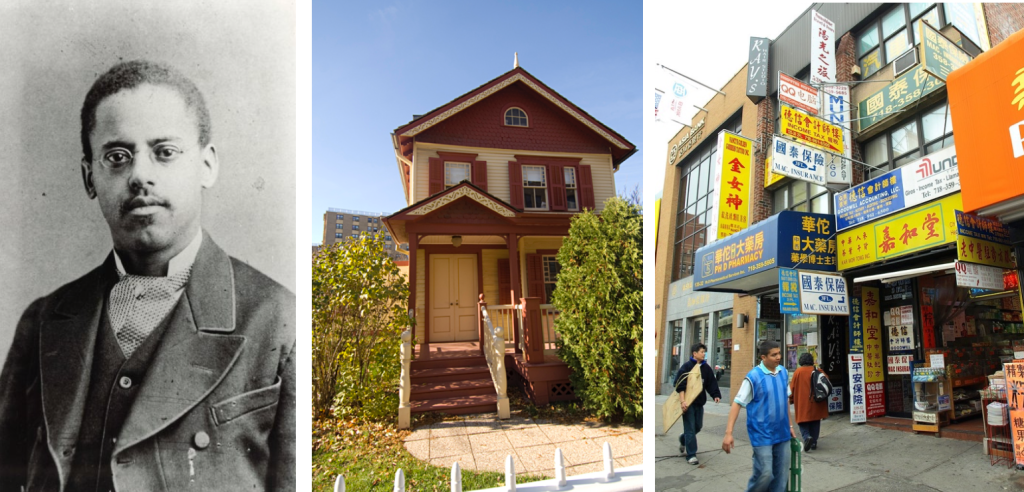
As Executive Director of the Historic House Trust of New York City, one project that I learned a great deal from was the Lewis H. Latimer House’s LatimerNOW Initiative and the “Light On Sound” (2015) Project.  Lewis Latimer (1848-1928) was an African American inventor, an electrical pioneer, and a son of fugitive enslaved individuals.  The family home in Flushing, Queens, NYC, was turned into a house museum and became one of twenty-three historic sites run by the Historic House Trust of New York City. 


(L to R) Olivia Cothren, LatimerNOW Initiative Manager, Historic House Trust of New York City; Monica Montgomery, Site Director, Lewis H. Latimer House; Ran Yan, Site Director, Lewis H. Latimer House; Caroline Drabik, “Light On Sound” Project Manager and Director of Curatorial Affairs, Historic House Trust of New York City

The goal of the innovative LatimerNOW Initiative (funded by the New York Community Trust, project managed by Olivia Cothren, and site-directed by Monica Montgomery & Ran Yan) was to learn from Lewis Latimer’s life and highlight the multi-themed narrative to engage the wider Flushing community.  In addition to being an extremely important site dedicated to sharing the African American inventor’s experience, the house resides within an area that is quite diverse, including Chinese, Korean, Native American, and other various native and immigrant populations.  Flushing, Queens is considered the most diverse location in the world relative to languages spoken. 

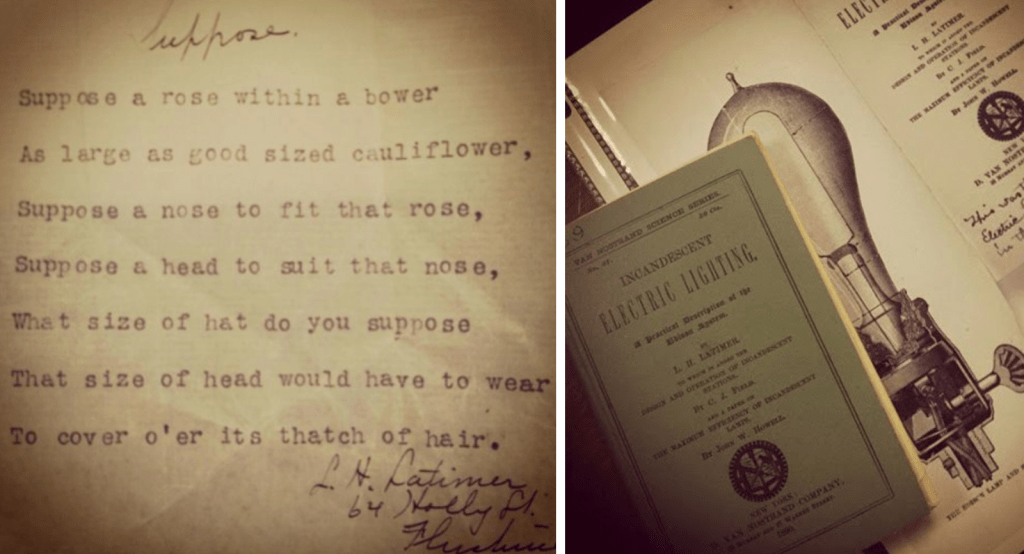
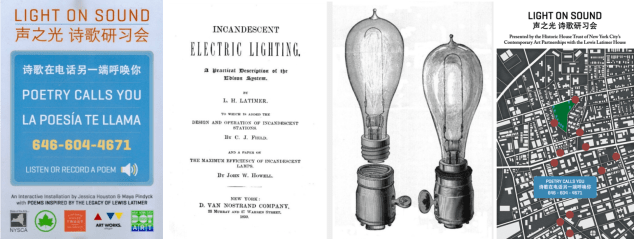
In response to the diversity of Flushing, the LatimerNOW team chose the concept of “communication” as the theme to use in crossing language and cultural barriers. It was determined that a combination of collection items would be the catalyst for a community-wide engagement project.  The collection items chosen to address the idea of “communication” were a series of poems and scientific publications that Latimer wrote.  As objects, they were two-dimensional documents with a mixture of handwritten and typed compositions.  The “Light on Sound” Project grew out of this humble stack of papers in the Latimer Collection.  The project was created by a collaborative team lead by Caroline Drabik, Historic House Trust of New York City, Director of Curatorial Affairs, artists Jessica Houston & Mya Pindyck, and myself.  In the artists’ statement it outlines:

“(Light on Sound) is an interactive poetry project and installation that engages The Historical Latimer House and the Flushing neighborhood with the voices of community members reading poems. The work commemorates Lewis H. Latimer, African American inventor of the filament for Edison’s lightbulb, and poet. Poems can be turned on through light and called up with a cell phone. The poems that fill the Latimer House and extend into the community were generated, recited, and shared by the people of Flushing in three languages.”

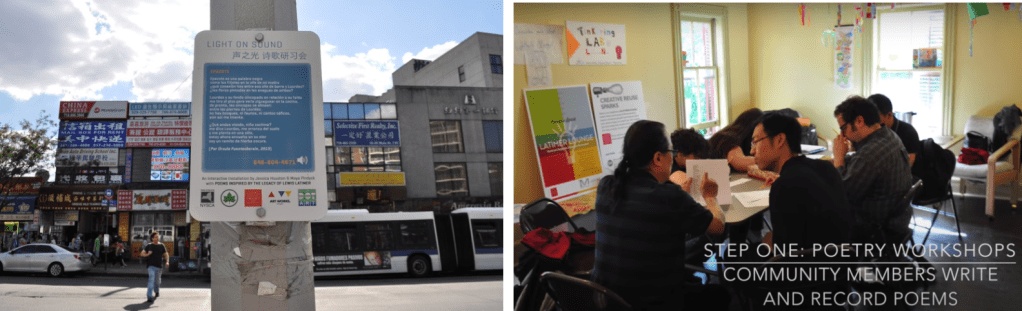
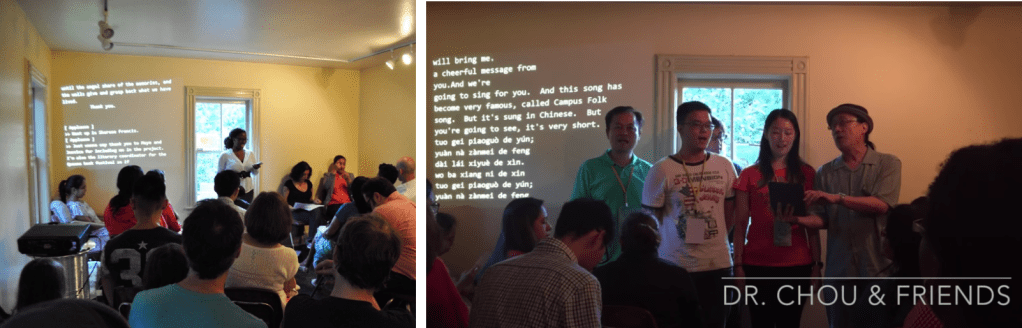
Through this project, a collection item expanded beyond its simple physicality and engaged a city-wide, contemporary audience with current dialogue.  Topics included race, social justice, gender, relationships, and politics. The project grew to include signage throughout the community, cell phone poetry uploads, on-site poetry workshops, and recordings resulting in several on-site poetry slams.

One of the most teachable moments from this project was seeing how a series of two-dimensional, physical collection objects could be the catalysts for a large, interactive, engaging, city-wide project.  The collection items helped to document and define the intangible emotive connections between Lewis H. Latimer’s poetry and the surrounding community.  The collection was not an end in itself, but by creating new ways to communicate its value and meaning,  we were able to tell a story beyond the simple factual details of the artifacts themselves.

I also think that the more we as museum professionals can collaborate, bring in outside artists, such as the talented Jessica Houston & Mya Pindyck, to highlight a different way of seeing our collections, the greater impact these objects can have in our present lives.

I would love to hear what all of you are doing to expand the

usefulness of things?

*NOTE: Even though the project Light on Sound took place in 2015, much of the engagement was digitally sourced making it useful as a prototype in our COVID-19 era.

*Special thanks to: Olivia Cothren, Monica Montgomery Nyathi, Ran Yan, Jessica Houston, and Mya Pindyck.

June Lucas – editing

LatimerNOW Initiatove: https://historichousetrust.org/what-we-do/innovation/latimernow-2/

Light on Sound: https://www.jessicahouston.net/#/light-on-sound/

Caroline Drabik White Rose Curatorial Services: https://www.carolinedrabik.com/03-about

One-night Stand: Preserving the Pieces

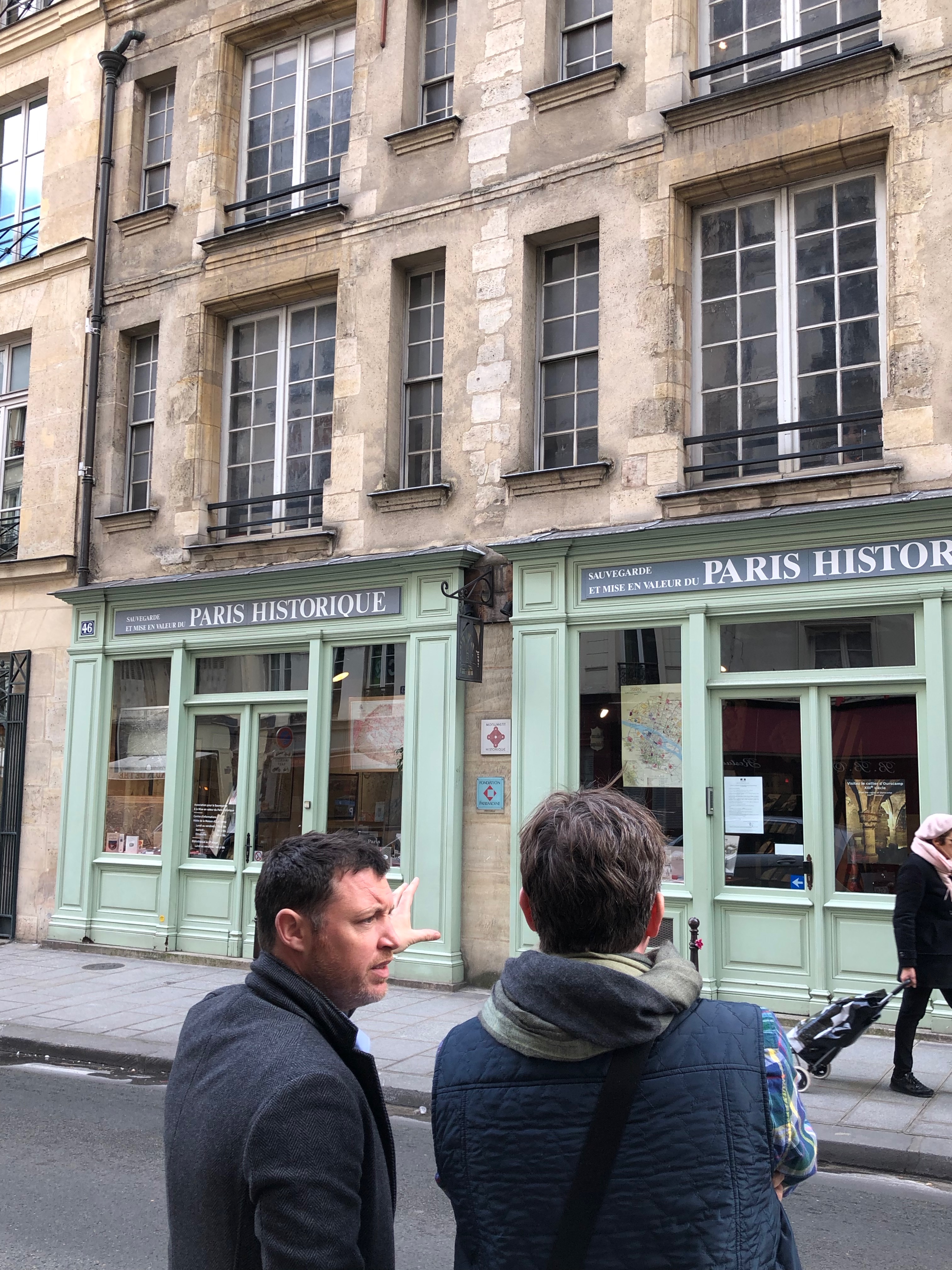
This “One Night Stand” almost didn’t happen.  As I sat across the table from Fabrice Duffand, International Delegate for the French preservation organization REMPART, and Pierre Housieaux, Director of Paris Historique, all I could understand was that the wonderfully French animated facial and body expressions and gesticulations meant that things were not going well.  It did suddenly occur to me that the obstacles inherent when trying to explain why sleeping in a historic space could be of value were multiplied by any language barriers.   I sat next to VP of Twisted Preservation, John Yeagley, who was my calm translator.  All I could do was sit and occasionally smile in apparent agreement.  Preservation is a collaborative and, at times, an adversarial sport – even when the players involved are on the same team.

The opera taking place in front of me turned out to be the core of this “One Night Stand.”  The discussion revolved around grass-roots preservation and how it can work under a larger preservation effort umbrella.  I do have a bit to say about this concept as I helped run two such organizations, one in Philadelphia (The Philadelphia Society for the Preservation of Landmarks), and the second in New York City (The Historic House Trust for the City of New York). It may not seem relevant to other themes found in these “One Night Stands,” but it actually forms the “meat-and-potatoes” of how and why I pursue these experiences.

With John’s translation, I realized that I generally understood the discussion that was taking place before my eyes.  I had many times been deeply engaged in this same conversation.   The argument had nothing to do with the concept of the “One Night Stand,” but rather how history is communicated, funded, and prioritized, and how a “One Night Stand” might be able to highlight these often hidden issues of preservation.  All valuable and important concepts to define. It’s not about what the site is right now, but rather the dance it took to get to the present state.  Such is the story of this particular “One Night Stand.”

This conversation was taking place in a room on the 3rd floor of the Hotel Ourscamp. The building was to potentially become the location for our first “One Night Stand” in the city of Paris. Fabrice had suggested it because in the early 1960s  the Hotel Ourscamp was one of the first buildings to gain notoriety due to the preservation efforts that surrounded it.  It would make a fascinating study of the long-term sustainability of preservation efforts. The building, the street, as well as the Parisian precinct it rests within all have a somewhat complicated architectural and social history. The animated conversation of preservation history notwithstanding, this complicated history is one of the very reasons that makes the Hotel Ourscamp so compelling.

GETTING THERE & THE CITY

This passion of the discussion reflects directly the complex evolution of Paris in general and the site of this “One Night Stand” particularly.

The neighborhood surrounding the Hotel Ourscamp is full of narrow roads, buildings buckling toward you, and steep stairs. This area of Paris, now called the 4th arrondissement, contains some of the oldest surviving Medieval structures and urban street configurations of all Paris.  But it nearly came to existing only on old maps.  Tracing this story provided me with a contextual urban narrative to dovetail with the particular narrative of the Hotel Ourscamp.

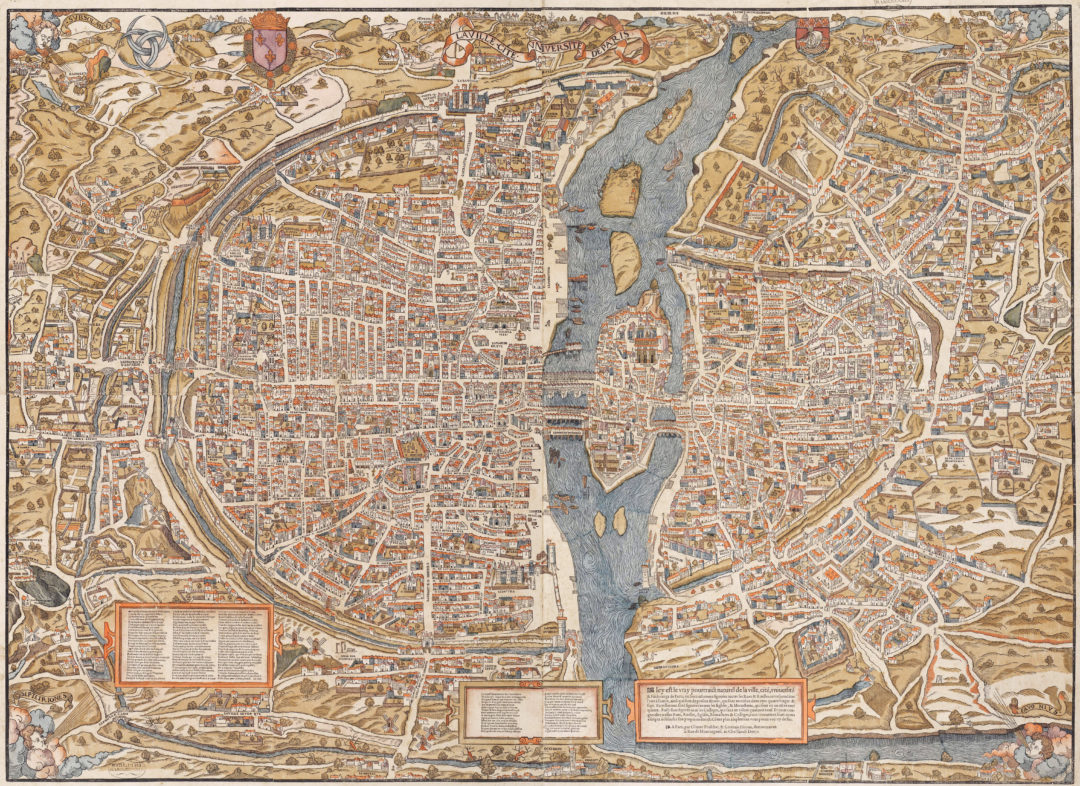
Amazingly, much of the street system of the 4th arrondissement is recognizable even today.  One of the earliest maps created for the city of Paris is the La ville, cité et Université de Paris by Olivier Truschet Germain Hoyau, c. approx., 1555 (Basel University Library).  It shows in amazing detail the built urban environment of medieval Paris.  If you zoom into the area that is now the 4th District, you can identify the very block (and perhaps building) of the original Ourscamp Abbey outpost house. Despite a long history as the aristocratic district of Paris, by the late 18th century, the district was no longer the most fashionable district for the nobility. Following the French Revolution, it fell into despair and was abandoned by the nobility completely.

The street that the House Ourscamp rests is presently called rue Francois Miron (originally called rue Saint Antoine).  Hotel Ourscamp was built on this road as it was the primary entrance into the city of Paris for merchants traveling from the East. The configuration of the street still maintains the scale, direction, and curvature of the medieval pathway.

Although the center of Parisian commerce in the 15th-18th centuries, by the 1890s the Ourscamp building and 4th arrondissement were in far too decrepit shape to live.  It was at this time that the concept of “urban renewal” took hold in Paris.  This urban renewal process began as an extensive survey conducted by Paul Juillerat from 1894 to 1904, which revealed problems of hygiene in certain districts of Paris. Specialists likened the occurrence of tuberculosis cases to the high population density, ancient building construction, and in particular to the narrowness of the traffic lanes in relation to the height of the buildings, resulting in a lack of fresh air. Although of some debate at the time, the City Council of 8 March 1906 created a list identifying six “islands of unhealthy areas” of Paris. The public authorities considered it essential to destroy or redevelop these neighborhoods.  Hotel Ourscamp was in a direct line for this push for urban removal.

The idea of urban renewal of Paris (and in particular the 4th arrondissement) took many forms and proposals.  One of the most dramatic and absolute was produced by one of the master architects of the last century, Le Corbusier.  His proposal would have demolished the medieval district – and Hotel Ourscamp – to create a new city. To give you an idea of the potential effects of Le Corbusier’s urban renewal on the fabric of Paris, one only needs to look at the 1922-25 Plan Voisin for Paris.  In Corbusier’s idealized and unrealized project, a large portion of the Marias district was leveled to allow for large housing towers with extensive green space surrounding the built form.  The medieval streets were eliminated and replaced with regular, gridded vehicular and pedestrian avenues.  The only way to gain a sense of orientation is by finding the Île de la Cité and Notre Dame Cathedral, then look across the Seine river.  The pressure to eradicate the old in favor of the new was a strong and real potential. The Hotel Ourscamp and many others would have been lost.

“The street consists of a thousand different buildings, but we have got used to the beauty of ugliness for that has meant making the best of our misfortune. Those thousand houses are dingy and utterly discordant one with another. It is appalling, but we pass on our way. On Sundays, when they are empty, the streets reveal their full horror. But except during those dismal hours men and women are elbowing their way along them, the shops are ablaze, and every aspect of human life pollutants throughout their length. Those who have eyes in their heads can find plenty to amuse them in this sea of lusts and faces. It is better than the theatre, better than what we read in novels. “(Le Corbusier and Jeanneret)

This level of urban renewal never took place, in part because of the role that the Hotel Ourscamp played in the public debate regarding the value of historic place vs. the vision for a new modern city.  By the 1950s the Hotel Ourscamp was considered too dilapidated to inhabit and further, even to restore.  This is when a group of preservationists stepped in and advocated for not only the building but also the entire Maris arrondissement.  The city agreed to retreat from their renewal plans only if the preservation group would restore and occupy the Hotel Ourscamp and make it the historic center of the district.

In many ways, the Hotel Ourscamp owes its existence to a slow, tedious, argumentative process involved in city planning and urban reconsideration.  Just like the discussion I was witnessing between my two new friends, preservation doesn’t come easily or without a fight.   In this case, the fight saved the Hotel Ourscamp.

THE ABBEY OURSCAMP and the HOTEL OURSCAMP

To better understand the location of this Paris “One Night Stand” – the Hotel Ourscamp – we have to start our story out in the French countryside far away from Paris.  Hotel Ourscamp was originally built in 1248 as the merchant outpost for the Notre-Dame d’Ourscamp abbey. The d’Ourscamp abbey, located about 50 miles northeast of Paris,  was established in 1129 and became one of the most influential, powerful, and wealthy  Cistercian monasteries in all of northern  France.  The name Ourscamp (house bear) goes back to a very old legend that states during the construction of the estate, they managed to harness a bear into pulling a plow to plant the agricultural fields. One of the profitable economic endeavors for the abbey was the agricultural production of staple crops, bringing them into Paris (storing them in the crypt of the Hotel Ourscamp), and selling them in the urban markets to residents. Today the remote abbey complex is a stabilized ruin with a few buildings later renovated for other uses.

The original  c.1248 Parisian Hotel Ourscamp was a squat building that contained a sizeable full basement crypt used for storage of agricultural goods to be sold, and two floors of housing for transient monks (who were studying in local libraries), as well as traveling merchants and craftsman.  The entire building was made of local stone with the crypt structure designed in the early Norman style of groin vaults.   In about 1585 the original stone building was demolished, and a new building was built on the foundation crypt of the original Hotel Ourscamp.  The house built in 1585 consists of the main body with a façade, and two floors and a roof at two levels existing under a very heavy French roof.  After he Revolution, the abbey was expropriated, the house sold, and small traders inhabited the building. The house underwent many transformations and additions over the 17th, 18th, and 19th centuries, resulting in the facade and interior configuration of today.

It is because of this somewhat layered and complicated history that REMPART suggested Hotel Ourscamp for a “One Night Stand.”  Indicative of preservation in France, our world is never as clearly defined as we try to make it out to be; Hotel Ourscamp stood as a manifestation of the complexities of making sense of history.  Here we had a c. 1248 crypt, acting as the foundation for a 1585 building, that in itself had many additions and modifications in the 17th, 18th, and 19th centuries, with 20th and 21st-century restoration efforts currently underway. You can’t get more authentic (and complicated) than that!

Somewhat off the beaten path of the tourist masses, just a few blocks west, this somewhat aesthetically quiet building held within its walls (and basement) a fully authentic and rarely surviving 16th-century crypt.  The crypt and multiple-floored structure have been the administrative center of Paris Historique organization as well as a street-level visitor orientation center.  The orientation center is stocked full of books, maps, and photographs relative to the urbanism and social history of the city of Paris.  This room alone (along with the very friendly greeters) is well worth a visit.  Compared to more trafficked history sites just a few blocks away, this highly accessible and non-touristy-center was waiting to be explored.


The location within the building that was chosen for the “One Night Stand” was either the crypt itself or another floor of the building that, just like the original abbey travelers’ building, housed visitors.  We chose to sleep on the top floor.  Under the weighty roof structure, one big room was used as a storage space for tools used in the continuous restoration of the building.  All around our cots were chisels, hammers, ropes, and a myriad of smaller buckets and containers used by the restoration preservationists.  In some ways, it felt like sleeping in a tool shed.  All of these objects of use served to keep the intellectual concept of restoration alive with the imagined sounds of steel chisels and hammers shaping stone. The ever-present layer of stone dust introduced itself as a fellow traveler – a traveler who was also residing at the Hotel with me.

The temporary quality of the cots felt appropriate, given the transitory nature of the building’s use in medieval times.  I imagined the steady flow of visitors from the abbey coming and going at all hours of the day, unloading produce to be sold at the Parisian markets.  Rather than feeling like I was staying in a comfortable home, it felt like the center of a wheel tying itself to the abbey, the markets, and the locals.  This building served as the unifying element for the Parisian population and the outlying agricultural producers.

With our cots established and all of our electronics plugged into the outlets, I stepped outside on to a balcony.  In the distance, I could hear the church bell of the neighboring St. Gervais and noticed all of the intricate details of the building up close.  Of particular interest was how the Hotel met and transitioned to the neighboring buildings. Many times, the historic buildings I sleep in are isolated and separate from the world; however, here I felt like I was a small part of a much larger entity.  This concept seems central to a more inclusive view of preservation of the built environment.  Contributing to a larger whole in a way that sustains an important fragment of our built environment can be seen as, in some ways, more important than restoring a single building to its “original state.” Every fragment of the whole that is stabilized and connected to the other fragments around it begin to provide a strength of place otherwise impossible.

The only way to get to the any of the floors of the Hotel was through an idiosyncratic and irregularly crafted winder staircase.  It is one of the remaining elements from one of the earlier building efforts on the site.  The steps are uneven, and the risers vary in dimension. My physical interaction with the staircase quickly became a point of anxiety.  I felt like I would fall the entire time I was traversing this wooden obstacle course. My experience on the stairs became a constant aggressive reminder of how regular and standard our lives have become. It would be difficult for someone living in a world of standard architectural codes that regulated things such as stair dimensions and construction to internally and tactically feel and understand the constant present tension involved with authentic history sites and, for that matter, narratives.  Our expectations are to even out the irregularities, soften the abrupt connections, and cover up the unsightly repairs to poorly constructed realities. This staircase kept reminding me that authentic history is neither standard, perfect, nor easily understood.

One of the ways that I avoided falling down these stairs was to keep a constant level of connection to the walls that encased the staircase.  Even during the night when the light was considerably dimmer, my steady guide was the touch of my hand on the wall surfaces.  The walls changed from wood, plaster, stucco, and stone.  It was an interesting sensation to be so intimate with the building. There were episodes of gentleness as expressed by some of the smoothed wood, in contrast to the stone and mortar that felt aggressive to my touch.  There was real sensuality to my relationship with the building. In many ways, I felt like I was encased in an environment of uneven and highly sensitive conversations.  Like an awkward marionette, my foot was balancing upon the surfaces of the everchanging stair treads, while my hands were caressing the walls, while my head was trying not to bang into the low door jambs. Our world seems devoid of such thrilling tactile environmental communications.

As the sun set, I went over to one of the two dormers that windowed the top floor.  Looking out through the warbled glass, the quickly changing sky color reflected off of the surrounding buildings.  The transition of daylight to nighttime produced that “Margit” moment where the sky is brilliantly colored while the light quality has diminished. I felt like everything in this experience was transitory, variable, and fleeting.  How can one possibly make such a thing knowable? It’s not my particular view of history, but rather what I do with my understanding of that history. Just like this building to the city of  Paris, I am only a very small contributing element to the much larger experience, and my understanding of the world around me can be modified and mature as the intellectual environment changes around me.

On the street level, off to the side and out of the way stands a sign on which is written, “ATTENTION ESCALIER DANGEREUX.”  Wandering over to the sign, I noticed that it was signaling the presence of a very steep, narrow stone staircase bisected by a fragment of a barrel vault.  My hosts told me that the stairs took you down to the original crypt. The crypt was used as the storage space for all of the goods brought in from the abbey to be sold at the Paris markets.  The travelers would bring the agricultural products to the crypt through a street-facing door and then climb this interior stair to their temporary sleeping quarters.  The condition of the crypt in 196? has been documented by a series of pictures showing that the space was half filled with debris from the many building campaigns on the site as well as the structural collapse of some parts of the groin vaults.  It became the first step in the restoration of the building to remove centuries of debris from the crypt.  Looking at the pictures of the young preservationists working on the building in the 1960s, you are reaffirmed how collaborative and communal preservation is.  It strikes at a group emotional need for continuity and stewardship of significant places.

Today the hidden crypt is at the center of the restoration efforts by Historique Paris.  Entering the space gives you a visual manifestation of all phases of restoration.  The activity and intense effort to restore the crypt is very obvious.  It is very rare to be able to get immersive in active restoration efforts. It is a fascinating experience to wander the space and decipher the process and history of the space through visual clues. Scaffolding and wood buttress staging are placed throughout the space as left behind skeletons of activity.  To a preservationist like me, the tools of the trade are just as interesting as the structure itself.  So much of the process is hidden from the public’s view.

When I visit historic sites, I tend to look for the details and the anomalies to the overall “packaged narrative.” While experiencing the crypt, my eye was pulled, not into the regular spacing and organization of the groin vaults, but the idiosyncrasies of around the edges – the items that caused a disjuncture to the cohesion of the space.  One of those was a small wastewater line scurrying out of a hole in the 16th-century foundation wall and traveling straight up into the building above.  To the right of the wastewater pipe was a small opening in the wall which opened up onto the street level.  The light storming through that tiny space made me realize how dense and dark the crypt felt.  On the opposite wall was a mysterious gate which locked off another space and hallway.  Upon asking my host, he told me that it goes into the neighboring building.  Most medieval foundations of Paris are intertwined with interconnected passageways and odd spacial relationships.

There is something about being in the ground, underneath all of the beauty of Paris, dark and removed from the public facing facade of this extraordinary city, that I felt a connection to the everyday people like myself who lived (and live presently) all around where I am standing.  Who preserves those memories? Who preserves those everyday experiences and tactile interactions?  Like my hand rubbing along the stone and wood wall as I ascended the spiral stair in the Hotel Ourscamp, who keeps that memory alive?  The insignificant. The fleeting. The common?

Exiting the crypt, I traveled through time all the way up to the top floor, turned around, and traveled all the way down the stairs to the street level.  Catching my breath and sitting on a chair in the now-closed visitors center of Paris Historique, I heard noise coming from the street.  It was getting louder and louder.  The street felt very narrow so that all of the activity occurring on either side of the street seemed to be occurring directly in front of my view.  Suddenly, and without any expectation on my part, streamed a large Parisian Garbage truck.  It kept stopping – men would jump off, grab the trash, throw it in the back, and the truck would move on.  It was fluid with almost no abrupt stopping or starting.  There was something very startling about this experience as I had just come out of the 15th-century crypt and now I was assaulted with the necessities of modern urban city life.

Squinting to the flashing red light atop the garbage truck, I began to image how medieval Paris, with the exception of the Plague, civil wars, and foreign occupation, at a very basic human experience, was full of life, complexity, and the necessities of urban life.  The right bank, where Hotel Ourscamp is located, was considered swampy and was occupied by the merchant class who lived and worked close by.  It is where the main marketplace was located and considered the commercial center of Paris. It makes perfect sense that the Abbey Ourscamp would build their outpost trading storage and residency building in this area.

In researching the medieval markets of Paris, I became interested in visiting some of the present-day markets.  I traversed the city visiting produce and flea markets wanting to get a feel for this layer of the city.  We ended up at the Flea market. The environments of the markets were overflowing with unique and eccentric items.  The term Marché aux puces literally translates to exactly “flea market.” The largest Paris flea market (and that of the world), located in St. Ouen, was established around 1870, earning its name because of the ostensibly flea-infested furniture and other wares sold at the market just outside of the city’s northern fortifications.

There is something about the confusion and seemingly staccato quality of the Paris flea market that feels somewhat like what medieval Paris itself must have felt like.  Much like how Corbusier wrote of Paris itself, “Those who have eyes in their heads can find plenty to amuse them in this sea of lusts and faces. It is better than the theatre, better than what we read in novels.”  As I walked down the endless streets of flea market booths, filled with every type of vintage artifact imaginable, I could imagine how some would find this atmosphere anxiety-producing. Perhaps this is how Corbusier felt about walking the streets of Maris.  The discordant styles, dirty streets, and the discordant complexities of urban life must have made him fill with anxiety.  All one has to do is look at his architecture and see his version of the ideal is housed in a “machine for living” – clean orderly, and consistent.

In some ways, this is precisely where I feel like preservation may have taken a wrong turn. Often, I will see beautifully fully restored buildings exist within a world of sterile perfection.  Even in an attempt to preserve, we have the ability to kill the very thing that drives us to preserve it.  Not always, but often.

That’s what makes the Hotel Ourscamp so compelling.  It’s not perfectly restored, nor could it ever completely fulfill our modern expectations of code-driven architecture.  Its architectural presence is so strong, its fragmentary combinations of habitation are so clear, that it stands apart from the world – yet is only clearly visible while it is a part of the world.  Its power and quality come from the uncomfortable abruptness it has with our contemporary habitation.

My traversing of the 15th-century stair made it very clear who was in charge – the building – not the inhabitant.  Like a Grand Dame, who was so old and had lived through so much, the building felt impatient and abrupt.  Not in a negative way, more like your great grandma who was way past trying to impress anyone but was instead living a transparent life of clarity and honesty. There is a point that you can’t cover up the wrinkles or flaws any longer, you can’t suck in your gut to appear skinnier.  You are what exists.  You exist as a result of your choices, decisions, and natural processes.  By accepting that, and embracing the inevitability of time, we become free from expectations and most importantly, nostalgia.

Maybe in some ways that is what Corbusier was searching for, an escape from nostalgia.  I wonder if we can bypass nostalgia by simply accepting things as they are and not imposing expectations?  Hotel Ourscamp exists both as a fragment of medieval Paris, but also as a part of modern Paris.  Its value comes from the simultaneity of these situations.  We must be able to hold both images and experiences together in the same place, at the same time, and allowing them to contradict and inform each other.  It is both a “beauty of ugliness” as well as a precious and rare artifact.  Just like the flea market, when you buy something, bring it home, clean it up, and make it a part of your like – it loses something.  There was a power to the companionship of place and challenging proximity of discordant abjectness.  Perhaps that should be the goal of preservation – to seek a simultaneous and challenging relationship between the past and the present.  Don’t try to resolve the uneven transitions, but rather celebrate those odd connections.  Like the passageways I found in the crypt that connected disparate buildings all throughout the Parisian underground, the undiagnosed and unconfirmed are in themselves an element of history worthy of being preserved and valued.

It seems to me that is what Fabrice and Pierre were arguing about – where is that line of ownership, value, and history? What is the level of anxiety and uncomfortable-ness we can accept as we preserve and restore the world around us?

After packing my bags, traveling down the stairs, and walking out of the building and toward the Seine River, I passed Notre Dame Cathedral.  It occurred to me that the Hotel Ourscamp and Notre Dame Cathedral existed at the same time in medieval Paris – both existing as fragments, friends of a bygone era.  After my experience at Hotel Ourscamp, the scene was overwhelming.  I walked through the crowds stopping once to view the Cathedral.  The line filled the building and lassoed the entire plaza.  I would come back another day to visit Notre Dame.  The best I could do that day was to snap a picture from across the street, but there were so many buses that the image I was able to achieve was, at the time disappointing, as you could only see the Notre Dame towers partially, the rest obscured by the busses.  Of course, three days later the Cathedral caught on fire.  And now, just like Hotel Ourscamp, I am reminded that we now have to hold discordant concepts simultaneously – and move on.  What it was, what it is, and what it can be.

SPECIAL THANKS:

Association Paris Historique – Pierre Housieaux (Director)

REMPART – Fabrice Duffand (International Delegate)

John Yeagley (VP Twisted Preservation) – Research, logistics, and translation

Karen Walter – Editing

The Allusion of Answers

One of my most difficult memories as a student of architecture is when I presented a project to a room full of people and one of the critics stood up, walked over to my meticulously drawn images and ripped them off the wall and crumpled them into small balls of waste paper.  I cried.  It was awful. I, wrongly, thought that it was a good project.  I stood there asking myself nothing but questions.

Decades later I find myself asking the same questions, but in a different context.  Is there a right and a wrong way to view & interpret history?  Who owns this history?  I keep asking myself this over and over.  I never really have a solid answer to the question.  As a capitalist, the answer might be, “whoever funded it”.  To a socialist, the answer most likely would be, “Everyone owns our collective history”.  Still, others might be a bit more cynical and state, “history belongs to the winners”.   For me, the deeper concern is how fluid is history?  How much change can history take before it burns to the ground leaving only ashes?

I am old enough to have lived several lives, been lucky enough to facilitate a few positive examples of cultural change.  What I am also old enough to know through personal experience, is how much real history is lost simply in the passing of time.  Details, undocumented comments, facial expressions, pivots of opinion, and of course subversive and behind the scenes constructions that no one publicly realizes.  Sometimes I have been involved in those meetings, but most often I have been on the other side of the door merely inferring from the results.

I do understand why most of us feel like real choices and decisions happen outside of public, transparent discussions.  This fuzzy feeling makes us skeptical.   I think being skeptical is a good thing.  We should keep pushing until we get a good answer – an answer that satisfies our innate skepticism.  Sometimes though, I feel like the monster of skepticism takes over and won’t allow for reason or discussion to compromise our thoughts.  Research is showing us that is f we generally have our minds made up, then there is not much anyone can do to change our minds.  I wonder how drastic, confrontational change must be for all of us to stand still – take notice – and realize that things are not as they used to be?

What is that moment when we realize that we have symbolically moved from Fall to Winter?  Do any of us have any real impact on the current of the stream, or are we simply in a raft floating along, falsely believing, that we are controlling the outcome?  I am not really speaking spiritually, although for many of you I know that you find comfort in believing that the stream is providence, for me I am wondering if anything we do really is impactful on the long-term life of memory?

Institutions have a life cycle.  Even within my life, I have noticed major organizations & companies go from monster economic engines to bankruptcy.  I have also, however, experienced the opposite trajectory from failure to dominance.  Are our attempts to maintain something merely a way for us to pass the time as the reality of this seasonal change inevitably rolls forward without any regard to our actions?

The machine is going to do what the machine was designed to do.  The question is – What are we supposed to do while it does that?  Is history simply our way of placating ourselves against the inevitable decay of memory?

I again feel like that young man, after the drawings were ripped from the wall.  I have more questions than answers.

First Kiss

Eastland Mall was the core of my adolescent social life. The enormous regional, retail complex was, at the time, the largest mall of its type in the state of North Carolina. Its parking lot was so vast that shuttles were needed to transport Christmas shoppers from their cars to the mall entrance and back. For me, Eastland Mall provided the setting for my high school existence. It was where I took my first date (think dinner and movie at T.G.I. Friday’s and the Regal Cinemas). It was where I worked a part-time job (hello Belk Department Store). And it was where “meet you at the mall” signaled the start of a Friday evening.  Looking back, I see that I was too young to understand the underlying social and racial bias behind the suburban mall movement, white flight, or the result of such forms of commercial segregation. To me, Eastland Mall was just the center of my universe.

A few years ago, it was demolished.  Pictures of the mall prior to its removal have a ghostly presence. Its death was prolonged and difficult to watch. The large illuminated “Eastland Mall” sign, like an artifact of looted colonialism, was removed from its original setting and is now accessioned as a collection item in a historical society. Interestingly, the same social reasons for the mall movement became the very reason for its demise.  Demographic change.

Something about this demolition makes me pause. Being an old, queer public historian, I have lived in the margins. I know that what seems central, solid, and standard can easily fall away. But this removal seems different – more intimate.  Perhaps I am now old enough to personally experience, within my own lifetime, the effects of such social progress and change.  I am no longer solely pursuing change; change is also being forced upon me.

People around me used to call me “Blue Sky” because I always saw the good and positive in a situation.  I was also the one who would step forward and try to solve a problem. I had to encase my deeply insecure self with a dense layer of positivity as protection.  Now that I am out, deeply flawed, and post-50 years old, it seems that rather than solutions, all I think about are the questions. I find myself pulling back, remaining quiet, and listening. That layer of bravado protection now seems like a suffocating obstacle, not a protective weapon. I am not so sure every problem has a solution. For the Eastland Mall problem, the solution was to remove it from existence.

When I was younger, I thought the past was a distant, observable, and clearly defined object.  Frankly, not of much use. Like a thing you can possess or an artifact you can buy at a flea market, the past had no nuance – it simply was with what you visually connected.  Now, in contrast, when I look to the past, all I see is an orgy of swirling, foggy, dimly lit shadows.  My new truth is this: the only way to figure out what is in the shadows is to walk into the obscure.

The difficult thing is that for those who do chose to enter into the mess that is “history,” you put yourself directly in the violently damaging range of “nostalgia.”  If there is one thing I have learned after 30 years in public history is that you don’t fuck with “nostalgia.”   Nostalgia is the fog that diminishes our ability to accurately see the world around us.  It will so reduce your vision that you can crash.

Nostalgia is fueled by words like “tradition,” and “precedent,” when what we really are describing is “memory.”  Truth is, memory is rarely authentic, accurate, or in reality what occurred.  In contrast,  nostalgia makes money, pays salaries, and is fairly simple to market.  In our Orwellian world of spin, nostalgia enrobes history like the fleshy substance of an apple.  Is the apple the soft part or the seed itself?  Again, I don’t have any answers; all I have now are questions.  I feel as though I am about to enter a phase of my life that is masked by fog and difficult to maneuver.

Like the empty site of Eastland Mall, restricted by a chain link fence, what remains when something is removed?   What part does nostalgia play in my memory?

I don’t really know.

All that I know is that it’s too foggy to continue.  I have to pull aside, wait till this confusion passes.  Maybe it will give me time to think. Maybe this is like a “time out” for me.  I am placing myself in the corner.

The Life Of Obsolete Actions

Who cares if I can make a chair without electric machinery? 

Oddly, I ask myself this question all of the time.  As a member of the team at a living history site, where among other things, we do show people how to make things by hand and without machinery, other than as a novelty, what importance might this have on contemporary visitors? How might my newfound knowledge of how a foot-powered lath benefit my thinking in 2018?  Could the answer to this question affect how I vote? What policies I promote? What I eventually do in my life?

Like a dandelion seed floating through the breeze, the answer to this question has far-reaching and unforeseen results.

I don’t know if I actually have an answer.  I understand why being knowledgeable about the tactics and strategies of history could better inform your decisions today, but I feel less firm on why the physicality of everyday life is an important thing to know.

I watch, stunned, as kids are presented with a rotary phone and asked to place a call.  The young minds have no concept of how the phone works.  “How do you text?” one young girl asks.  Another, instead of rotating the dial, continuously pushes the holes of the rotary dial expecting the call to go through.  Will they ever be expected to use a rotary phone?

I know how all of this must seem.  It’s not even an issue for the everyday person.  For a visitor to a living history site, it’s all novelty and visually arresting.  To those of us who really work at making these experiences meaningful beyond simply the cool-ness of the interaction, it weighs heavy on our minds.  Is it good enough to simply be compelling?  Is it Ok to also be thought-provoking; challenging; and sometimes adversarial?

I am fundamentally a sculptor.  I make things (  https://franklinvagnone.org/  ).  Watching people make things, and even better making the things myself, can be one of the most satisfying experiences at a living history site.  In fact, I often find myself sitting and chatting with the woodworkers at history sites – asking them questions. Why? What about this behavior fulfills something in the modern mind that is missing?  At a most basic level it is tactile.  Sensory engagement matters. Is that all there is?

What’s the next level of benefit of this experience – how can an obsolete action inform my life today in a useful and substantive way?  

Any ideas?

One-Night Stand: Poetry of Four Pears

I locked the door to my stone-walled, tower office. The office was accessed through a lone, tight set of spiral stairs.  It was a beautiful space, but at times I felt like I was sitting in the middle of a big bullseye target.   I rushed over to a corner of my large office and lay down on the dusty floor.  I slid under a large table as I needed it dark.  I didn’t know why – I just did.  I was in my good suit, but I didn’t care.  My heart was beating so fast and the room was spinning.  I didn’t know what was going on, but it scared me.  I was always the one who kept his shit together; I always seemed able to keep things moving without difficulty – so why was this happening?  I felt like I couldn’t breathe and that I was going to faint. To this day, I do not know what specifically brought on this disorienting emotional state; I only know generally that it was a result of a lot of complicated worries and concerns.

Surrounded by exquisite beauty, I was running a large heritage site owned and occupied by a very conservative church.  I often found myself internally battling with the isolationist perspective of the site’s congregation.  I was young, and everything seemed important; I had no perspective on things.  At that time, I had a firm sense of right and wrong.  Looking back, I was unable to understand that my personal “right” could, in fact, be someone else’s “wrong.”  The panic attack was my body’s way of telling me to pay attention.

So, there I was on the floor.  Was I going to die, and no one would find me?  Would I die alone?  What would people think? The last question now seems the most telling – I was on the edge of death (so I thought), and all I could think of was what other people would think!  It was ridiculous and egotistical all at the same time.  Now I am embarrassed to write this, but in hindsight and with a bit of maturity to guide my thoughts, this question rested at the core of my problem.  I didn’t have the maturity needed to reflect on what was going on around me.  This was certaintly a difficult time in my life, and I was afraid to tell those around me about the problems I was having.  Keeping things quiet seemed easier than asking for help.

DZnT3qdU8AAIIDd
use of photo for educational purposes only

I think it would be hard to find someone whose life has not been affected by some form, either temporary or more long-term, of mental health issues.  Just as I was resistant to ask for help, it might be difficult to find others who are willing to talk about these issues and the real-life consequences.  In the age of social media, where only our very best selfies and beautiful travel shots get portrayed online, our less-than-attractive, everyday struggles often get pushed back into the closed-door darkness of our private lives.

This reality became very clear in my latest “One-Night Stand” at Kew Palace in London, England.  On the surface, of course, it’s a palace for the King, Queen, and family of England, and it’s pretty spectacular.  The palace structure and gardens provide an Instagram-perfect setting for anyone’s weekend or holiday.  As you walk through the landscape and the palace, on the surface you get much what you expect – fabulous-ness and exceptionalism.  At this level, the visit was as anticipated — beautiful, engaging, and perfectly narrated.  That was until I started to sit quietly in the palace rooms and began to understand what had taken place in these quiet rooms.

Although beautiful, Kew Palace is best known as the location that a mentally ill King George III spent much of his troubled time.  It was to Kew Palace that the King was brought so that his doctors could treat his illness away from public scrutiny.  From the start of his reign, beginning at the age of 22, every moment of his life was on view and discussed.  From historical accounts it is evident that the King’s later life was difficult and full of torment and mental decay.  King George III had recurring states of mental incapacity.  These attacks began in 1788 and continued, on and off, throughout the rest of his life.  Eventually in 1810, exacerbated by the death of his daughter, he became permanently deranged, and officials deemed him incapable of ruling as King and the regency began in 1811.  King George III finally died in 1820.  Although still debated, it has been suggested that his mental illness could be attributed to a hereditary form of porphyria. More recently, some scholars have suggested that King George III experienced recurring exacerbations due to bi-polar mental illness.

The King and his family habitually split their time between three residences – Kew, Windsor, and the Queen’s House (now known as Buckingham Palace.) Kew was primarily used a summer residence, and although it was initially popular when the King’s family was young, he came to prefer the residence at Windsor in later life.

ReconstructionKew


There were two palaces in the Kew estate, The White House and the Dutch House.  The White House actually was the original royal residence at Kew. In 1728, Queen Caroline (George’s grandmother) bought the current Kew Palace (known at the time as the Dutch House) as a sort of overflow house for her many children. Both the White House and Kew Palace would have been used by the royal family up until the late 18th century when the White House started to fall into disrepair. It was destroyed in 1802, so when the King was in his last period of confinement at the palace in 1804, it was in the Dutch House, the current Kew Palace.

 Both of these buildings played a part in the treatment of King George and the residence of Queen Charlotte and family. In November 1788, King George moved to Kew (the White House) because its private gardens protected him from the public gaze. The Queen lived there with him, but in a separate apartment, and was only allowed to see him when the doctors judged him to be calm enough. In 1801, during his first relapse, the King was forcibly detained in the Dining Room at the red brick Dutch House (now called Kew Palace) and was told he could not see the Queen. From then on, he was confined in the White House, while the Queen and her daughters stayed in the Dutch House.  In early 1804, during his second relapse, the King was moved to the Dutch House.  This is the era for which the palace is interpreted, during which the King was kept in the Servants Wing, strapped into a straitjacket every day.

From that point, it is accepted that the King never made a full recovery. Eventually, the Queen refused to be alone with him. However, the King continued to rule and be seen in public.

Queen Charlotte undoubtedly walked the hallways of the Dutch House concerned about her husband, King George III, and his mental health.  The Queen wasn’t merely concerned about her husband, she was worried about the Monarch – its stability and long-term sustainability given the extreme unstable quality of the King.  The palace contained within its walls the weight of not only a wife but an entire country.  Not a single beautiful object or decorative element of the palace could make up for the possibility of sovereign crisis and loss of her husband. At what moment might the Queen cease noticing the gilded frames, the harpsicord on which Handel’s first public concert of “Water Music” was played, and become just a person wandering the rooms in a state of dismay and upset over her husband?  In what ways did the King’s poor mental health affect her life?

My contemplation was detoured by my welcoming hosts, Rachel Mackay, Kew Palace Manager and Karren Harris, Preventative Conservation Supervisor, who escorted me up three floors to the raw spaced attic.   As we walked from the beautiful public rooms, up the stairs, through semi-restored rooms, down long darkish hallways and up still more stairs, I felt like the gloss of social media images slowly gave way to a more real and structural back story.  Nothing seemed straight forward or direct; it all seemed oddly contorted and one step removed from the highly ordered gardens I could see outside of the passing windows.  I started to feel a definite disconnect between the regimented landscape gardens and the inner guts of the palace.

Once up in the attic, I could see that the ample space was partitioned off into smaller maze-like rooms.  I was told that I could sleep anywhere I like, but wherever it was would have to be on the hard-wood plank floors.  After walking about a bit, I threw my bags down into a north-facing room and set up my sleeping area.  Throughout the attic were disparate groups of images and graffiti, handwritten on the walls.  I was told that the messages date from WW II when soldiers were using the palace as part of the military effort.

For a moment, as I was unpacking and glancing at the graffiti, my mind wandered into considering the ramifications of having a governmental leader who is mentally unstable.  Much has been written about various WW II leaders wrestling with mental illness, yet who still managed to convince entire countries of a vision which eventually led to massive death and destruction.  Mental illness can, if left untreated, tear apart an entire family system.  In many ways, it can do the same for a governmental system as well.  Kew Palace itself seemed to be the very manifestation of this attempt to contain the destructive potential of untreated mental instability.

Wandering around the upper floors of the palace started to feel like peeking into someone’s bedside drawer or closet.  It was not presentable in a traditional museum way.  In that way, it was quite compelling and lovely. It felt stabilized but not sanitized. The attic structure was like seeing the real structure of someone’s life, not simply the Instagram presentation.  The cobbled-together, spliced, multi-part concoction that is our lives.

IMG_3406

The first floor of the palace has been restored; however, the upper floors have been stabilized and show various levels of decay and restoration.  As you travel up through the palace vertically, the experience is as if you are moving more interiorly into the historic narrative.  The palace shows you its age, scars, and not-so-great nooks and crannies.  I loved this about Kew Palace.  The outside and the gardens couldn’t be more picture perfect, but the house was allowed to be more honest and to treat you with respect.  I didn’t feel like the palace was trying to be something that it wasn’t – it seemed just as it should be.

The semi-stabilized interior spaces periodically had furniture placed within the rooms.  The furniture also was allowed to show its age.  My impression was that the palace was hinting at what I can only call “shadow narratives.” These narratives may not be fully communicated, yet the scars of those narratives still exist in restorations, additions, decay, and habitation.  Different eras seemed to blend together and make the experience even more juicy and compelling.  What mattered?  What didn’t matter?  Maybe it all mattered – or maybe none of it mattered.

As I walked around the first floor, I entered a very clean, fully restored and orderly room.  I was about to walk out of the room as quickly as I had entered when my host pointed to a typical door and suggested that I open it.  I did.  I stood there a bit confused because the door opened up onto a brick wall.  I am used to fake doors in this period building as a way to achieve symmetry, so I suspected that was what I was looking at.  I was told that the brick wall covered up an opening that led to a wing of the palace built to house the ill King and his doctors and servants.  Attempting to keep the King’s illness away from the public, an entire wing of the palace was built and kept private.

The Queen and family lived in the primary portion of the palace while the king was kept – as mentioned before, sometimes in a straitjacket – on the other side of the now-bricked-over door opening.  I was told that later, after the King’s death, Queen Victoria tore down the entire wing of the palace and bricked over the door opening, leaving no trace of the King’s extended struggle with mental instability.  Gone.  Just like that.  I became interested in this lost narrative and researched Kew Palace as it existed with the wing still attached to the main structure.  As I learned more, I went back to my photographs and started to see where there were architectural hints of the previously existing structure.

Food safety, hygiene, and health care were still misunderstood during the Georgian period.  Of course, the King and the royal family received the absolute best quality care available at the time, but such practices still contained large amounts of conjectural theory.  The period of King George was in some ways the last chapter in Medieval medical practices. Following the Regency period, germ theory and biomedicine would be recognized.  It was widely thought that illness and disease were, caused by “miasmas,” or evil air – rotting things and filthy objects that caused bad smells.  It was believed that breathing in these things would bring about rotting and evil within the body.  This belief also included foods and drink. For this reason, large fragrant gardens were planted, and the flowers cut for use as interior arrangements.  These fragrant smells would counter act the evil “miasmas.”

Oddly, at the time, the cause of the King’s first bilious attack (the first hint that he was ill) was thought to have been caused by four large pears he ate for supper the night before.  This makes sense when we understand that certain foods, like raw fruit and vegetables were thought to contain bad “miasmas” because of the perceived evil night air.  Doctors and cooks during the Regency period believed that foods should only be eaten cooked.  In hindsight, fertilizer used during this time could have contained large amounts of human feces and thus would have caused extreme cases of diarrhea.  At this time, diarrhea could have been fatal.

In addition, the concept of humoral medical is founded on the belief that there are four elements essential to the human body.  They involve combinations of hot/cold and wet/dry.  Each element of the material world was a different kind of humor, or biological fluid, which invaded the body.  Health deepened  the combinations of these humor “fluids.” The balance of the humors was seen in combinations of external and internal forces, emotions, temperature, and food.

Food during the Regency period played significant health, social and symbolic roles. For royalty, large, multi-course extravaganzas not only symbolized wealth and dominance but also acted as a form of proactive health care.  Cooked food, recipes, and menus were seen contextually as combining to formulate atmospheres of good smells, miasmas, and health-producing effects.  It wasn’t merely taste and sustenance; it was a complex constellation of unseen barriers to poor health and harmful humors.

I wanted to talk about these ideas, so I asked my hosts if I could go to the original Georgian kitchen while the food historian cooks prepared the meal for the evening.  They took me down into the impressive Kew Palace kitchen and introduced me to the food historians, Robert Hoare and Thomas Hunt.  The kitchen was an enormous rectangular room with two massive hearts and multiple open coal “stove” counters.  In the center of the room were two large simple work tables upon which the food preparation was taking place.  The windows were placed high up on the wall and sun shone through in distinct rays as the fires filled the atmosphere with a thin dance of smoke.   This kitchen, in particular, is important because it has been left untouched since 1811 when Queen Charlotte died and Kew Palace ceased to be used as the Royal residence.  In fact, our dinner was something of an event as it was the first time since 1811 that a dinner was prepared in the kitchen and then served in the original Dining Room.

As I entered the kitchen, I could see that Robert and Tom were already busy at work preparing the food for our dinner.  They welcomed me and began to show me the recipe books that they were using to guide the food preparations.  The book was  ‘The English Art of Cookery’ by Richard Briggs, 1788.  and I was told that it was considered one of the most important recipe books of the era.  Dinner consisted of Beef Olives (p226); Oxford John lamb (p251); Currey of Chickens, with rice and hard-boiled eggs (p296); Asparagus, with butter sauce; (p321); Mushrooms Stewed (p322);  Green Peas (p321); Syllabub, (made with cider); A dish of pickles; Claret and sparkling water;  Chocolate cream; and Bread rolls.

Our cooks headed out to the kitchen garden to grab some fresh ingredients for the meal.  As I sat back and watched the team combine the ingredients, I was reminded how during this period they were not merely creating a great tasting food but combining elements in a way that could facilitate positive humors and internal “fluids.”  These things, of course, would ensure good health.  This viewing gave me a new understanding of a “medicinal and kitchen garden.”  Many of these plants served several purposes.

The meal itself included Blanquette de veaux, which was last cooked in the Kew kitchen and eaten by George III in February 1789.

While chatting over dinner, I was told about how the staff was preparing for a new public program related to mental health.  They want to use the history of King George’s illness as the basis for the relationship to Kew Palace.

The story of George’s ill health is the most popular topic of conversation between staff and visitors to the Palace. It’s a powerful story that everyone can relate to, and in talking about it, people often end up sharing their own experiences. The Kew Palace team wanted to harness that power, and so the week before our visit, they had worked alongside suicide prevention charity, CALM (the Campaign Against Living Miserably), to trial a pilot program. The event explored how, like George, people dealing with mental health issues today can utilize the restorative power of nature and encouraged participants to take place in kitchen garden tours, poetry and drawing workshops, and mindfulness sessions. Most importantly, it became clear that talking about George’s story – his suffering, his treatment, his relationship with his family – made it easier for people to talk about their own situations. This fairly obscure historical event had become a way to open up what can be a difficult and – particularly in the case of suicide prevention – often heartbreaking conversation.

Screen Shot 2018-09-28 at 11.43.11 AM
Screen Shot 2018-09-28 at 11.45.43 AM

Looking ahead, the team plans to use what they have learned to get ready for 2020 – the 200th anniversary of George’s death. The project is very much still in the planning stages, but the intention is to produce an exhibition and a season of programming around mental health, working with partners such as local health services and mental health charities. In particular, the team is keen to explore the idea of that long-forgotten wing where George was held, and what it means for that specific part of the building to be destroyed.

After dinner, I was asked if I wanted to tour Queen Charlotte’s personal retreat.  I happily agreed, and we headed over to a beautiful, romantically designed Tudor-esque, thatched-roofed dwelling.  The retreat was built in 1770 and was used by the Queen and the Royal family for more intimate outings and occasions.  As I walked through the spaces, I wondered if Queen Charlotte and her children ever snuck away from the King’s mental illness to gain a bit of composure and calm?  Did the house function as a safe spot where the anxiety of everything that was going on within the palace could at least be temporarily shut outside of the quiet little house?

IMG_3465.jpg

As I exited the palace and then walked through the extraordinary gardens, I was again hit by the same mental discussion I often have after leaving a historic site or house museums.  How can I reconcile the beauty of the site and building with the harshness of the narrative? In this case, how can the terrifying story of King George III’s free fall into instability be told in a way that responds and complements the natural beauty of the estate?  In many ways, I ask this question whether I am in Mobile, Alabama at a plantation house of an enslaver, or a small iron house of a colonizer in Melbourne, Australia.  It seems to me that this dialogue is fundamental to interpreting historic sites: our lives and experiences are messy and not without torment, suffering, and bad choices.  All of us would have to admit to such complexities.  The question is how best to tell these complex stories in places of visual beauty.

In leaving, I walked past the detached kitchen where our dinner had been prepared the night before.  I remembered wandering the building alone, finding a solitary room with only a bath tub placed in the middle.  The tub was damaged, rusted; an artifact of past use.  Wondering, I asked my hosts about the tub.  They told me it was a late 18th-century tin bath found in 2011, stuffed up the chimney. An emotive object because it is believed the very one used by King George III when he was ill at Kew. He preferred to bathe in the kitchens because he felt it was easier for his servants to do so, rather than have them take the water across to the palace – a surprising act of humility for a king.  It is objects like this unusable bathtub that bring a difficult story in a state of poetic resolve.  In my mind, difficult stories may need poetry to allow us to engage the horror of the incident while still grasping onto some humanity.

IMG_3540

Special Thanks:

My site hosts Rachel Mackay, Kew Palace Manager and Karren Harris, Preventative Conservation Supervisor

Food historians Robert Hoare and Thomas Hunt

Historic Royal Palaces of London for allowing this to take place

Twisted Preservation Team: John Yeagley (Research & Photography), Karen Walter (Editing)

One-Night Stand: A Complicated Tango

As we left the Overground transport train and entered into the Hackney area of London, I became utterly confused. Spending the last decade in New York City, I was used to a regular grid and quickly gaining my orientation within the urban landscape.  Not so easy in London.  I followed my friends, who had visited Sutton House before. They knew where they were going.  I followed like a little kid trying to keep up with his parents.  I don’t know why, but I always find myself at the back of walking groups.  Maybe it’s because I am getting old and my stride is slower but being in the back of the line gives me a front-row view for surveying the environment.  I sometimes feel like I am an elementary school kid, sitting with my grandmother in her kitchen, helping her put together one of her many puzzles.  We would first lay them all out, image side up, and then she would begin surveying the lot to imagine a world where these came together, fit together perfectly, and produce (in this case) a puzzle of Da Vinci’s The Last Supper. I remember when we finished this puzzle, she glued it down to a piece of cardboard and framed it.  It remained above the breakfast table in the kitchen until she passed away.  After the house was sold and emptied, I never saw it again.

My confusion over directions to Sutton House reminded me of the initial confusion I felt when my grandma set out to produce her Last Supper puzzle. I knew eventually it was supposed to make sense, but at that moment I didn’t see it.  I have to be honest – I feel confused most of the time.  I am beginning to turn into the “Mr. Magoo” of the museum world.   My problem is that my personal perspective on heritage and visitor experience seems to be out of line with many professionals working in the field.  Like the image on the cover of the “Mr. Magoo” book, I feel like I am trying to hang up a coat inside of a grandfather clock.

As we walked, I took notice of a “Sutton House” street sign.  “We must be close,” I thought to myself as I trailed the others.  As we approached the National Trust of the United Kingdom site, I recognized it, but it didn’t really hold any presence from the street.  It felt like a single instrument in an orchestra – important in the collective, yet it didn’t stand out.  The house rests on a busy spaghetti plate of roads, which lessens the threshold quality of the entrance.  The house isn’t, in a stereotypically romantic sense, photogenic.  In fact, the overlaying of contemporary and traditional elements causes, at first, a disconnect.  Across the street from the heritage site is a new, mirrored, blue glass building; organized and geometrically tidy, as if to mock the Sutton House for its less than perfect alignments.

This confusion continues when I am told that the house, even though it is called “Sutton House,” was never the dwelling of Thomas Sutton.  All historical documents suggest that he lived next door rather than in the house that now bears his name. In doing a bit of research, I distinguished how the original roads looked and compared it to today’s transportation system.  In many ways, the two are very closely aligned with the exception that what used to be open farmland is now densely packed with residential buildings.  Sutton House estate, originally called “Bryk Place” (c. 1534-5), was a free-standing walled estate resting comfortably among long open green spaces.  The town center of Hackney was close by and within walking distance.  I think I found my first set of puzzle pieces.

Screen Shot 2018-03-07 at 9.44.26 AM

The house itself aligns perpendicularly to the street side and then shifts toward the southeast on the rear.  Thus, begins the awkward, and wonderfully ill-aligned composition.  All of this urban torque seamlessly continued as I entered the house.  The two back wings of the house were separated by an exterior courtyard.  There felt a peculiar relationship with the street, as the entrance space was catawampus and seemed crammed between the house and the street.  Immediately upon entering, our hosts asked if we wanted to have tea or go straight into the Queer Tango class.

Of course, we said, “Queer Tango!”

We quickly left our bags in the gift shop and headed out to the large community room at the back of the house complex.  You could hear the music from out in the exterior courtyard, becoming louder as we opened the door into the transitory dance hall.  A huge smile took over my face as I became aware of what “Queer Tango” involved. The room was full of roaming, tango-ing same-sex and opposite-sex couples in a dancing embrace. We were immediately pulled into the class and invited to tango. While attempting (poorly) to tango, I was struck by the need for a collaborative effort between dominance and passivity; between control and release; between the intellectualization of the steps and the spontaneity of the action. The complexity of the dance pulled me out of my head and into the physicality of the effort.

4e2e04_3ba1cd1d152c4a1da9468c022fb65bb8_mv2_d_4096_2049_s_2

The history of the tango has its beginnings in the brothels and common cafes of Buenos Aries at the turn of the 20th century.  Originally a dance between two men, it has been theorized that the dance was a way for the sexualized men to pass the time while waiting for the next sex worker. The dance was more like unison mortal combat between men than the embracing opposite-sex dance of today.  I found this transformation from one emotional extreme to the other compelling – how can forms remain the same, and the emotive directive evolve? The complexity of this transformation was well housed in Sutton House.

For the past two years, Sutton House has initiated a new community-based program called, The Queering of Sutton House.  It involves interpretive and programmatic insertions into the established heritage narrative of the site that presents various LGBTQ happenings and exhibitions.  They have received much praise and press for their unabashed pursuance of such empowered and forward-thinking efforts.  This is one of the reasons that we wanted to hold a “One-Night Stand” at Sutton House because the staff seemed not only willing but seeking expansive community engagement beyond the traditional heritage site audience.

In some ways the irregular and surprising form of the house, and the jarring way in which it engages the street seem analogous to the manner in which the staff has approached their innovative programming.  It’s as if the house somehow manages to accommodate nonnormative, behaviorally off-center in a way that feels wholly comfortable and expected. The queer’d and, at times, camp interpretation clearly targets a self-important aspect of heritage sites.  The Sutton House happenings force a level of self-reflection upon the heritage community in ways that are unexpected.  In transforming traditional heritage elements into elements of camp and humor, it manages to dig to the core of some of the problems with these sites –that narratives, as well as the very experiences, seem to have been created to maintain the established, heteronormative establishment view of habitation.  This problem is something that I have often attempted to address in my writings and speaking events. Just ask yourself how do history sites address sexuality, fetish, behavioral and mental experiences?  Do we all not deal with these issues every day?  Were, in this case, the English Tudors exempt from these normal life experiences?

virgin-tour-by-kev-clarke
pants-by-kev-clarke
henry-by-kev-clarke

After our Queer Tango class, we headed up to the “squat room.”  Did I mention that the Sutton House, while abandoned back in the mid-1980’s became a squat for a group of community-minded punk rock anarchists?  The room that we are sleeping in for this “One-Night Stand” is a room that has existing graffiti from this era and has been curated into a period room from 1984.  The squat room is on the upper-most attic level.  The low roof trusses make it hard not to bash your head as you enter the room.  Our bed for the night was a basic mattress resting directly on a couple of pallets. There was also a decaying sofa, beanbag, and a few makeshift side table-like things holding a mix of light fixtures, books, and artifacts.  On the windows hung tie-dyed cloth and various pieces of different sized fabric.  On the wall were murals painted by the squatters.

As we were unpacking, our hosts brought in a collection of advertisements for the “Blue House.”  The Blue House was the name given to the Sutton House by the squatters.  The goals of the squatters were to turn the abandoned house into a community center with a super8 cinema, a music venue, and café.  The playbills that we were shown were posters advertising the various music shows that took place at the house.  In addition to the poster collection, there were various editions of the Squatters Handbook. The Squatters Handbook has been published by the Advisory Service for Squatters in London since 1976. It is now in its fourteenth edition and provides over a hundred pages of detailed legal and practical information about squatting and homelessness in England and Wales

In many ways, the goals of the squatters continue with the National Trust’s interest in making Sutton House an engaging heritage site for a wide community.  The inclusion of the squat room as an interpreted element in the narrative is an example of this intent.

Over an Italian dinner with the Sutton House staff, we discussed the relationship of the Queering of Sutton House to our own personal lives.  I was interested in how current elements of our intimate lives could engage a heritage site.  By dessert, I realized that, at least in our group, the fluidity of sexuality, gender pronouns, monogamy/open relationships, bisexuality and other relationship models made it impossible to designate an orderly or even standard model of behavior.  I wondered to myself how such social fluidity would be expressed 100 years from now in a heritage site? How our views would affect the built environment? Surely these lifestyle choices were not unheard of during the Tudor period of the Sutton House (and squat room era).

Back at the house and after getting ready for bed, I wandered the sunset darkened rooms.  At twilight, the odd angles overlapped built forms, and misaligned shapes became even more strongly felt.  My internal attempt, just as when I was a kid with my grandmother creating that puzzle of the Last Supper, was to fit the pieces together; to make sense of the architectural chaos that is the house.  Outside of myself, I realized that I was in the middle of an intellectual tango, mediating between the dominant normative idealized desire and the marginalized counter-normative of reality. Even stopping once and a while to peek out of the windows, I was reminded of my skewed relationship with the outside world – who was following whom in this dance of history?

The night was uneventful.  Needless to say, the thin mattress on pallets wasn’t the softest bed I had slept on – but it also wasn’t the worst.  Waking up slowly in bed, I took notice of the room and its contents.  The haphazard feel of the furnishings, along with my own bags, shoes, and clothes blended seamlessly into one environment. There was a comfort in the relationship between my personal items and those of the curated period room.

As the sun rose in Hackney London, I took a final walk-about through the site.  I walked into dark room after another, making odd turns and stepping up and down various stair elements finally exiting the first-floor hall out into the open-air courtyard.  The sky was bright blue, and the house jumped out against the flawless expanse. From the courtyard, I unintendedly wandered out into what is called the “Breakers Yard.”  Formerly a derelict car breakers yard, the garden site next to the Sutton House is now a unique blend of installations and hidden spaces connected by undulating brick paths.  Award-winning landscape designer Daniel Lobb and arts-based educational charity, The House of Fairy Tales (led by Deborah Curtis and Gavin Turk) created the garden in partnership with Sutton House.

The centerpiece of the Breakers Yard is a 1970’s caravan camper which has been re-interpreted as a fancy manor estate house.  It was in this garden that I really felt the puzzle pieces coming together for me.  The integration of contemporary installations, the acceptance of a continuous narrative rather than the typical narrow “period of significance,” along with the backdrop of the house itself all combined to produce a unified, yet complex whole.  Sitting in the caravan manor house and looking back toward Sutton House magnified the non-normative quality of the experience a visitor feels at the house.  It’s almost as if there are many layers of translucent fabric, each with their own history shadows imprinted on them, all blowing in the breeze and forming a live, current, unique, moment of interpretation.  There is nothing standard and stable about this moment.

As I sat in the Breakers Yard, typical of England’s weather, the sky went from bright blue to overcast with billowy clouds.  I looked back at the house and snapped some pictures.  I was in the moment, so I had no time to reflect.  Rain began falling, and I went back inside of the house.  It wasn’t until later when I downloaded the pictures to my computer that I noticed the emotional change that came over the house once the clouds came in.  Again, Sutton House surprised me with its nimble ability to be many things at the same time. It, in itself, manifested a continuum of history that with ease embraced me at the same time it stood as a fragment of a past era.  My time at Sutton House ranged from Tudor 1500’s, straight through the 1980’s squat, and right into the present day as I sat in the Breakers Yard installations.  The house also had the strength and courage to take on messy, controversial, and complicated issues presented by the amazing Queering of Sutton House. This heritage site is no stranger to any of this.  In fact, I left Sutton House feeling like I just had a life lesson from a very wise elder.

Screen Shot 2018-03-16 at 8.59.16 PM

Don’t write off this place a “merely old” – you do so at your own loss.  Put on your feather boa, tie-dyed shirt, and get yourself to this special spot.  I warn you:  don’t come with any expectations.  This house is like my grandmother – they lived a vibrant, messy, sexy, fun, full life.  We just need to sit back and listen to them and enjoy the epic.

There is nothing simple, straightforward, or easy about history – anyone who tells you that is not listening to this house.

Screen Shot 2018-03-16 at 9.12.54 PM

Special Thank You:

National Trust of the United Kingdom: Tony Berry

The Staff at the Sutton House: Chris Cleeve, Sean Curran, Lauren “El Sween”

Cheryl & Mark Wiltshire