I don’t mean to pick on Old George, but he really slept around. A lot.
Have you ever noticed that the official messaging for a historic house site usually involves an obscure detail? The most obvious – “George Washington slept here”. I have been stunned to learn the sophistication that some house museums have in defining they’re messaging and outlining their importance. It has ranged from the first house to have indoor plumbing in the area, to the first house to use nails, to the biggest, tallest, heaviest, house with the most glazed windows, or the best moldings in the southeastern part of the state. Still another avenue of description defines a house as the only museum that exhibits male/female/ /animal/children/servant/ life of the 1845’s in West Middletown. Yet another battleground is the age of house museums. Never have I seen such visceral word-smiting take place as when two house museums are arguing over which is the oldest. Once the age argument is won, then the battle for the area of jurisdiction takes place– so much so that what we get is something like… “. Oldest house in the southern county… “.
If you are lucky, your historic house museum might be the oldest house in the county with clapboard, indoor plumbing and exhibits animal life of the 1830’s. The possibilities are overwhelming – and ultimately internal eye-rolling.
After a while I become numb to all of the hype – I have since started using the phrase “The narcissism of details” to describe this ever-elevating attempt of house museums to state their case & define their singular importance for being against everyone else’s singular importance for being.
What the narcissism of details does to us on an everyday level is that it makes house museums extraordinarily territorial and adversarial toward other house museums. We feel the need to stand out in a crowd of thousands and in order to do so we must locate that sweet spot of messaging that will bring in the masses to tour our sites and leave behind donations. But in reality, to me, it becomes white noise.
This battle of significances is tied to what I also call the mythology of “a period of interpretation”. I feel so suffocated by all of this artifice at house museums – I understand that the period of significance is mandated by the authorities to pass a landmarked status on a property, but let’s get real – it is simply a professional construct to organize a normally messy, real-life existence. If what we are looking for is AUTHENTICITY in our lives, I suspect that the complex authenticity we are seeking is not to be found in artificial categories or meaningless tag lines.
I would propose a new paradigm to define these special cultural pots on our life path – How about they simply are houses, built – lived in – and loved by people just like us. Ill-defined, messy, complex and not at all professionally manicured.
In everyone’s life there is a list. A list of details that define who we are and what we think is important to complete in order for our existence to be successful. I just wonder if what we have done to historic house museums has erased the everyday, mundane list and replaced it with the gilded, super-spectatcular list?
When walking around New York City, I am always struck by how complicated and messy the lives of buildings are. The same building contains many lives and businesses. One goes out of business, while another thrives. One family dies off while another younger family moves in. In reality, who is to choose the “period of interpretation”? Whose story are you telling?
While meeting at a house museum, I was asked to participate in a discussion regarding the curated interior of a parlor room. They wanted to visually express a “tea party” but were concerned that the room layout was wrong. Should the chairs be in a circle or random? I went to sit down on a chair and they stopped me – I went to pick up a tea-cup and they stopped me – I went to pour some hot water for tea and they stopped me. My answer was that it was not a tea party if I couldn’t get some tea and sit and chat with all of my new friends! I can’t help but to feel that we were all lost in the narcissism of the details.
I anxiously awaited visiting a house museum that has taken great efforts to re-think the basics of house museum experiences. I agree, many parts of the visit were great (I wish them good luck on further efforts), however one aspect stuck out as obviously left untouched – It was still a guided tour where we all stood around and listened. It felt like to me that part of the re-thinking might take into consideration that we were tired, hot and still interested and we would have liked to sit down and enjoy the room. There was an effort to not have a traditional period room collection-based experience (which is great), but in re-thinking, perhaps the narcissism of the details took over and we forgot about comfort? Just a thought.
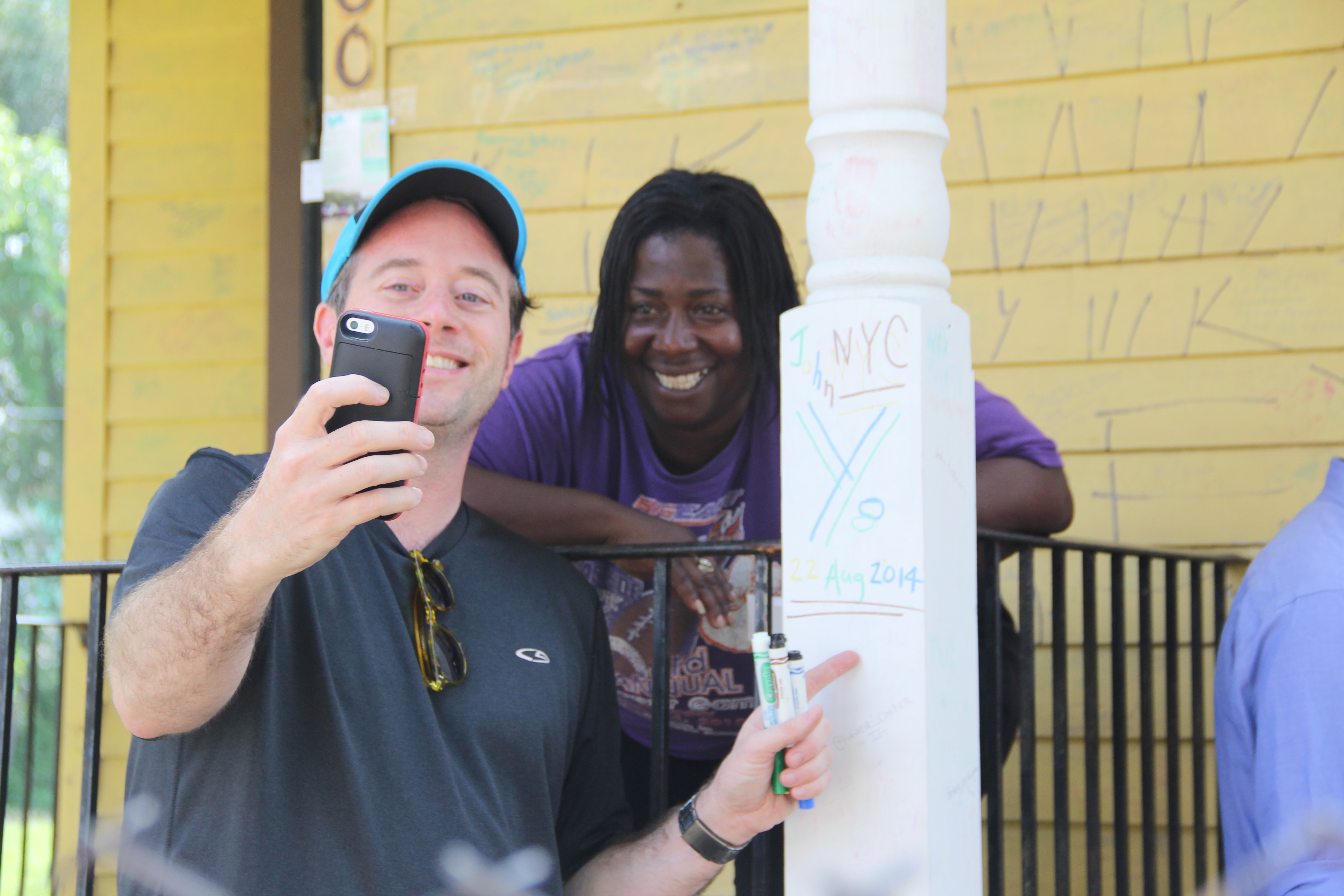
Don’t scratch your name in the wall OF COURSE! – But, what do we take away with us from a visit to a museum? postcards, a book and a “selfie”. Why does this matter to a house museum site? Because what I consider important may not be the same for you. We have to allow a visitor to “FINGERPRINT” their visit in all kinds of ways. In this case, the “selfie” played a major role in the engagement of the site and artifacts. Allowing humor is another factor in “fingerprinting”. Just because we are making faces in our “selfie”, doesn’t mean that we are not appreciating the Snake-Dragon, Symbol of Marduk, the patron god of Babylon, Panel from the Ishtar Gate (604-562 BC), Babylon, Detroit Institute of Art, 2011
In some cases, “fingerprinting” may be the desire to sit quietly in a space – as here in the Jefferson designed – University of Virgina Library Rotunda building, 1826. There are several important factors exhibited in this photograph: 1. The ability to actually sit (rather than forced to stand), 2. The ability to find a private space to engage the building on my own terms, 3. A non-interpreted environment in which one can individualize the experience.
In other cases, “fingerprinting” may exist in the need to take a rest from the activities of the day. This visitor engagement should not be seen as inappropriate, in fact this should be viewed as a sign that the visitor considers the site a safe-space to relax without any worries or judgements. This photograph was taken in the rose gardens of Lyndhurst Estate in Tarrytown, New York, house designed by Alexander Davis in 1838.
A “selfie” at Grounds for Sculpture, Trenton, New Jersey. 2014.
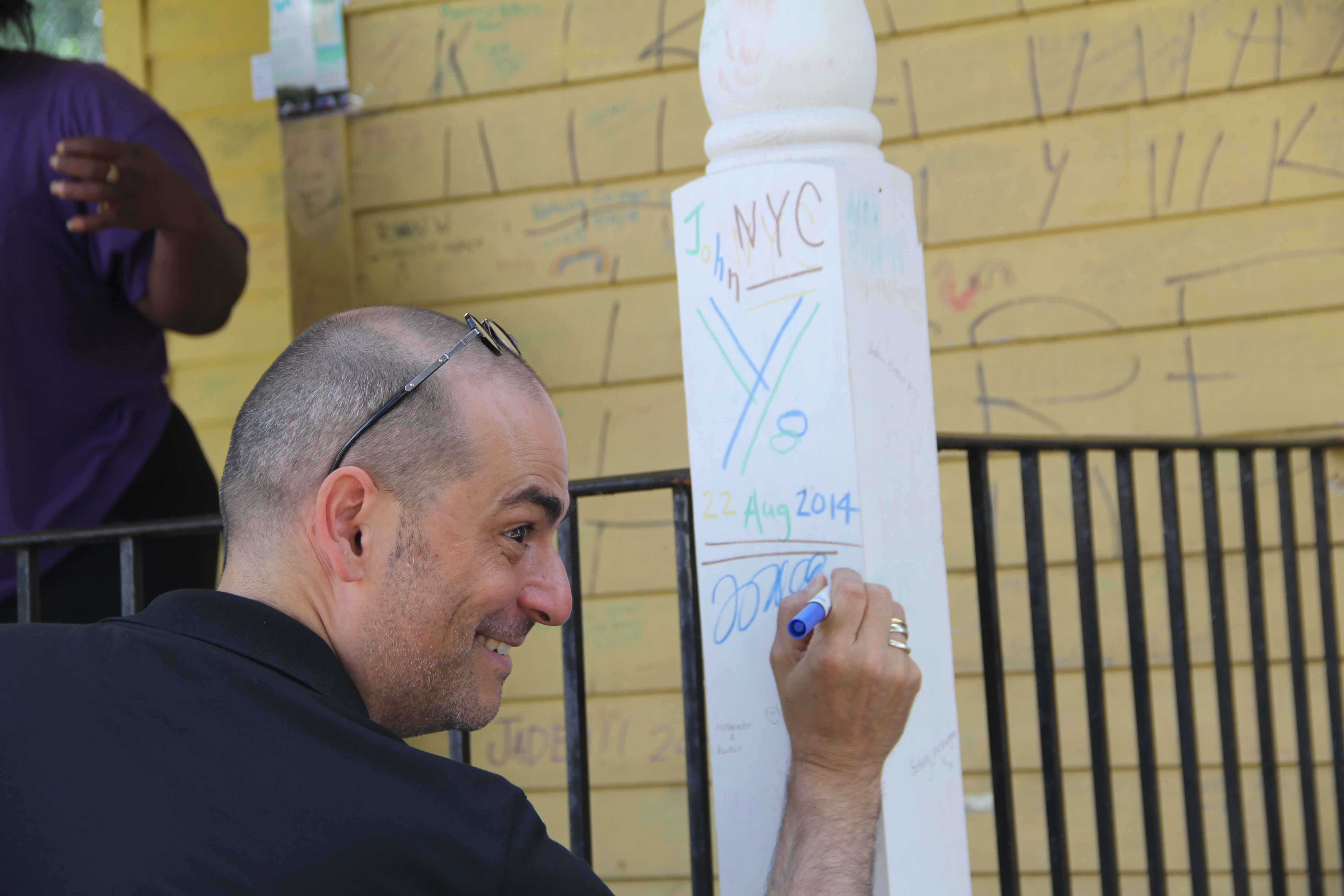
Several ideas of “fingerprinting” are shown in this photography; 1. You can donate toward the restoration of a house project and in exchange you can write on the house itself. In essence literally leaving your mark on the process of preservation (Heidelberg Project, Detroit Michigan, The “yellow house”), 2. the owner of the “yellow house” engages a visitor/donor on her porch and poses for a “selfie” as part of the experience. In this way the visitor leaves something and takes something away with them. 2014.
Making your mark on the “yellow house” at the Heidelberg Project, Detroit, Michigan. 2014.
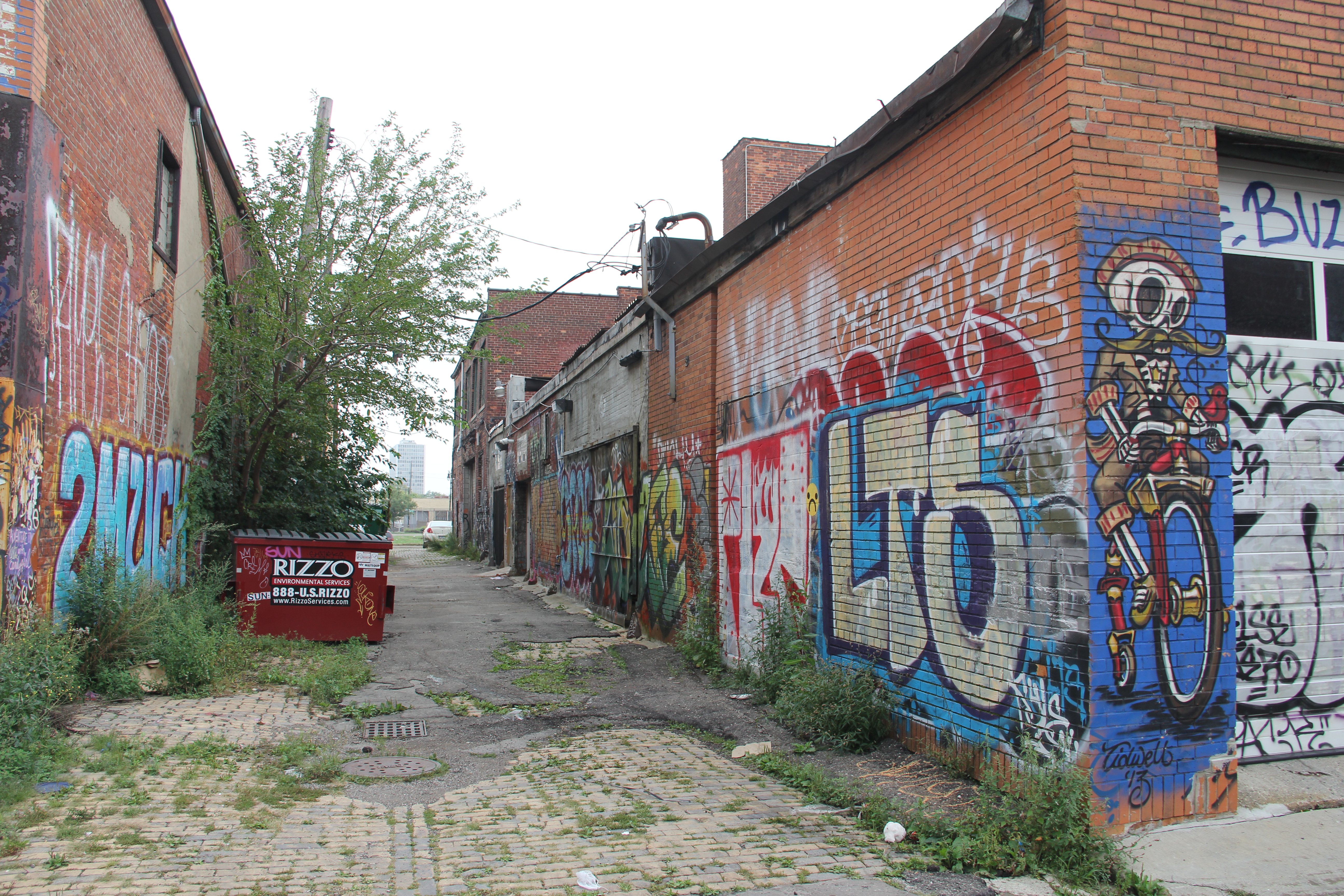
It’s not hard to see why “tagging” with street art is a form of place-making as in this alley in Detroit, Michigan. 2014.
Forms of guerrilla art, such as these artist produced leaflets, also are used a means of “fingerprinting” an urban space and personalizing it. Detroit, 2014. Take a look at this link – Paris Locks
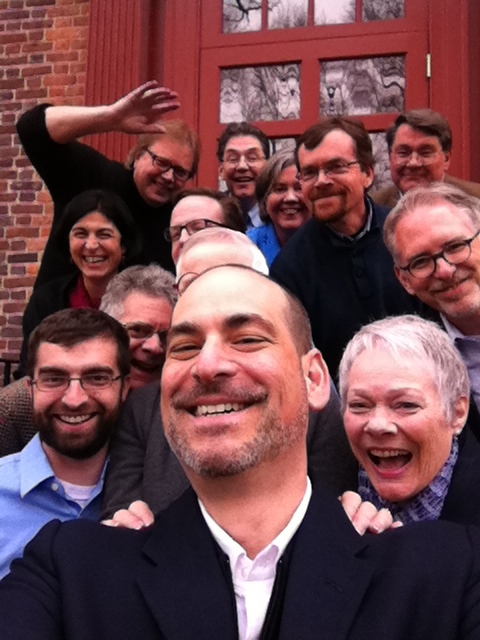
Even us museum nuts enjoy a “selfie” after a Chipstone Foundation THINK TANK. The THINK TANK was one in a series of discussions to help re-envision The Wilton House Museum. http://www.wiltonhousemuseum.org
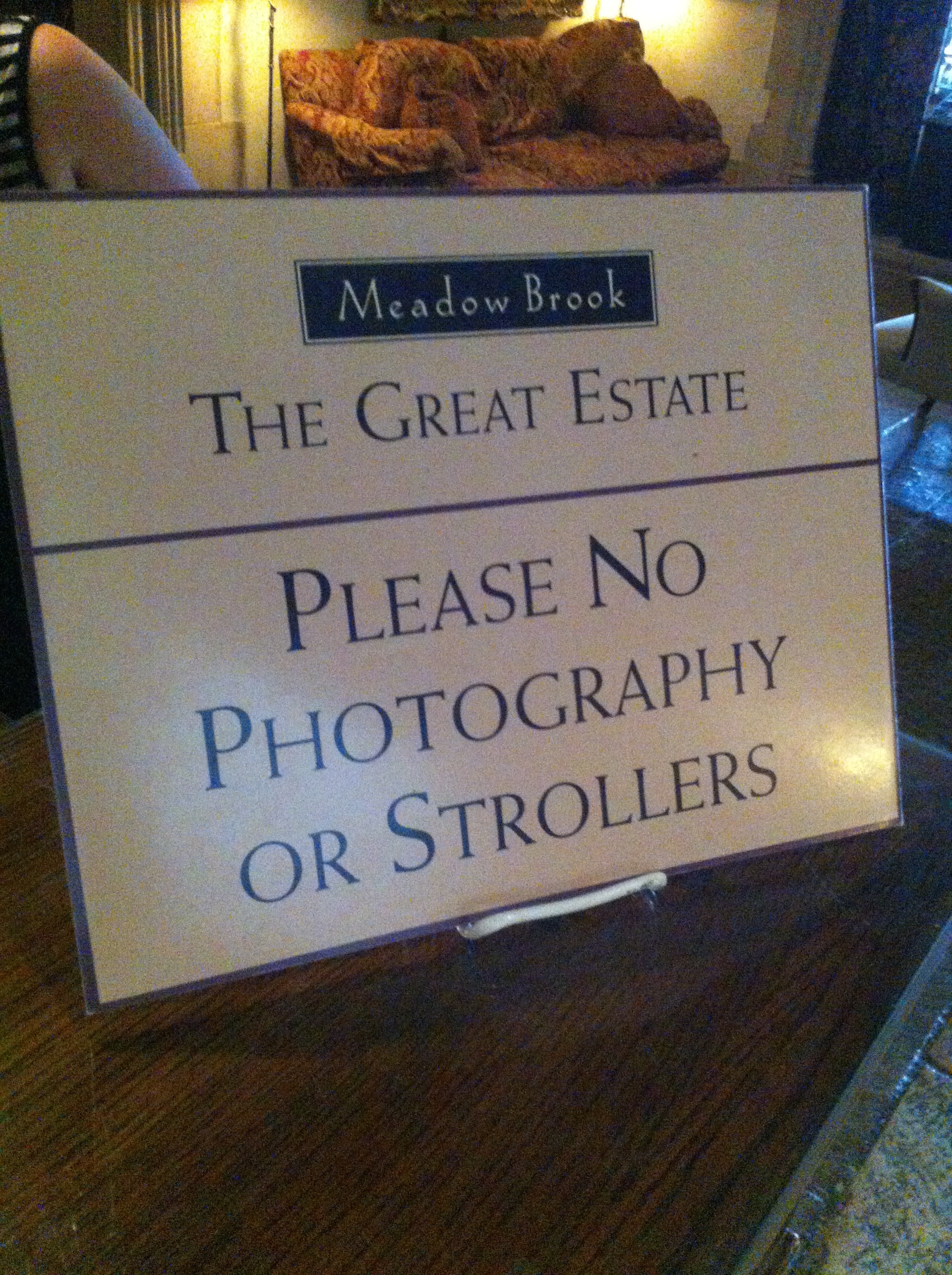
Meadow Brook Estate, Rochester Hills , Michigan Unfortunately, after seeing the above sign (my family group and I)- walked straight to the gift shop, bought a post card, and got in our car & left. We proceeded to have a great lunch instead of a restrictive tour. All of this – after we traveled out of way to go and see this estate.
Schindler House & Studio, West Hollywood, CA, 1921-1922, Bathroom. “I shut the door, locked it, and in silence and intensity just stood there – looking around…when (if ever) have I actually been able to use the authentic bathroom and toilet of an historic house museums? “
Johnston-Felton- Hay House, Macon GA, 1855-1859. During an “Anarchist Guide to Historic House Museum” workshop at the Haye house, the group was allowed to roam freely, open all doors, closets and ask questions as needed. Interestingly someone found this toilet room at the top of the main stair hall and asked a question- Awkward Silence. The Executive Director proceeded to tell us the story that the very obese owner died on this toilet and they had to remove him through the window with great mechanical assistance. I sat down on the toilet and started asking more questions! This became one of the highlights of the workshop.
Greenbelt Museum’s Historic House, Greenbelt, MD, 1936-1952 WPA planned community housing. On a recent trip to the WPA Greenbelt Historic House Museums, I once again was allowed to actually use the historic house’s bathroom. Not only that – I could weigh myself on the vintage scale. The scale of this room and its function perfectly manifested how a notion of habitation can pull in a visitor and compel them to ask for more information. This house was fully interactive and completely engaging.
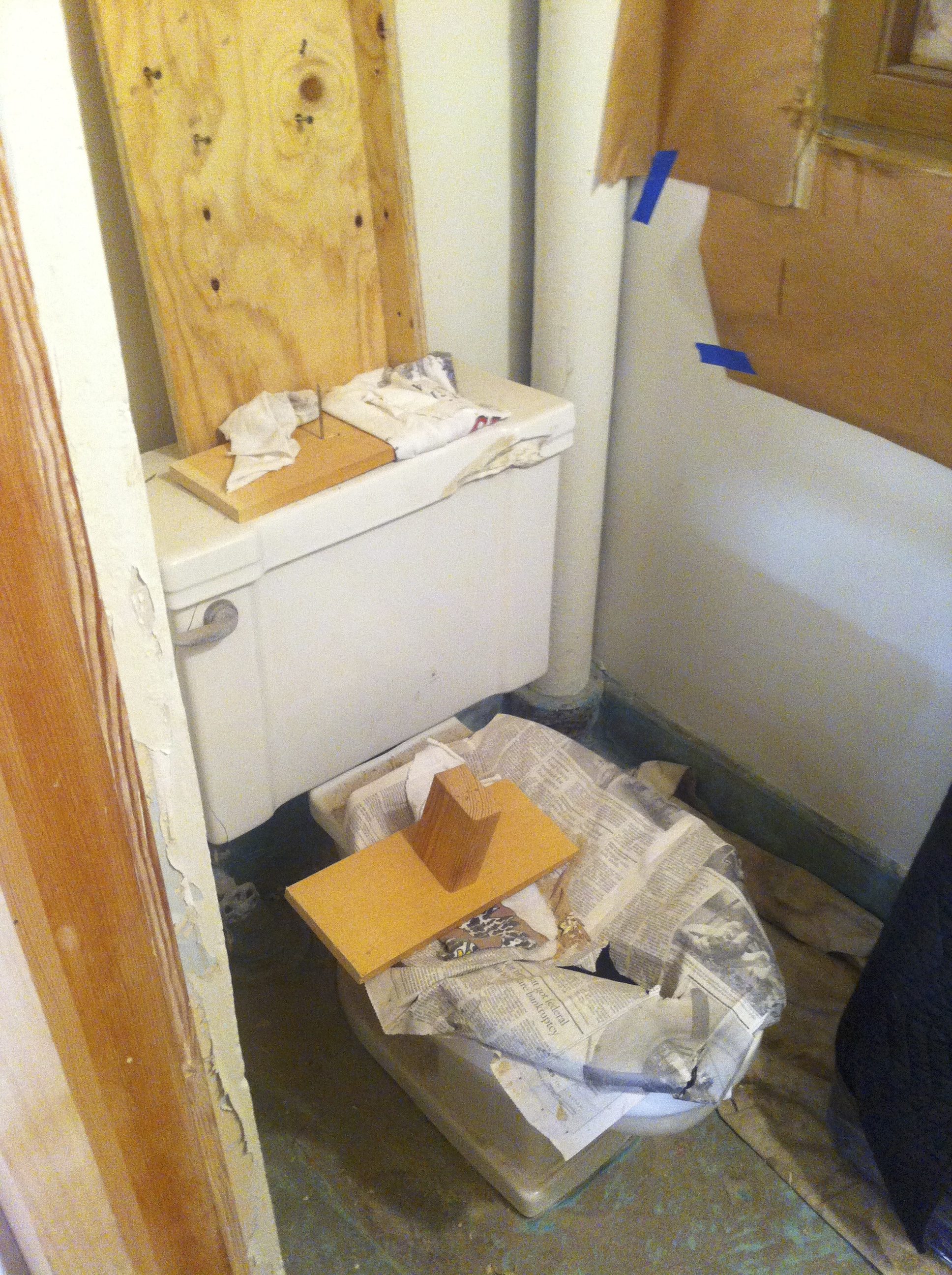
Hollyhock House (Barnsdall House), LA, CA, 1919-1921. Bathroom during renovation. Toilet as “collection artifact”.
Lott House Interior, Brooklyn NYC, photo shoot for Historic House Trust of New York City (James Graham – photographer) behind the scenes image by J. Yeagley
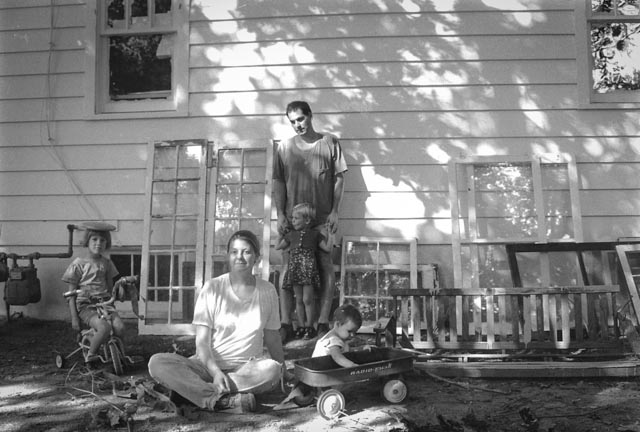
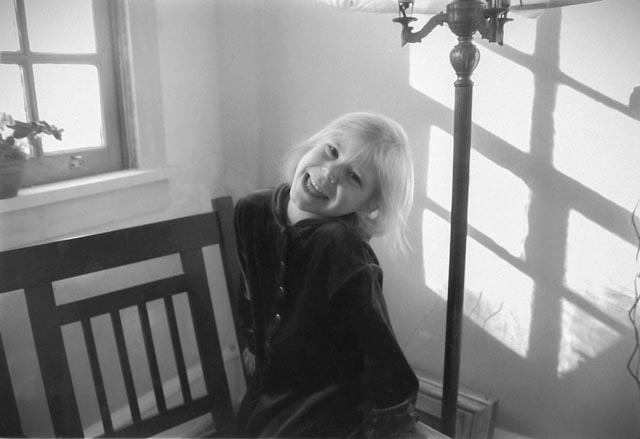
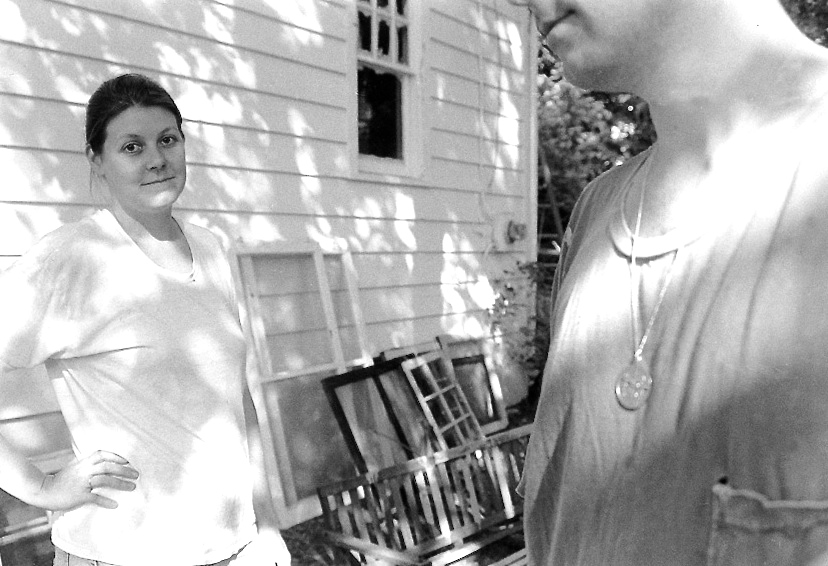
Franklin Vagnone with Laura Orthwein, Claire, Emma and Sophia – surrounded by a few of the extensive window sash collection. Photos by Daniel Eller. 2001.
I realize most people would see my view of the world as unbearably right brained. But for me, right now, while restoring my arts and crafts bungalow, the act of reviving old windows has become a way of thinking about my life and the world around me.
I wonder; how will my children remember these chaotic summers of renovations? Are they only taking in the apparent disorder, or are they somehow aware of the greater harmony I feel at work underneath? When I grit my teeth over their little drywall-dust footprints artistically patterned over the floors and up the stairs, – Does it bother them? What they will remember of me, and of this, when I am gone from this world?
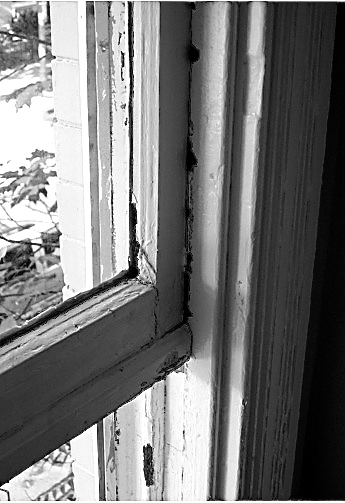
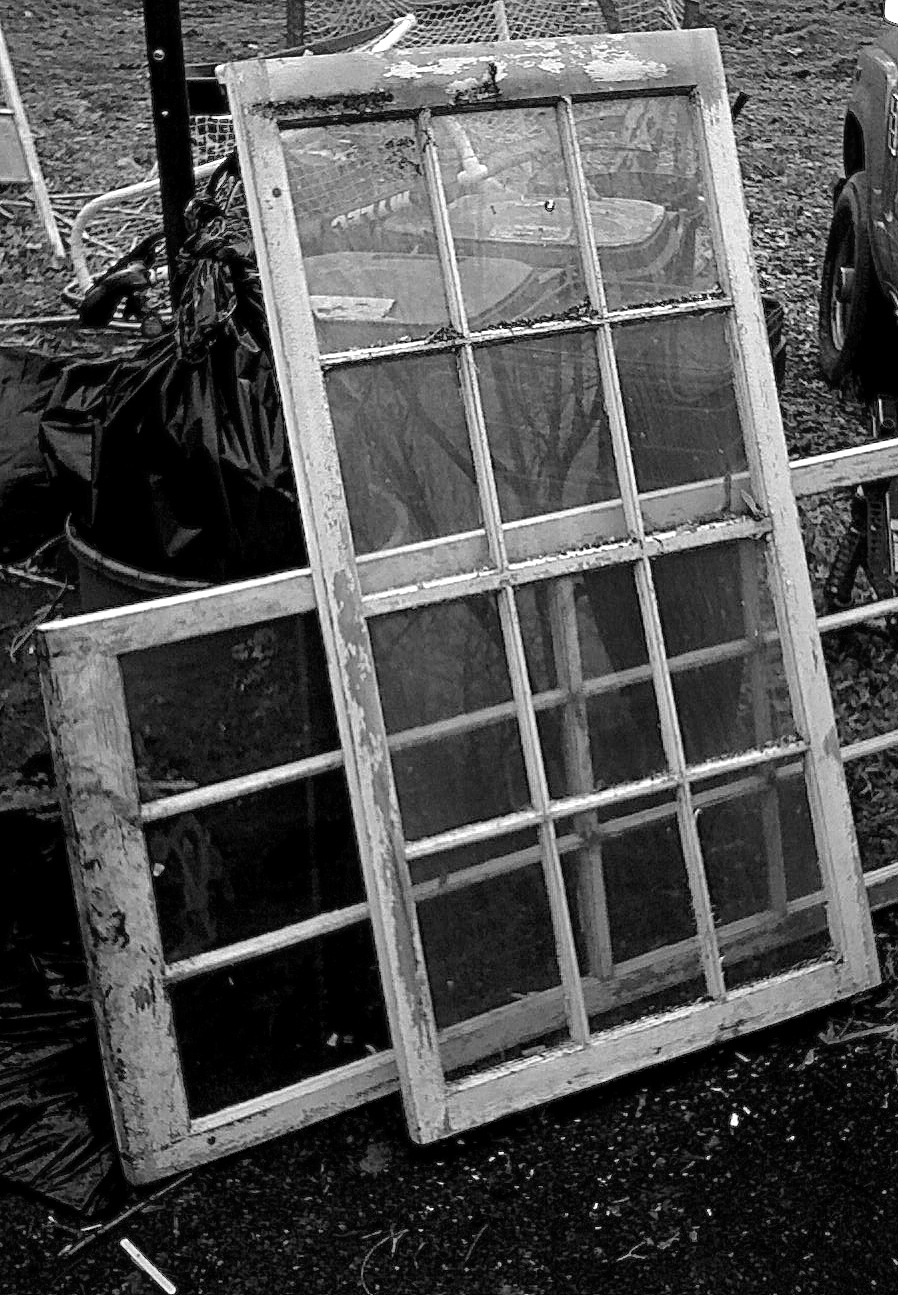
A window released from restraint & paint is so beautiful. It seems to gasp for air as you remove the suffocating pigment from its skin. Photos by Franklin Vagnone.
One thing my kids may remember of me is that I collect old windows. Lots and lots of windows – Piles of windows. I run a foster home for old windows. I recently had a contractor tell me (as he dropped off yet more discarded old windows from a job site) that he liked old doors the way that I like old windows, except not so extremely. I found comfort in the thought that others too might be stricken with an uncontrollable need to free all double-hung windows from years of imprisonment; to be rewarded with active service from these particularly useful member of the old house team; but am I extreme? Would my kids remember me as extreme?
In every act of making & re-making, there lies latent within further potential, like the seed in a fruit; future generations are already present. From every work of restoration, seeds once dormant germinate begin to grow. Photo: Grumbelthorpe Historic House Museum, Germantown, Philadelphia. Damage due to a brick thrown through a window. Photo by Franklin Vagnone.
My enthusiasm for both the material and metaphor of old windows leads me to try and convince others that they are worth the trouble of befriending. Most just see the trouble. And I do have to go through a lot to free a window. Before I can actually re-hang the window sashes, I have to pull out the stop, pry out the nails keeping the windows shut, scrape away the caulking that kept decades of winters outside, and, finally, force the sash free from bondage. Then I scrape away the old paint, sand the wood, re-glaze the exterior glass, attach new cord and the old weights to the sash, and finally test. The window must open and close using one finger.
There is no struggle with a properly restored window. Top and bottom slide effortlessly to open and close as needed. Why would someone nail, caulk, and paint a window shut? Or maybe more painful a question, why would someone go to the trouble of undoing someone else’s nailing, caulking, and painting shut of a window? I first learned to ask why more than 20 years ago, when I first noticed a neighbor carrying one of his window sashes to his workshop. I wondered, “Where did he get that? How did it come out of the window? What’s he doing to it? And most importantly how do you get it back in? I couldn’t just leave this puzzel alone– – I had to actually move off my lawn chair and go and talk with him. My love of old windows had begun.
The act of stripping old wood down to discover the original grain is a labor of intense satisfaction. “The love we liberate in our work is the love we keep forever.”Elbert Hubbard. Photo By Daniel Eller 2001.
Sometimes windows are stupid; they can’t open or close . On the other hand, some windows have the ability to incrementally adapt to subtle nuances of need – to adjust. A good window moves. To nail a window shut is to deny the very purpose and usefulness of its existence. When I see an old house whose windows have been pried open and released from their artificially closed state, I can feel its thankful breath billowing in and out. All I can think about are the lives that depend on the house; that the good of a house is the dwelling in it.
Which leads me to my philosophy of old windows, born of my love of restoring them and what they have taught me.
I think that every generation deserves the right to re-establish, re-invent and restore itself. Like windows, we can open and close our minds as the decades pass. What’s a necessity in one generation becomes useless hardware in another. I believe to take something that has become obsolete, and restore it to its place as a useful object is a great application of the power of our minds. In doing so, we re-evaluate and re-purpose what came before, attaining a new understanding of how we want to live in the present, and what artifacts of our purpose we want to leave behind.
Restoring a window is not simply an act of re-possessing a material object, but is an honoring of a creative, productive, useful legacy.
Years ago, one of my young daughters sat watching me sand a window in our dining room, and asked why was I tearing a-part the house I replied that I wanted our windows to work, to be useful. She sat still – looking serenely at the hole in the wall that is the window and enjoying the breeze afforded by the opening, and said: “can I help?” I handed her some sash cord thinking that she would tie knots. She began to jump rope with it.
The philosophy of old windows had been reinvented.
I think that every generation deserves the right to re-establish, re-invent and restore itself. Photo by Daniel Eller 2001.
love of old windows takes tolerance – a lot of tolerance. Photo by Daniel Eller 2001.
NOTE: This article was originally written in 2001 and revised in 2014. Edited by Laura Orthwein with photographs by Daniel Eller.
How can historic house museums flip the script when connecting with local communities — by working backwards and rejecting traditional practices?
This mobile kiosk will provide an opportunity for Flushing residents to explore ideas and themes relevant to the historic Lewis H. Latimer House — outside the house and out on the street. Image: Historic House Trust of New York City.
To explore this topic from the angle of historic house museums, I reached out to Franklin Vagnone, the Executive Director of the Historic House Trust of New York City (HHT). I’d previously learned about his concept of the Anarchist Guide to Historic House Museums — and heard about an ongoing project that’s implementing the Guide, called LatimerNOW. This initiative is testing strategies for engaging visitors at the Lewis H. Latimer House in Flushing, Queens, New York.
In the conversation that follows, Franklin and I discuss the Anarchist Guide to Historic House Museums, how it challenges traditional thinking about community engagement, and how the experimentation in the LatimerNOW project is creating new possibilities for connecting people across cultural experiences and identities.
Franklin Vagnone, Executive Director of the Historic House Trust of New York City. Image: Franklin Vagnone.
Kendra Danowski: When we started discussing this month’s topic of cross-cultural collaboration, partnerships, and relationships, I immediately thought of the Historic House Trust’s LatimerNOWproject and all that you’re doing with your concept of the Anarchist Guide to Historic House Museums. First, can you explain the Anarchist Guide to me?
Franklin Vagnone: The Anarchist Guide to Historic House Museums is a collection of concepts that push for historic house museums and sites to rethink their relevancy and how they project their information through engagement with communities.
We think that the traditional kinds of interpretation (blocking off furniture, locked drawers, telling only one individual’s story) needs to be expanded to a long list of practices that is probably very counter-movement to the “best practices” for historic house museums. That’s what the Anarchist Guide is.
KD: What is the Anarchist Guide’s philosophy on community relationships?
FV: Well, we actually say that’s where everything starts. Most historic houses and sites do not engage the communities that immediately surround them. Many times we will hear people say, “I’ve lived here my whole life, and I never knew that that was a historic site that was open to the public.” That’s a clear signifier that these sites are not engaging their next-door neighbors.
So, instead of first asking, “What’s the story to tell?” we suggest that it’s more powerful and compelling to invert what historic house museums have traditionally done and start engagement with their neighboring community, not end there.
The problem is not that we have a group of disinterested people not coming to our historic sites — what we’re suggesting is that historic house museums need to find out what their communities are interested in, and work backward to build meaningful programming and opportunities for engagement.
The LatimerNOW project’s Anarchist Guide advisory team. Image: Historic House Trust of New York City.
For instance, that’s why the Anarchist Guide team for theLatimerNOW project is composed as it is. The members of the project team collectively speak seven languages and are from a handful of different cultures, identities, and experiences – but that was intentional when we started this project. That’s not simply how we ended up.
KD: It seems like these are intentional connections that you’re making based on your knowledge of the community and the various ideas and experiences that are already there. Rather than saying, “Here’s what we have,” you’re asking your project team, “What can you bring?”
FV: Exactly. For example, we’re not saying, “We have a lot of beautiful blue and white dishware, let’s make programs for people who like blue and white dishware.” (Laughter)
On the contrary, the first step in the Anarchist Guide is researching a house’s neighboring community. So, in the case of the LatimerNOW project, we completed some significant demographic research in the community of Flushing, Queens, which guided who we pulled onboard for the advisory team, and told us things we didn’t know about the community. By working to understand the needs and interests of the community, we’re able to guide our programming and explore new ways to interpret the narrative of the historic house.
KD: So, that research helps you identify common threads and build connective narratives that might not be so immediately obvious.
FV: Yes. So, in the case of the LatimerNOW project, the primary narrative is the incredibly important legacy of African American inventor, Lewis H. Latimer. But, after doing demographic research, we realized that less than 2% of the population of Flushing is African American. And 85% of the population is first- and second-generation Mandarin-speaking Chinese immigrants.
The research has shaped the project’s big question: How do we take – and not lose – an important African American legacy and story, and intertwine it with stories that will speak to the Mandarin-speaking Chinese population in Flushing? If we hadn’t done our research, we might just solely create programs directed at the African American community, or at people who are interested in inventors and inventions, and that would automatically be self-limiting to what our potential audience could be.
Furthermore, our research also taught us that there was no cultural precedent for historic house museums in China. The only historic sites that they have a similar idea are really large palace. So, the Chinese community really didn’t even have a kind of sense of why the Lewis H. Latimer House was there. It’s a kind of institution whose purpose had no significance for this community.
KD: There’s no precedent for even understanding how to interact with the house.
FV: Exactly, like, “What is that? What do you do? Do you go there?” There just was no understanding of it.
KD: It seems like this research has also allowed you to recognize assumptions being made about who would be interested in the Lewis H. Latimer House. Are you recognizing that those assumptions are not necessarily true, and don’t have to be true?
FV: Definitely. We, as museum professionals (including myself), will often present these assumptions about who our communities are without realizing that there’s a kind of bias in them.
KD: Let’s talk a little bit more about the LatimerNOW project. What is the Lewis H. Latimer Historic House Museum?
The Lewis H. Latimer House in Flushing, Queens. Image: Historic House Trust of New York City.
FV: Lewis H. Latimer (1848-1928) was the son of runaway slaves who was an extremely important inventor and electrical engineer. He is best known for working with Thomas Edison — he invented and patented the carbon filament, which made it possible to create mass-producible light bulbs. So, Lewis H. Latimer is a really significant inventor – not just because he’s African American, but because he played a critically important role in the formation of lighting and electricity.
He lived with his family in New York City in Flushing, Queens, in the house that’s today named after him. The physical building hasn’t really had any traction as a cultural center in neighborhood. There’s an interesting state of change and transition with this particular house and the surrounding community, which is why we chose the Lewis H. Latimer House to prototype the Anarchist Guide.
Last year, New York Community Trust gave us a $100,000 grant for a two-year project to take the Latimer House, which is not by anyone’s standards an economically or programmatically successful historic house museum, and experiment with as many of these Anarchist Guide concepts to see if they can impact the house and its neighboring community in a positive way.
Our first year was really about community engagement, finding out who the stakeholders would be, and assessing what we have as far as collections at the house. The second phase will start in July and is about figuring out how to implement these ideas, engage the community with real programs and events, and start to see if we can make the Latimer House an important presence in Flushing.
KD: How are you beginning to shape and implement programming that feels authentic and is able to create cross-cultural relationships or experiences?
FV: We recently held a pilot event called Latimer Lounge, where we invited poets, artists, and performers of different ethnicities and languages to gather at the Latimer House for one evening. They spoke about the idea of creativity in all aspects of life, like in the culinary arts, for example. It was a successful test to see if people were interested in gathering together in that way, and it worked – we had a full house.
Latimer Lounge is just one way we’re trying to connect people across experiences by stretching beyond Lewis H. Latimer’s life narrative to explore simply how he was a creative person: an inventor and poet, among other practices.
One of the Anarchist Guide tenets is that we don’t dedicate a house to just one person. So, we’re interested in exploring the stories of Latimer’s wife, his daughters, and his grandchildren, and what they ended up doing. For example, the site also has history as a boarding house – one of Latimer’s daughters rented out the upstairs to African American women who were attending college. By also engaging those stories, it expands the opportunity for connecting with a much wider range of people in the immediate community across cultural experiences
KD: Oh! So, for example, the Latimer House might also provide a space to explore what it meant for a young woman going to college in the mid-20th century, which allows you to make resonant connections to other young people today who are pursuing educational opportunities. It sounds like there are many possible narratives to explore through the Latimer house, which opens doors for more interested visitors than you might originally think.
FV: Exactly — in most historic house museums, it’s thought that the more narrow and focused the narrative, the better, and I disagree completely.
We don’t know if we’re going to succeed or fail. We’re going to try stuff and when it doesn’t work, we’ll try something else. What HHT is willing to do is to take the heat, and try it. That’s what the Anarchist Guide is all about – feeling safe and okay to try things and fail. Our project proposal even had a section called, “We’re Going to Fail,” where we talked about failure being built into this whole process.
KD: Cool! That is relevant to much of our work here. It’s risky to try new practices!
FV: I think historic house museums and sites feel like they always have to have the right answer, especially when it comes to engaging their communities. And the point is, with this project, that I don’t know the answer.
KD: As I was preparing for our conversation, I was thinking about the kind of vulnerability, honesty, and willingness to fail that the Anarchist Guide really seems to value. I’m learning that the Anarchist Guide views historic houses as spaces that embrace flaws and mistakes – and thus, they actually allow for more vulnerable and honest interactions between people of varied cultural identities and experiences.
FV: You’ve hit on that fundamental thing, which is that historic houses have lost the very quality that makes them compelling – that we lived in them. All of those interactions – and the real tangible qualities of those small spaces – are lost. Furniture is supposed to be sat in and eaten on! If you take all of that away, and you put a rope in front of it, and you tell the audience not to imagine themselves in a similar interaction, it makes everything so analytic. Nothing is real and tangible, and it eliminates thinking about the very experiences of day-to-day living that could potentially connect with people.
Doing things that “aren’t allowed” is probably what makes the Anarchist Guide the scariest for people. But ultimately, that willingness to break out of the traditional ways of doing things, and to harness collective wisdom and history, will allow historic sites to make resonant and relevant connections with and across communities.
The Anarchist Guide to Historic House Museums, on Facebook and LinkedIn
How does your artistic work foster collaboration across cultures? We encourage you to reflect on this month’s research questions and share your responses with us here.
Thaden Jordan mid-century modern sideboard. Molded birch plywood sideboard designed and produced by Thaden Jordan Furniture Corporation, USA, late 1940s – early 1950s. After selling this piece of furniture on Craigslist, I began to think about my relationship with the objects in my life & how that relationship has helped form a broad philosophy of preservation.
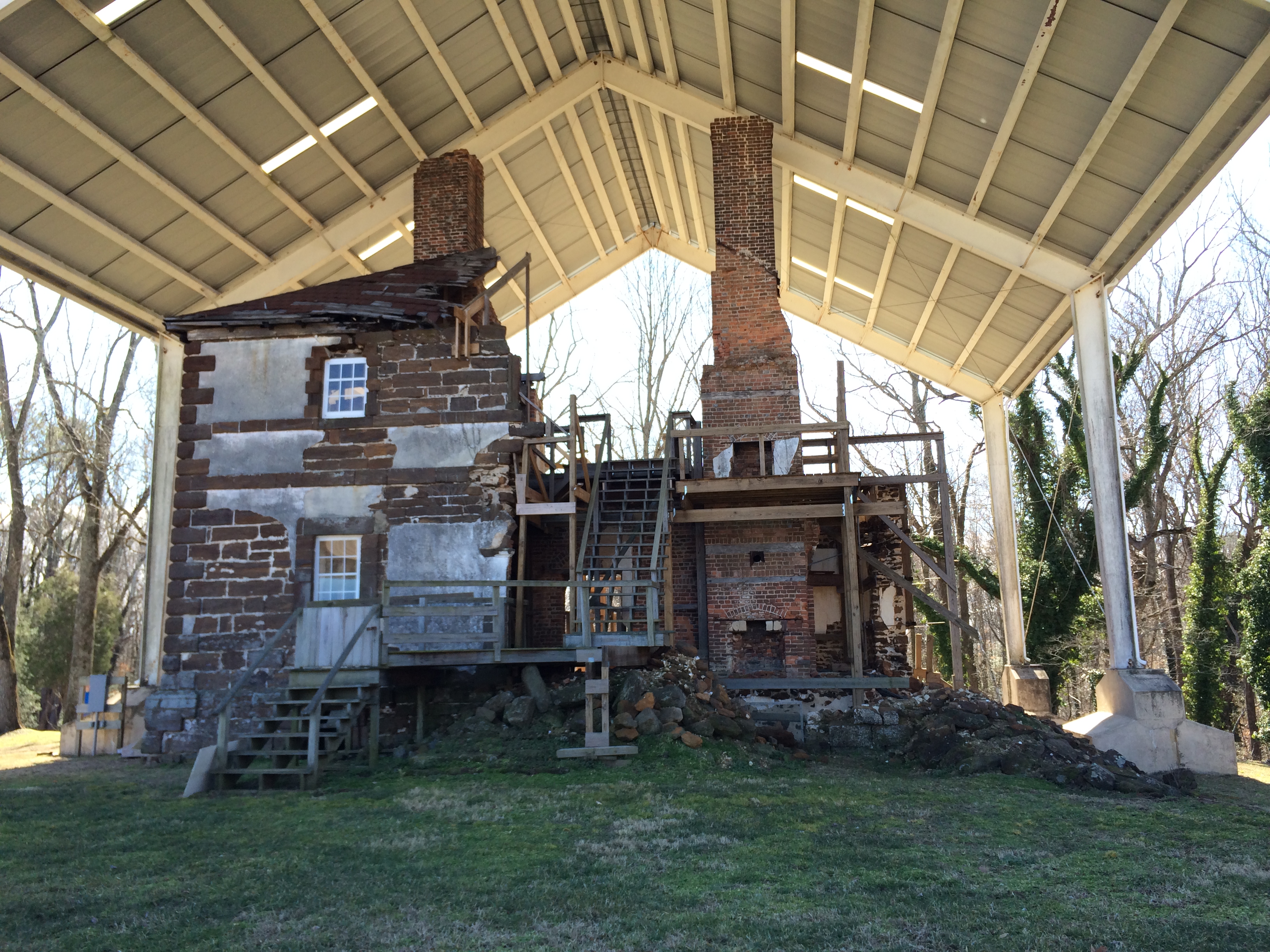
Menokin Historic House Site, c. 1769, Warsaw, VA. Stabilized preservation. My visit to this historic house site convinced me that the issues of preservation needed to embrace a full spectrum of solutions. I realized that we need to hold lightly to traditional models of historic site managment and business models so that new creative ideas can take root.
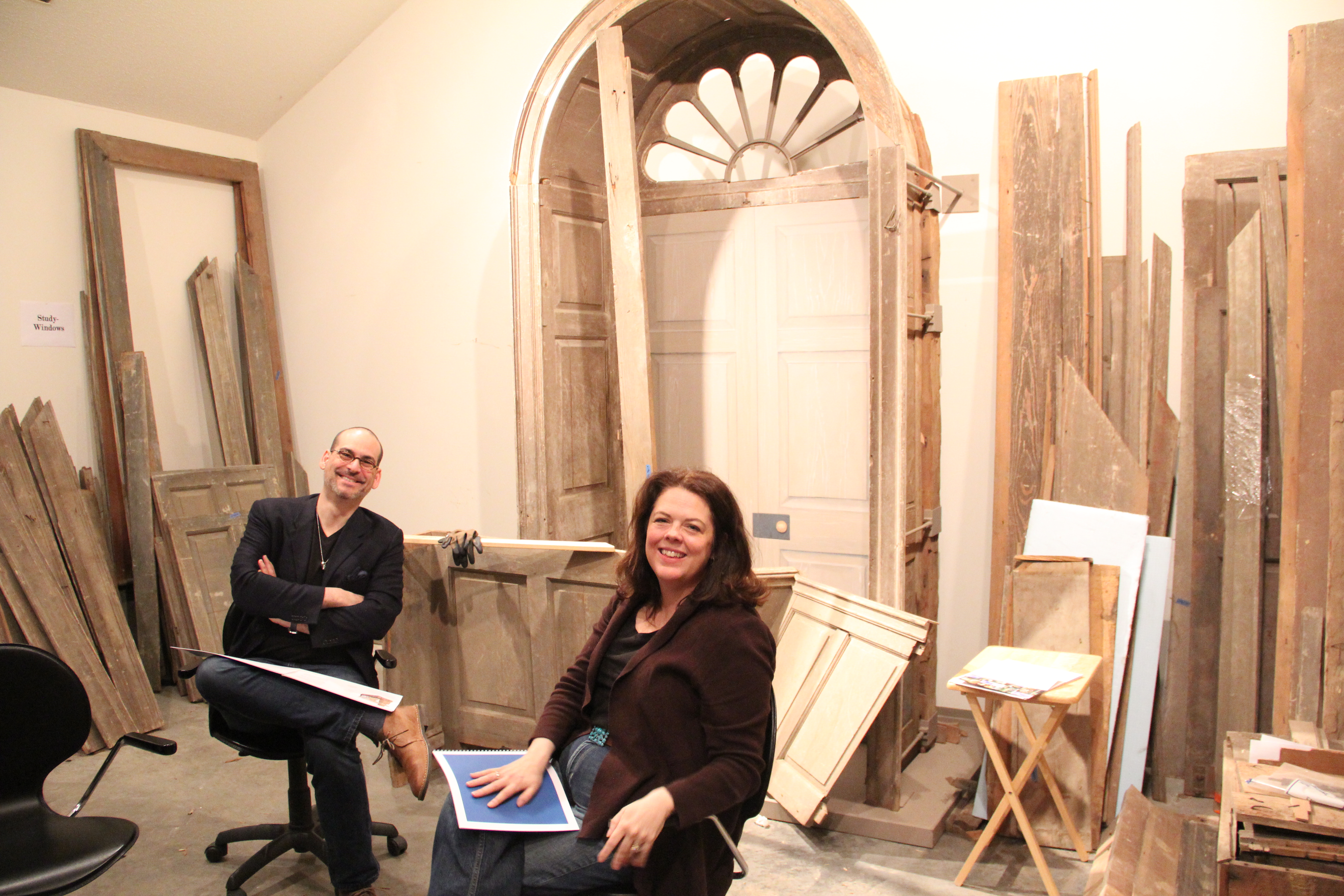
Menokin Historic House Site, c. 1769, Warsaw, VA. During my visit, I sat down with Executive Director – Sarah Pope – and discussed the special issues involved with the public use and “restoration” of the Menokin historic house site. All remaining interior wood fragments have been removed from the site and now rest within an an archive. In the past this house might be restored to it’s original character – today we are lucky to have forward thinking organizations like the Menokin Foundation considering alternative forms of preservation and public use.
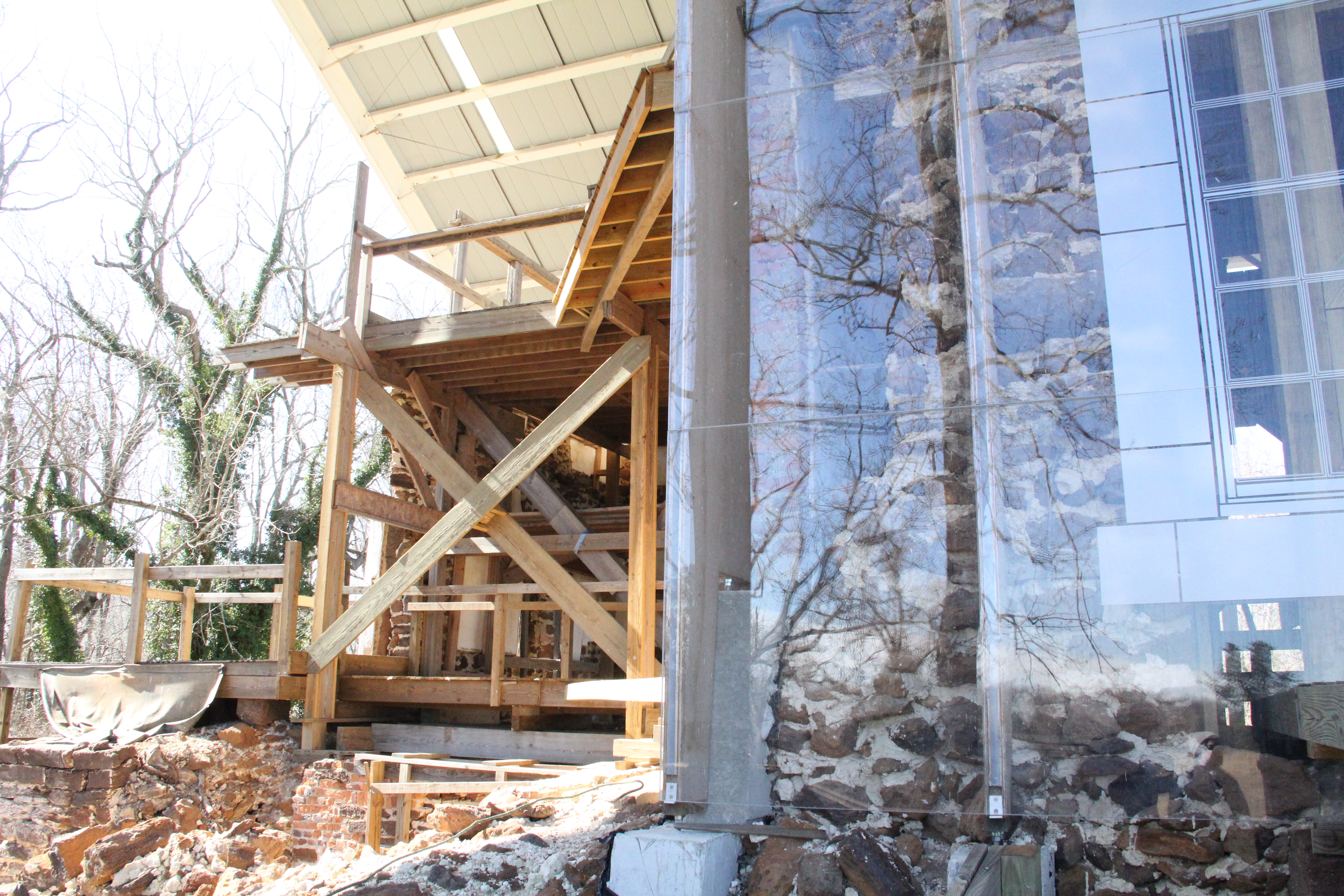
Menokin Historic House Site, c. 1769, Warsaw, VA. Image showing the conceptual idea of “restoring” the historic house by constructing glass walls. The new construction would show in a graphic manner the missing components of the structure. The interior of the completed structure could serve many uses such as a conference center.
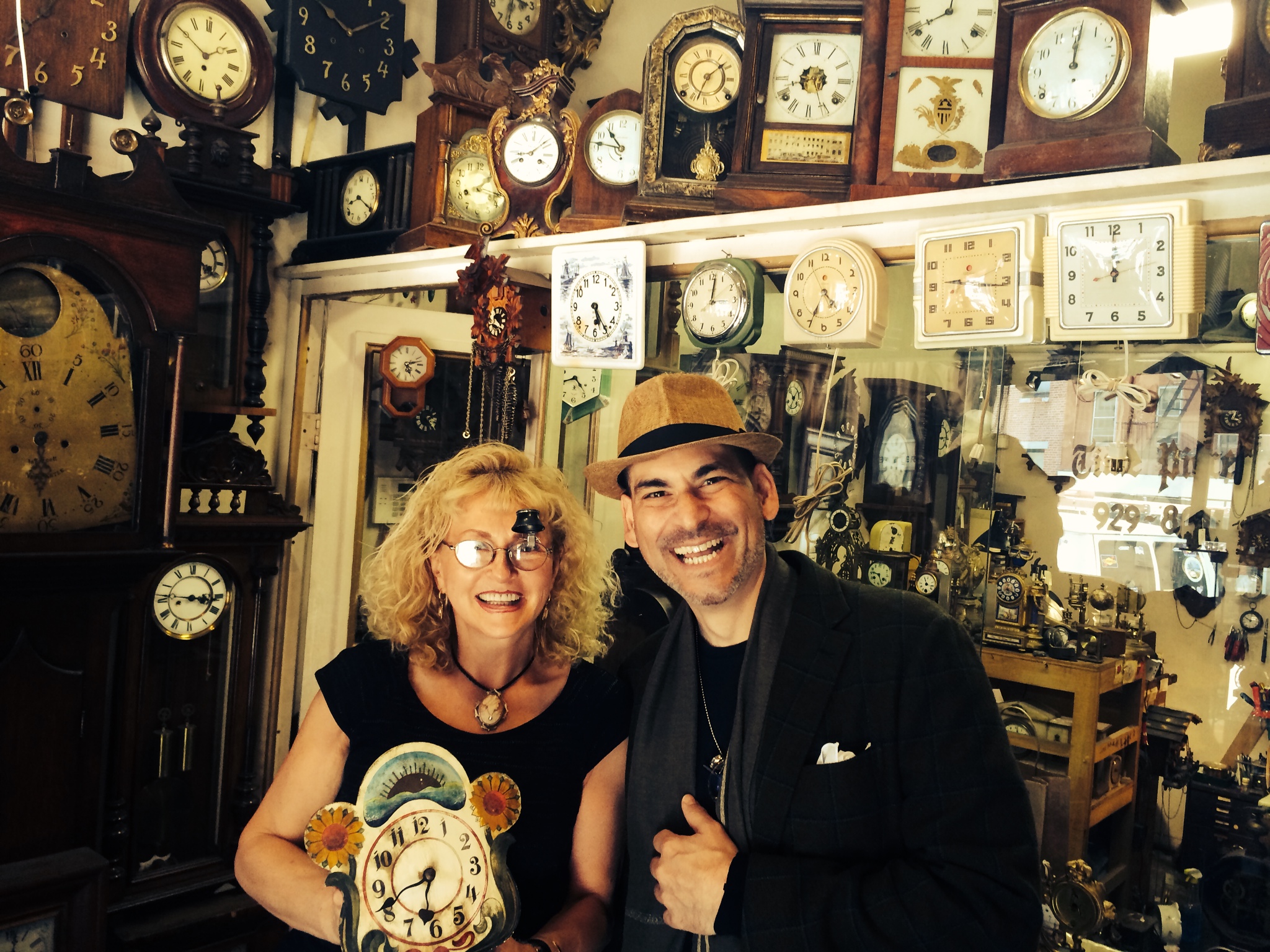
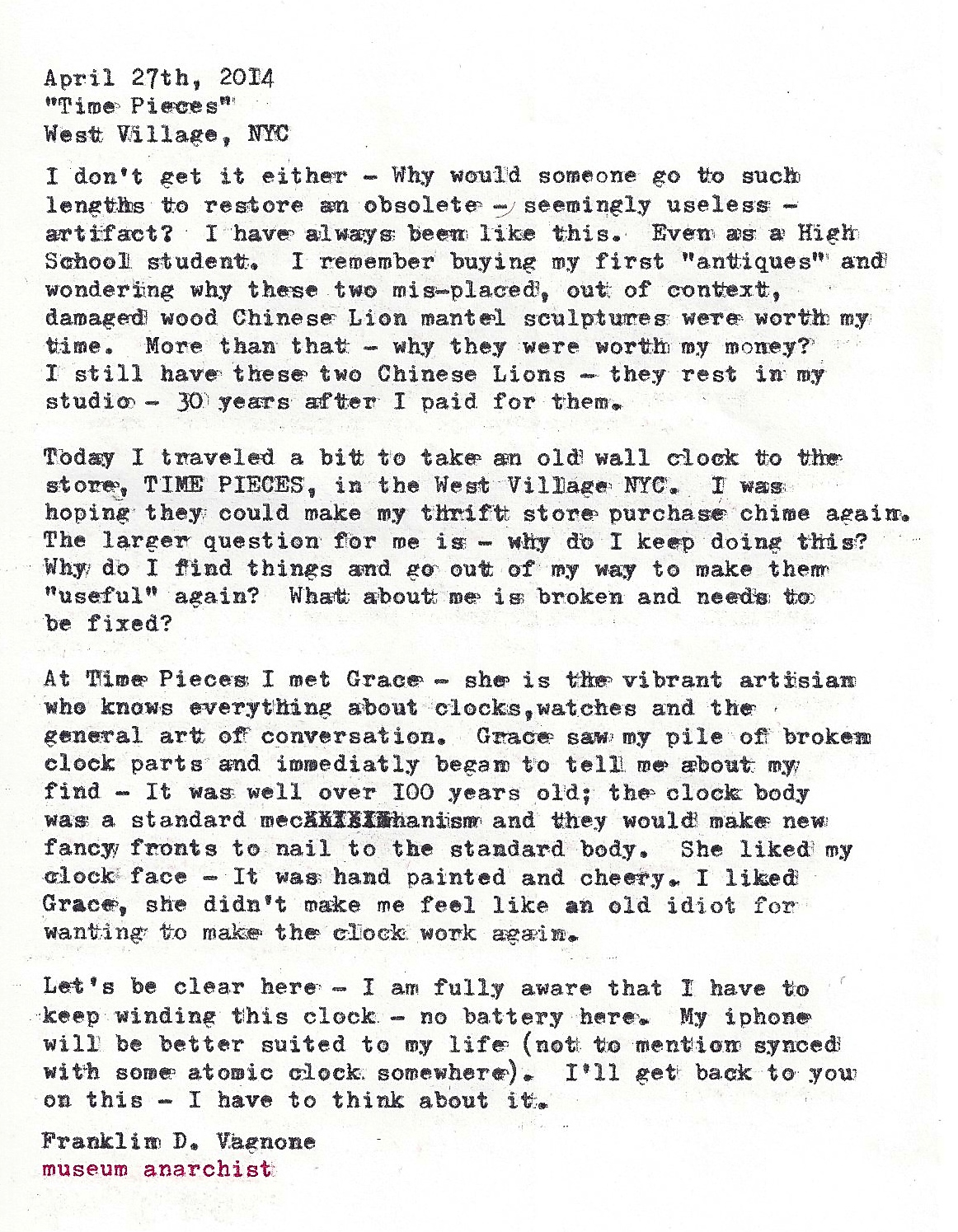
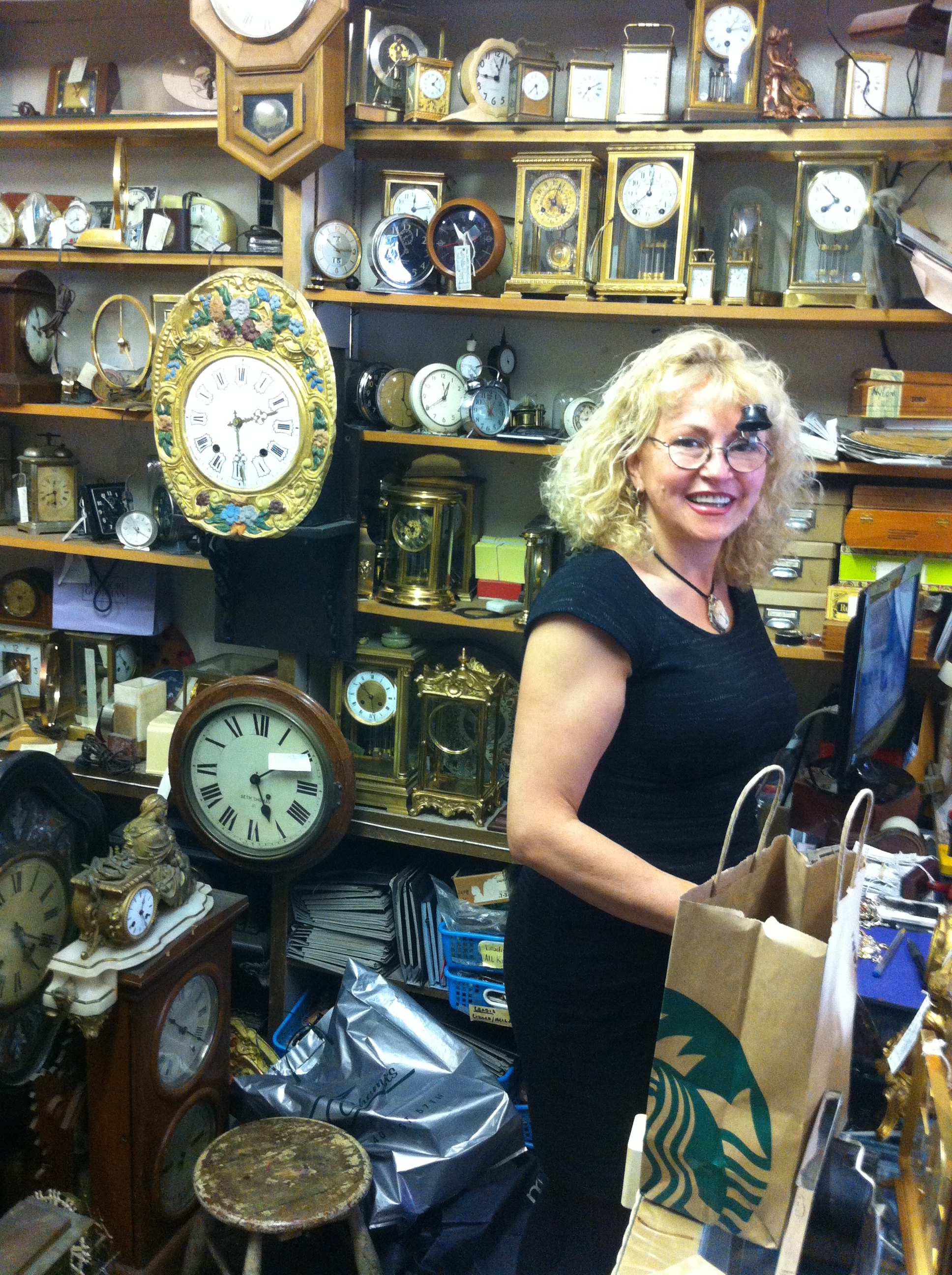
Here I am with Grace Szuwala, the owner of TIME PIECES. She understands my nutty behavior and is is going to help me by “fixing” my clock.
My clock doesn’t work on its own. I think there is hope – just listen!
The tiny store is layered in stories (and clocks)
Grace welcoming me back to her work-station.
The jewel-box of a store. The kind of store you walk right past and wonder how they stay in business.
Just to prove to you that I have always been like this – I still have the very first antique objects I bought. When everyone else was saving up money to buy the new NIKE tennis shoes, I was making payments on these Chinese Lions.
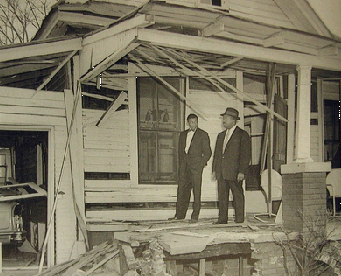
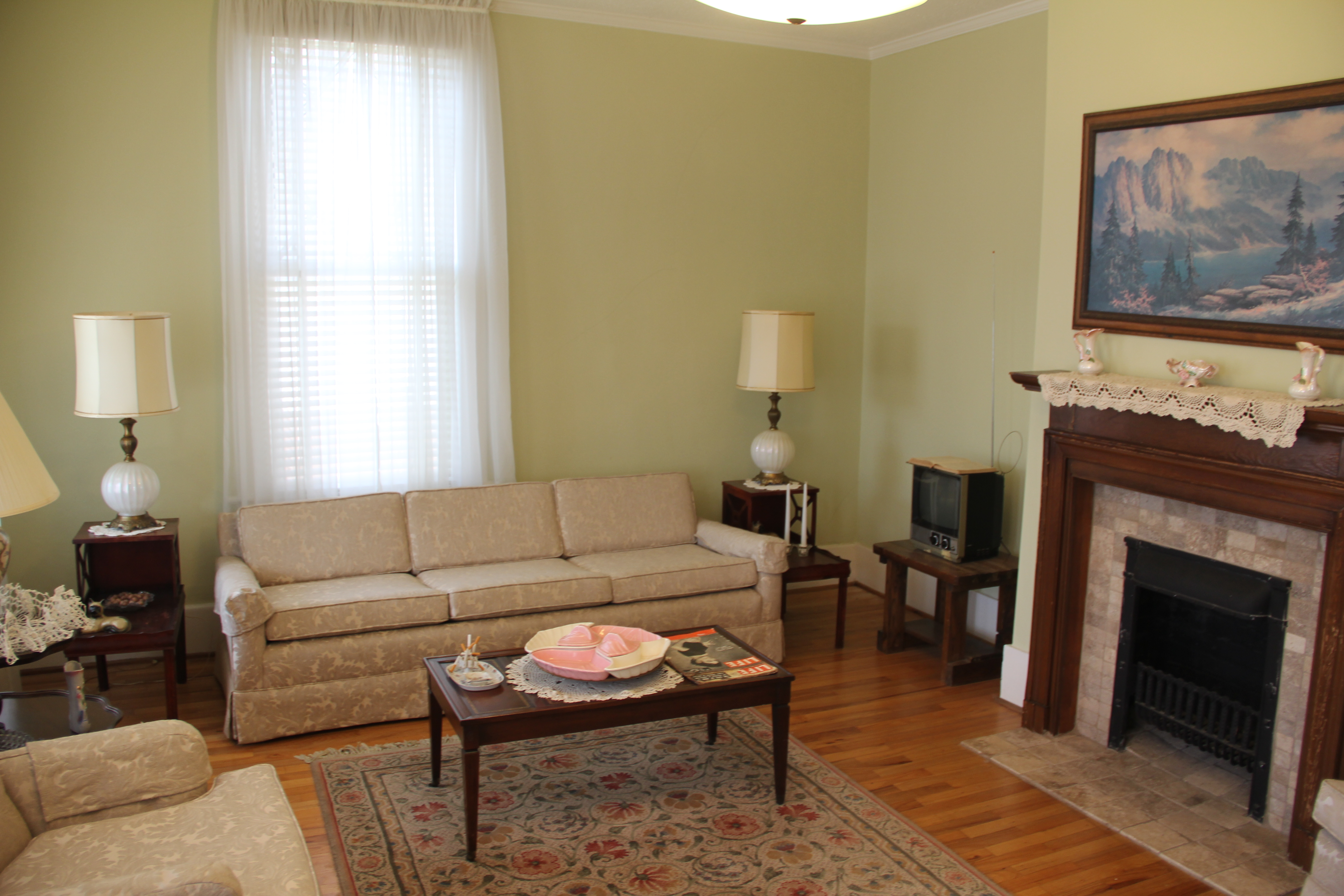
I traveled down to Montgomery, AL to visit the Dexter Ave. Parsonage. Dr. Martin Luther King Jr. and his family resided in this home during a 1956 bombing attack. It is now an historic house museum. (Image: Franklin D. Vagnone)
The damaged porch of MLK’s Montgomery home. (Image: blogspot.com)
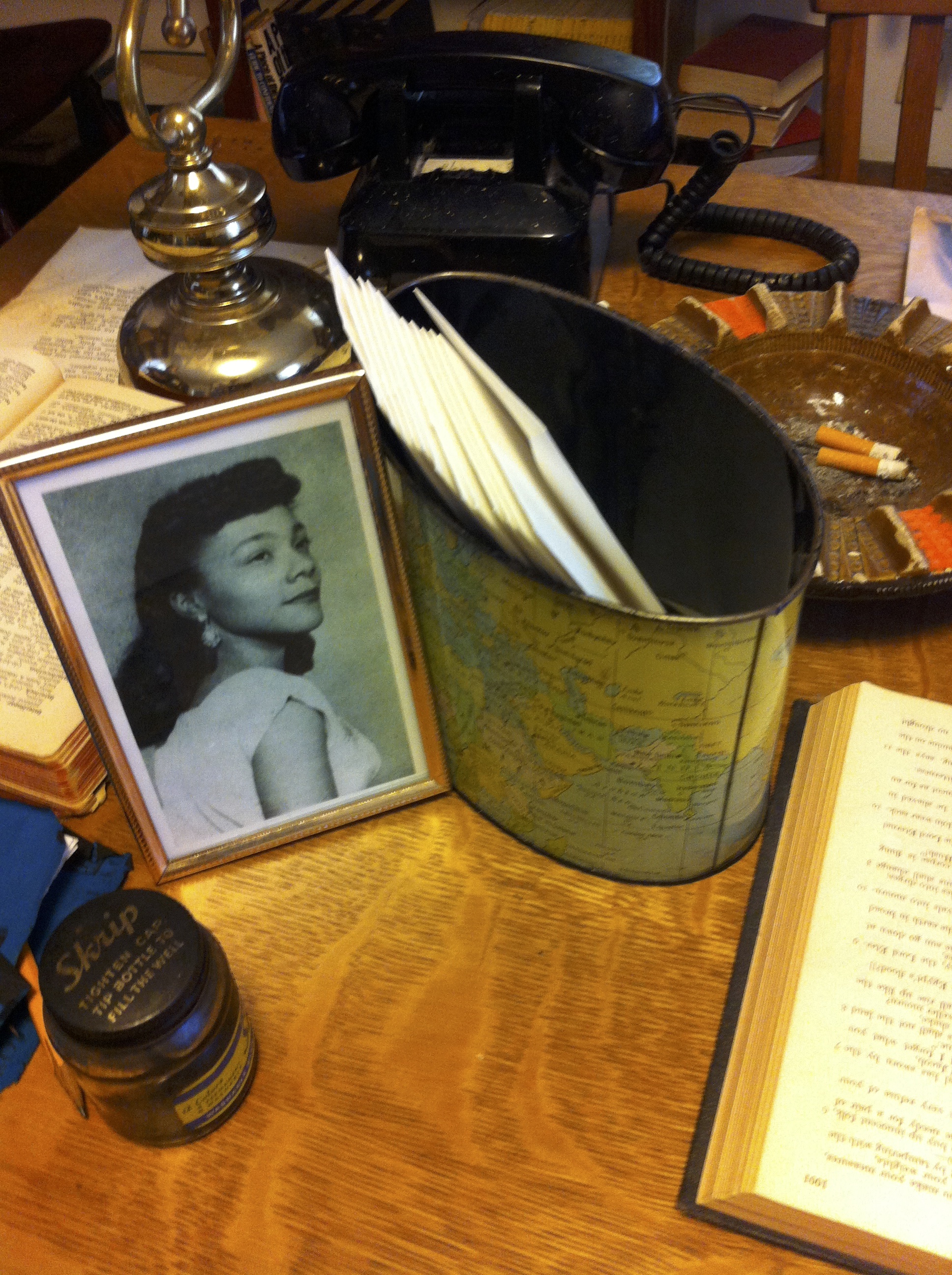
One of the most amazing things presented was the that MLK was a “closet” chain smoker – they had ashtrays throughout the entire house. This was done to make sure that you left that house museum knowing that MLK was flawed – not perfect. They told the story of his human side – such a rare message for a house museum. (Image: John F. Yeagley) On MLK’s desk sat a photo of his wife, a Bible, a book by Gandhi, and one of his many, many ashtrays. (Image: John F. Yeagley)
1. An amazing outbuilding. Private residence. Privy, Upstate New York.
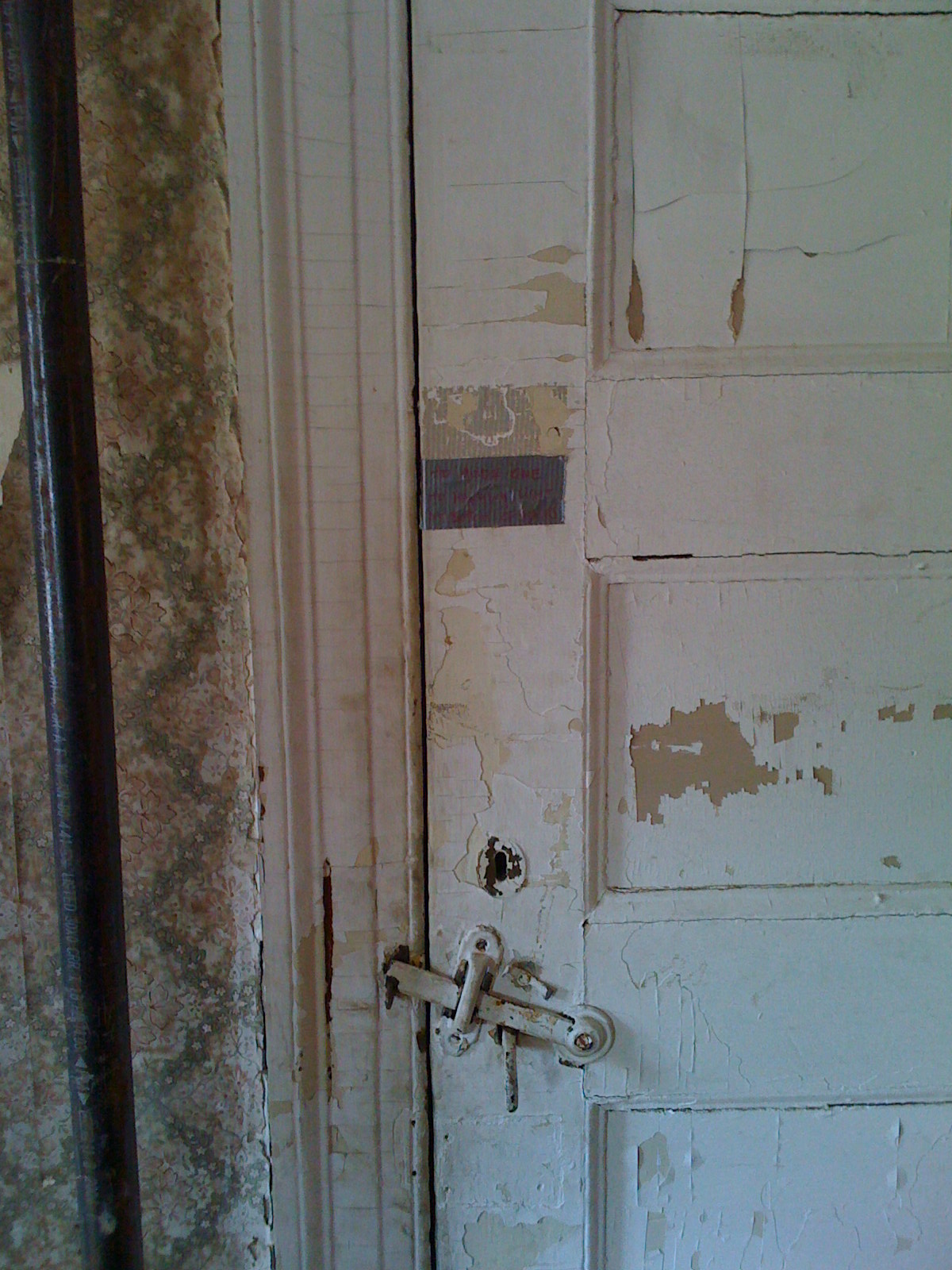
2. Multiple layers of history expressed through paint, hardware, wallpaper & many repairs. Lott House, Brooklyn, New York
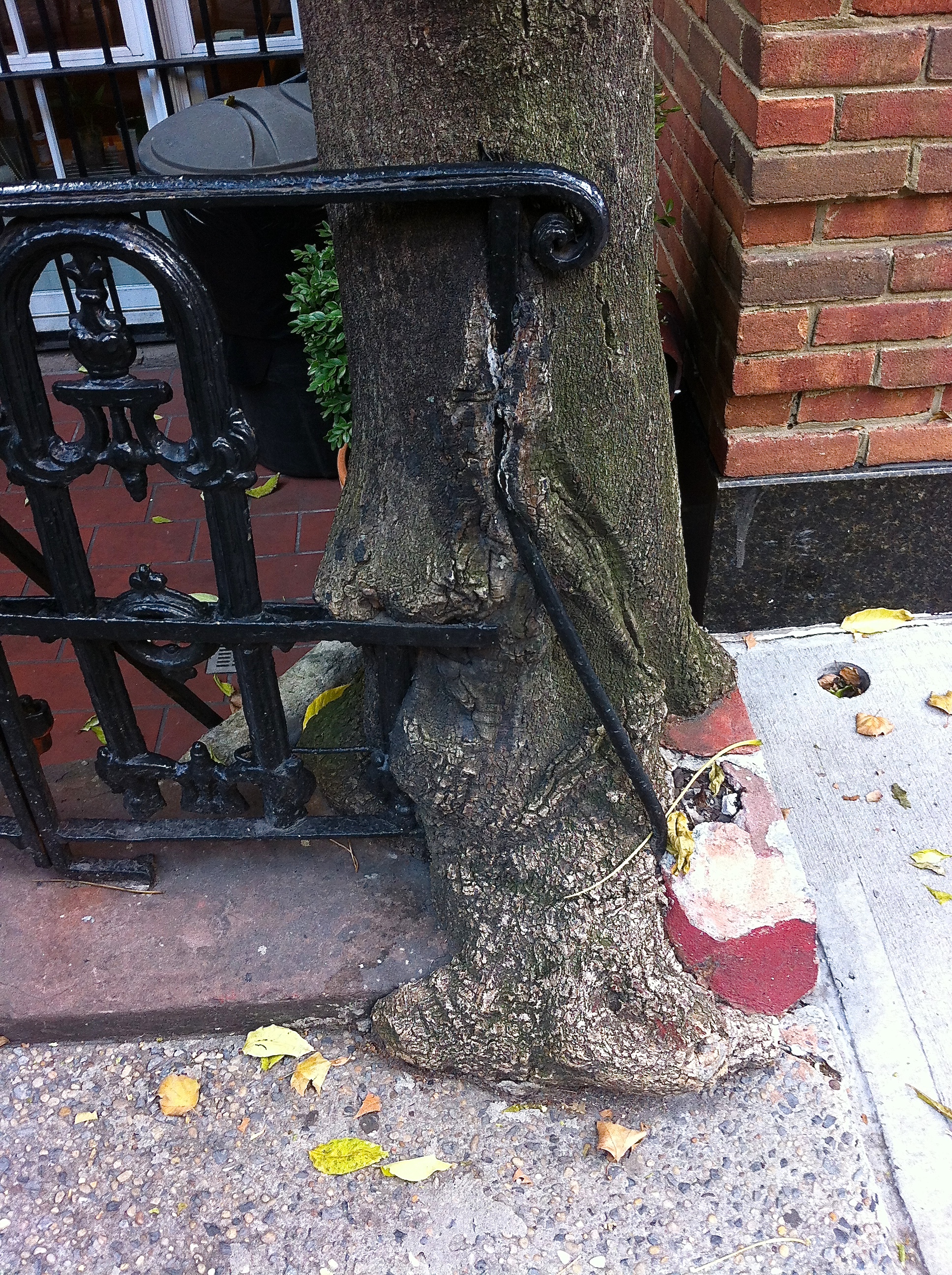
3. Which is dominant – historic artifact or time? Upper East Side, New York NY
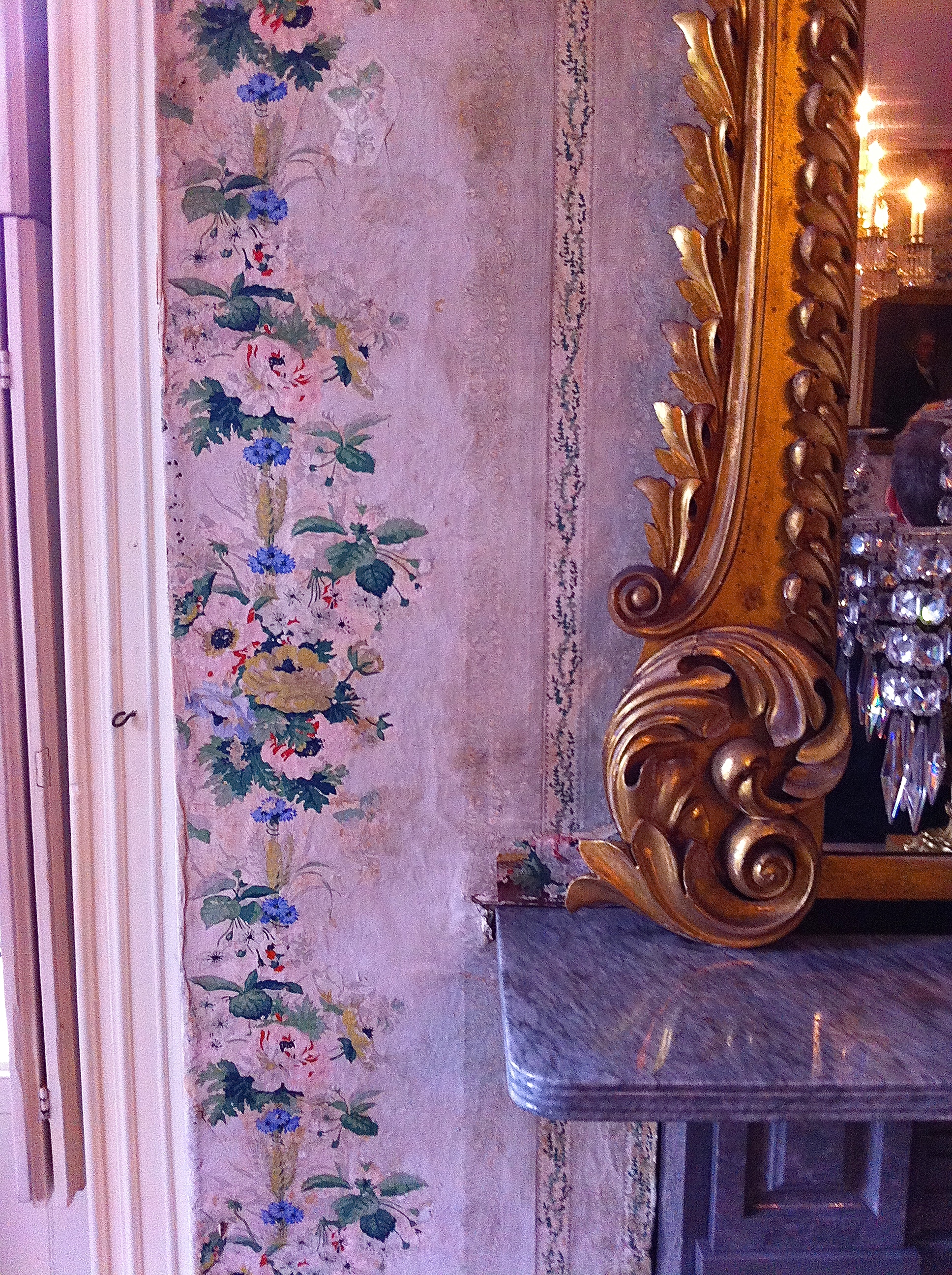
4. It is quite common for situations like this for the original wallpaper to be reproduced and then replaced by that accurate reproduction. Historic wallpaper still intact. Upstate New York
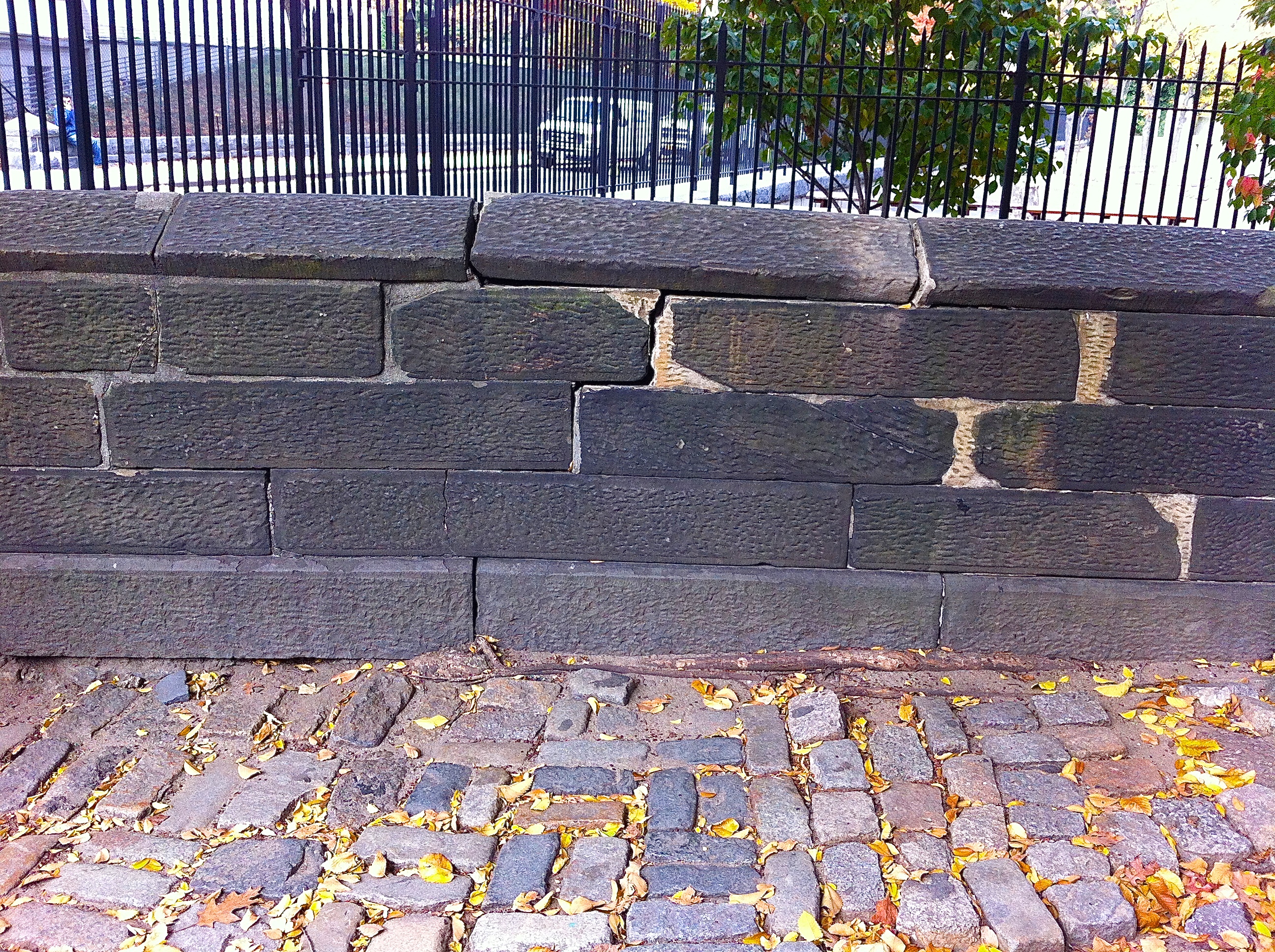
5. At what point will weathering compromise the structure? What can be gained by seeing multiple repairs on the same artifact? Fifth Avenue, Central Park wall, New York, NY
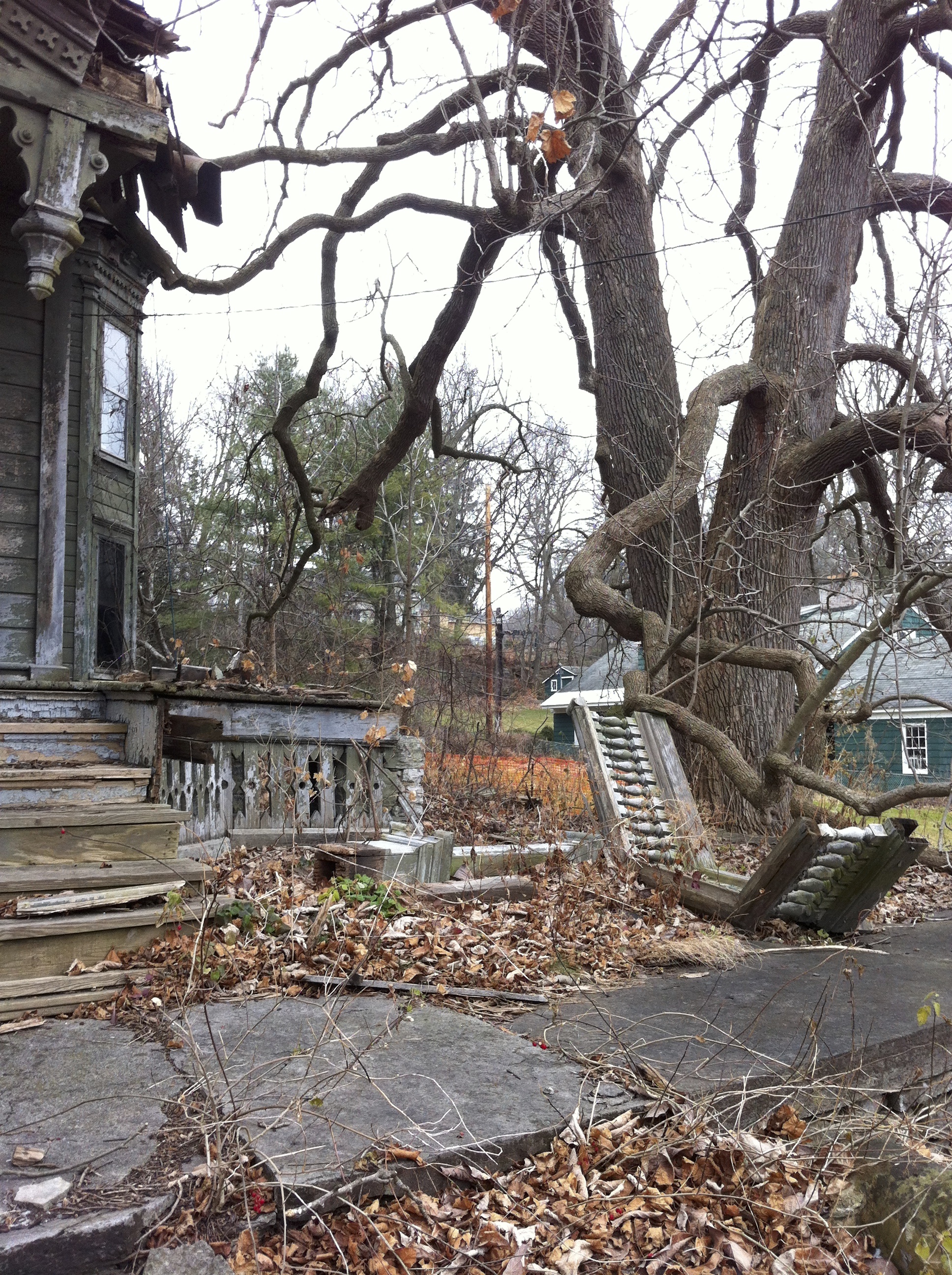
6. Wagner House, Palatine, NY. Inventor of the “sleeping Car” in 1858. Webster Wagner House is a historic home located at Palatine Bridge in Montgomery County, New York. It was built in 1876 and designed by noted architect Horatio Nelson White (1814–1892) as the home for railroad car magnate Webster Wagner (1817–1882).
7. The unfortunate poetics of decay. Wagner House, Palatine, NY. Inventor of the “sleeping Car” in 1858.Webster Wagner House is a historic home located at Palatine Bridge . It was built in 1876 and designed by noted architect Horatio Nelson White (1814–1892) as the home for railroad car magnate Webster Wagner (1817–1882).
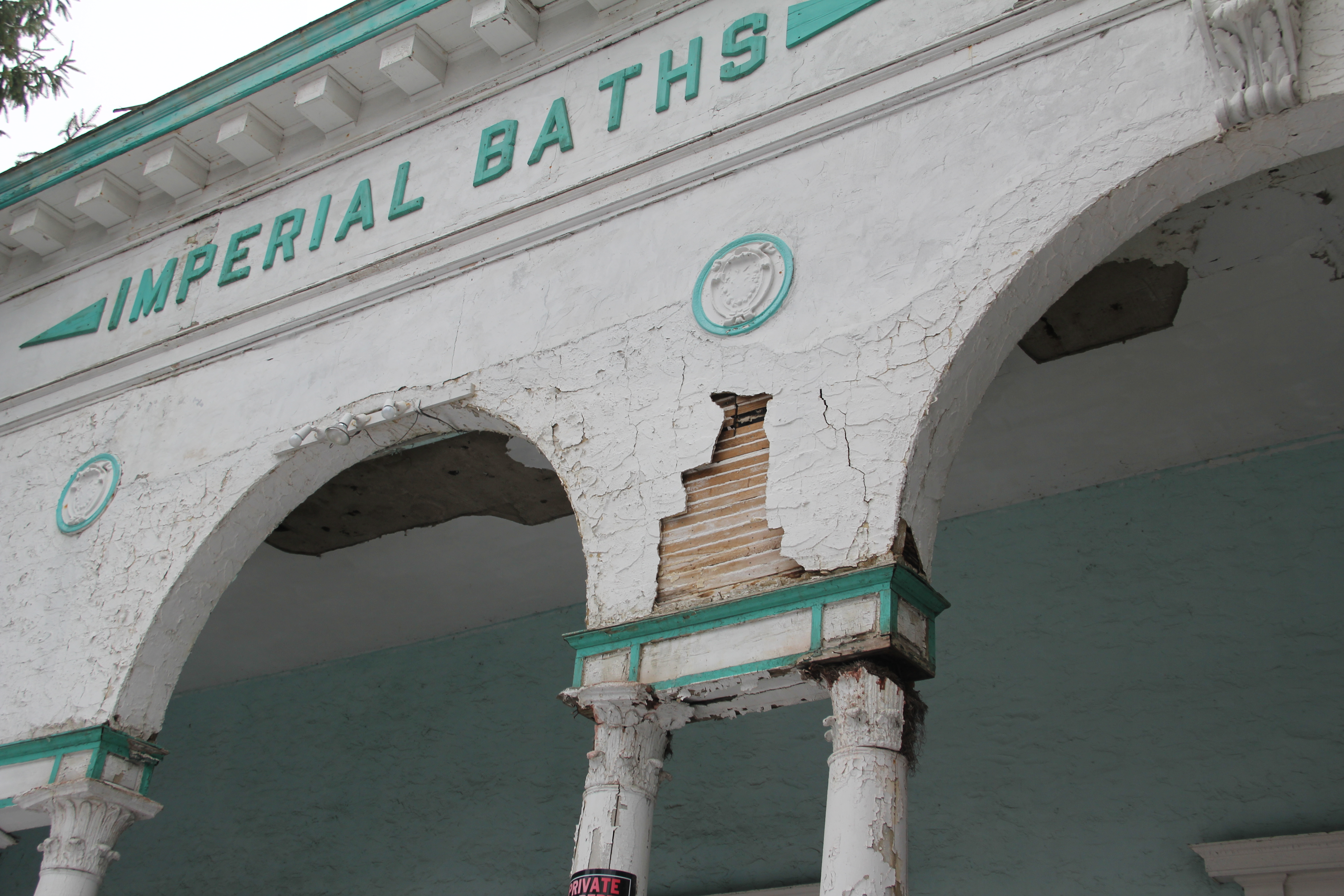
8. Imperial Baths, Sharon Springs, NY. c. 1927. The Imperial Bathhouse was opened July 1, 1927. It is located on the west side of Main Street in the center of Sharon Springs Historic District. It offered sulphur baths, massages and mud treatments to relieve pain and as a cure for a variety of illnesses. As many as 5000 treatments could be given in a single day.
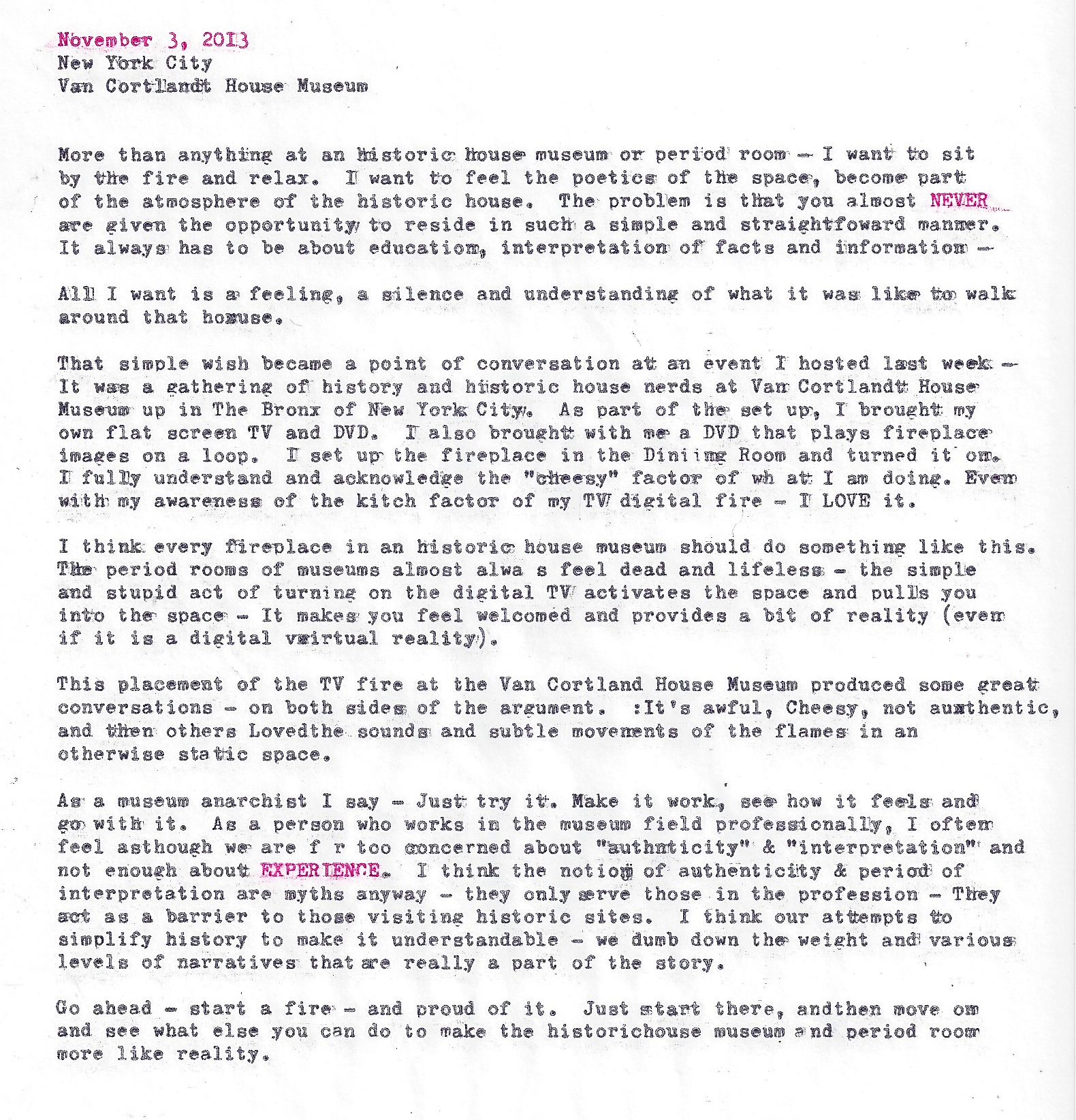
It is such a simple idea. Buy a large flat screen TV and DVD. Plug it in. Place it in all of your historic house museum fireplaces, press “PLAY” on your fire dvd AND I promise you the space will come alive. I have found such opposition to this idea – “it’s cheesy, ugly, dumb, not historically correct, not part of our interpretation, those kinds of fires didn’t exist back then, it’s in-authentic!”. I say – JUST GO WITH IT!
The Aline Barnsdall Hollyhock House, Frank Lloyd Wright, c. 1921 (romantic music added by FDV)
Room from the Powel House, 1765–66; remodeled 1769–71. Philadelphia, moved to MET, 1918 (romantic music added by FDV, Photographs used for educational and non-commercial purposes only.
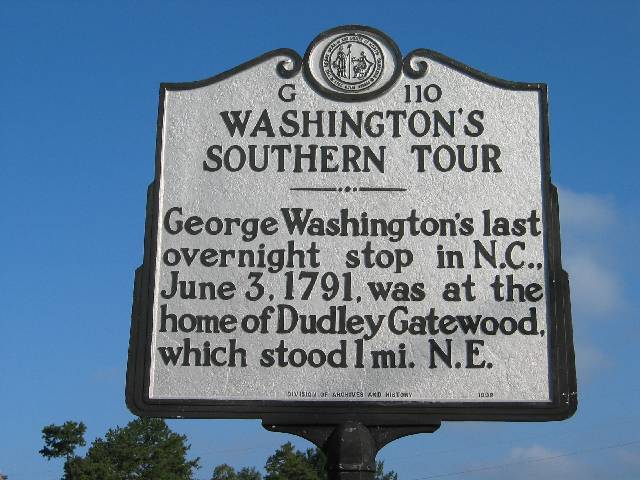 I don’t mean to pick on Old George, but he really slept around. A lot.

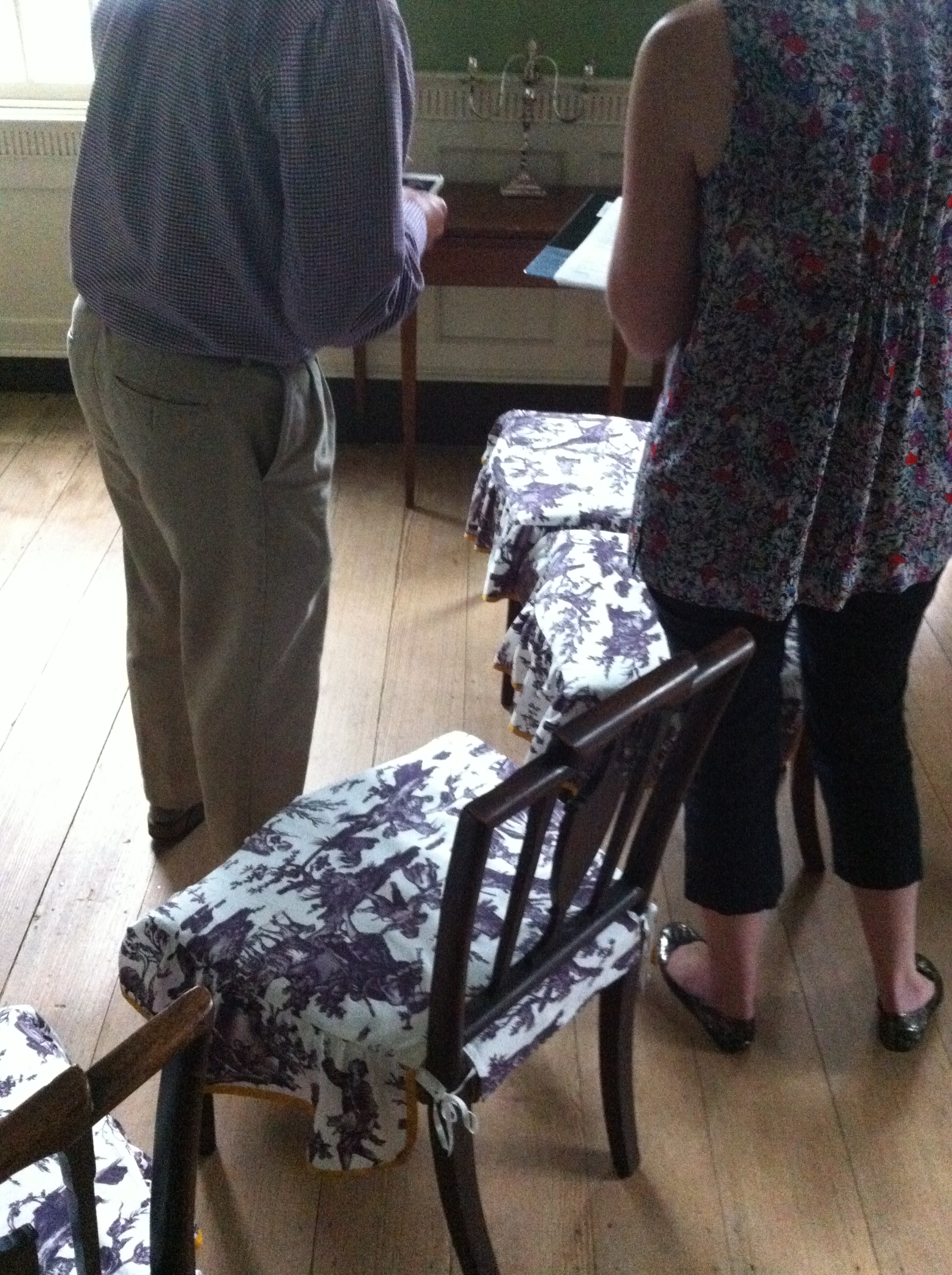 While meeting at a house museum, I was asked to participate in a discussion regarding the curated interior of a parlor room. They wanted to visually express a “tea party” but were concerned that the room layout was wrong. Should the chairs be in a circle or random? I went to sit down on a chair and they stopped me – I went to pick up a tea-cup and they stopped me – I went to pour some hot water for tea and they stopped me. My answer was that it was not a tea party if I couldn’t get some tea and sit and chat with all of my new friends! I can’t help but to feel that we were all lost in the narcissism of the details.
 I anxiously awaited visiting a house museum that has taken great efforts to re-think the basics of house museum experiences. I agree, many parts of the visit were great (I wish them good luck on further efforts), however one aspect stuck out as obviously left untouched – It was still a guided tour where we all stood around and listened. It felt like to me that part of the re-thinking might take into consideration that we were tired, hot and still interested and we would have liked to sit down and enjoy the room. There was an effort to not have a traditional period room collection-based experience (which is great), but in re-thinking, perhaps the narcissism of the details took over and we forgot about comfort? Just a thought.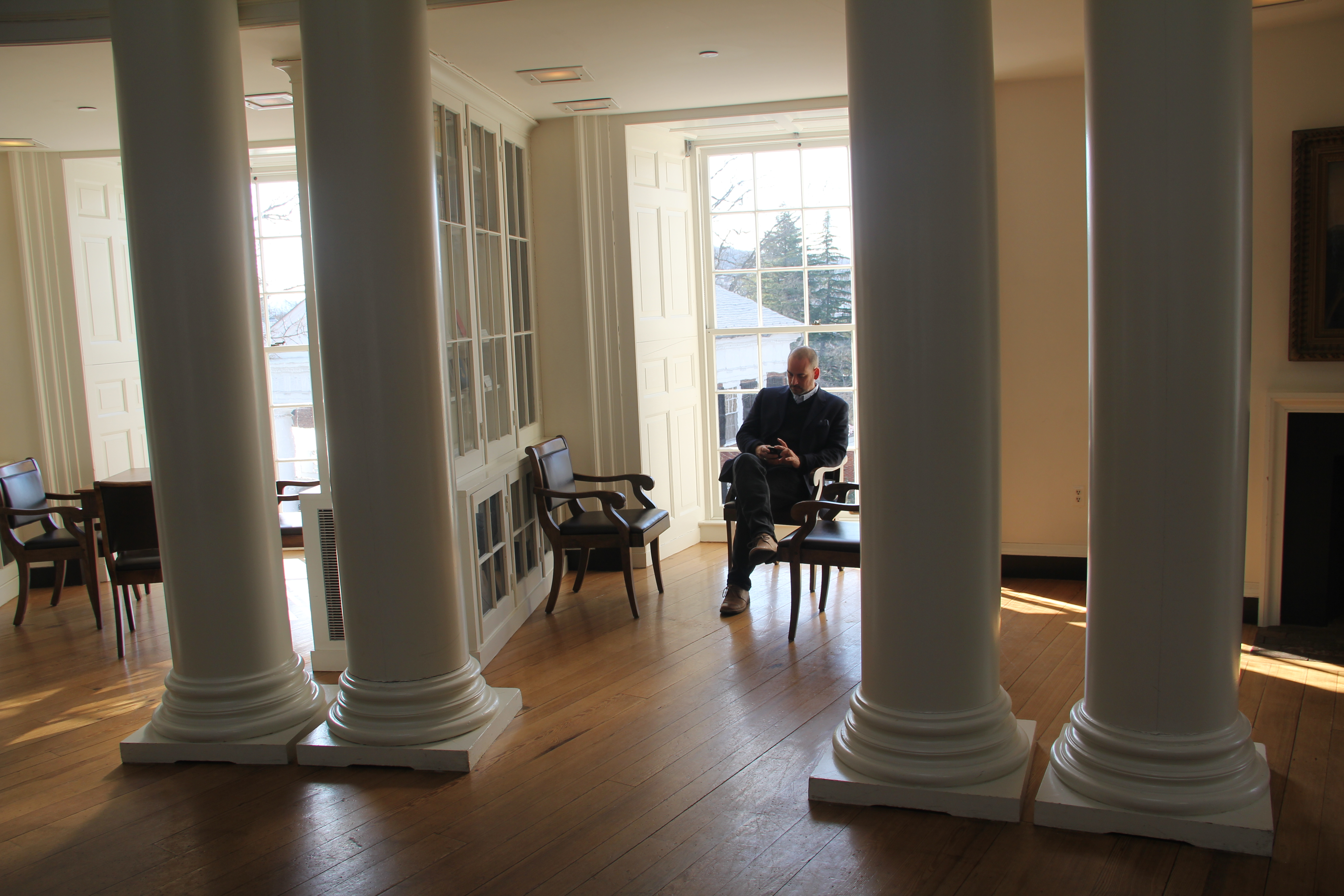





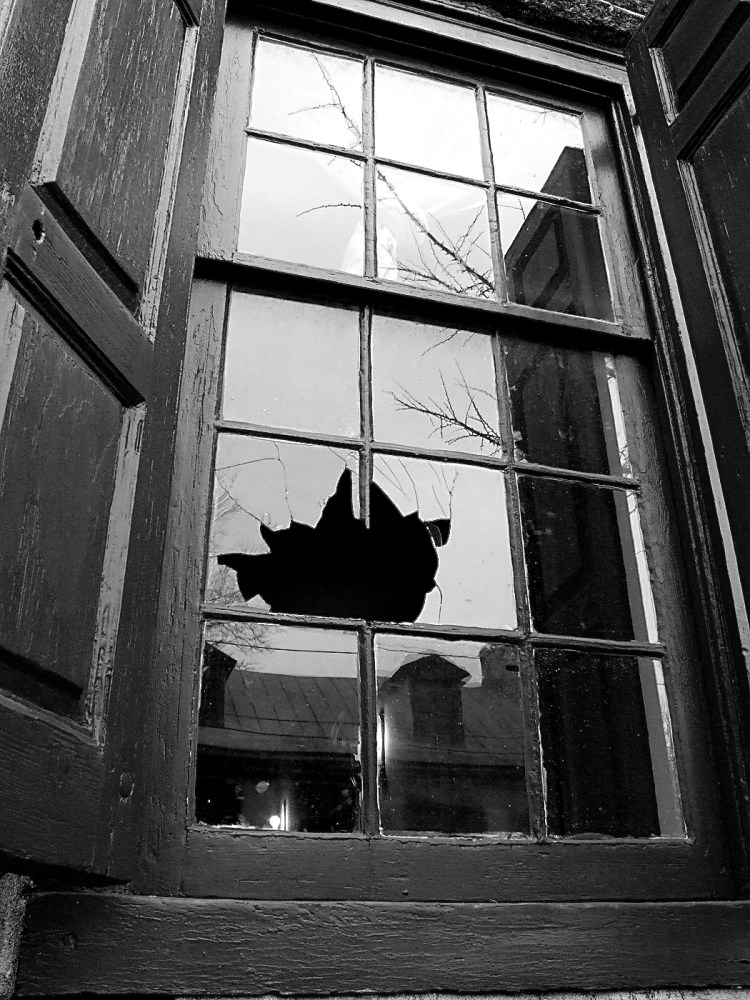 In every act of making & re-making, there lies latent within further potential, like the seed in a fruit; future generations are already present. From every work of restoration, seeds once dormant germinate begin to grow. Photo: Grumbelthorpe Historic House Museum, Germantown, Philadelphia. Damage due to a brick thrown through a window. Photo by Franklin Vagnone.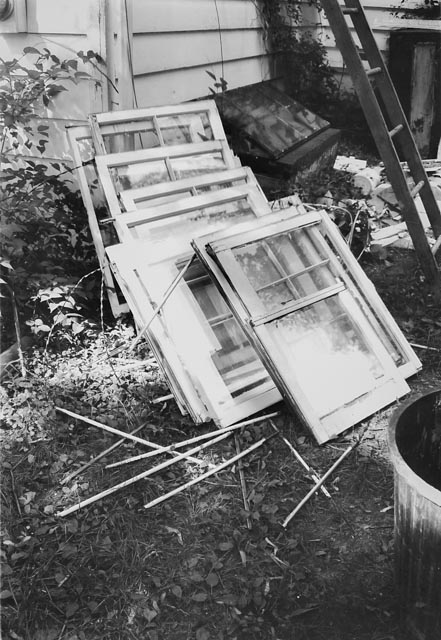








 Twisted Preservation